Of 87 investment projects oriented towards prevention – and valued at at least S/19,938 million -, 28 have progress above 80% and only 10 of these managed to complete their physical execution at 100%. Meanwhile, another 41 have reported no progress or maintain an execution level of 0%, according to information provided to ECData for the Development Studies Network (NETWORKS).
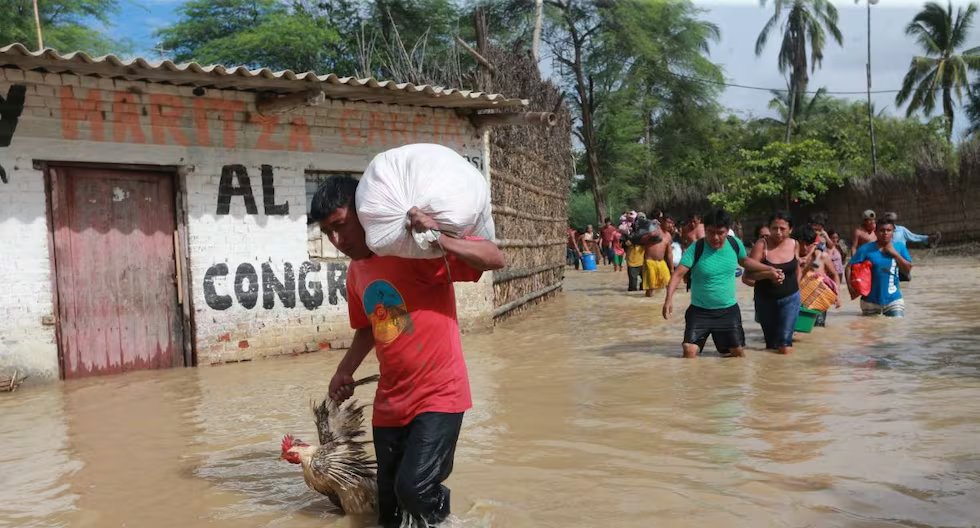
The projects cover nine regions of the country and belong mainly to Lima, Piura, La Libertad, Áncash, Lambayeque, Ica and Tumbes, areas with a high level of vulnerability to disasters associated with the rains and floods that this climatological phenomenon brings.
Likewise, 42 of the 87 interventions began their execution before 2020; That is, they have been in the implementation process for at least six and a half years.
Authorities in charge
From this list, which includes drainage works, riverside defenses, retaining walls, as well as clearing and channeling of rivers, 31 interventions are currently in charge of the National Infrastructure Authority (ANIN)an entity created in 2024 that replaced and assumed the powers of the National Authority for Reconstruction with Changes (ARCC). The latter stopped functioning at the end of 2023. The interventions carried out by the ANIN are part of the “Multisectorial Plan for intense rains and associated dangers 2025-2027”.
According to REDES, 14 of the 31 projects corresponding to the ANIN have zero physical progress or less than 20%, while only six have physical progress greater than 80%.
The remaining 56 projects are assigned to other entities at the three levels of government, among which regional governments and municipalities stand out. Of this list, 29 projects do not report physical progress or have it at 0%.
Immediate action pending
What measures could be proposed to reduce this gap in project execution? Giacomo Puccio, REDES economist, told ECData that a way would have to be ensured for the ANIN to have sufficient financing to begin the works, although he stressed that the requests should have been made in advance, immediately after the last coastal El Niño in 2023.
“When the ARCC is dissolved and the ANIN is created, it takes on all the projects with the execution modality from government to government and the rest were left for other instances of the Executive, the regional governments and the municipalities. There are some works that are at risk of being paralyzed if the budget is not enabled, which is going to be complex because we are in a context of a ‘hurt’ fiscal fund. There are certain limitations of the ANIN to give priority to all projects”he explained.
Drainage and flood protection works — Peru
Lime
Lambayeque
Piura
Click a bookmark to view the project
Although there is some heterogeneity in the progress within the 31 works that the ANIN is in charge of, the expert comments that the important preventive infrastructure, such as the flood protection system on the Huarmey River, in Áncash (S/829 million), or flood protection in the San Ildefonso ravine, in Trujillo (S/1,241 million) they already have a physical progress of 80% and they would only need the last section.
On the other hand, the resources of budget program 068, called “Vulnerability Reduction and Emergency Response to Disasters”reached S/3,062 million during the first half of the year. However, only 26% of this amount (S/ 929 million) has been allocated to works to prevent disasters. Of this last amount, only 26% (S/ 239 million) has been executed.
This figure is still 25% below the final budget reached in 2024, the second year of the last coastal El Niño that the country experienced.
Riverside defense, evacuation and flood protection works — Peru
“If we look only at the part of program 068 that corresponds to prevention works, it has grown very little. Even in the years in which there was Niño, 2017 and 2023, it grew 12% and 13% compared to the previous year. After 2023 it is plummeting”, he opined.
What can be done to most efficiently mitigate future damage in the few months left? For Puccio, there are clearing projects that can be much cheaper than the large infrastructure works that were promised and that did not materialize. “Although they are minor interventions, they can be executed in a short time and have an important impact for prevention”Puccio pointed out.
In interview with the program Versus of El ComercioJuan Manuel Arribas, executive director of the organization Hombro a Hombro, a business initiative that coordinates preparation and first response actions in the face of disasters, pointed out that, although there is no time to carry out large infrastructure works, progress can be made with elementary actions, such as cleaning drains, cleaning basins, as well as massive educational and health campaigns to avoid outbreaks of diseases such as dengue, which usually appear during floods due to the permanence of stagnant water.
“The most important entity in disaster response is the district mayor, whom we will not meet until November. One of the suggestions that we want to bring to the new government is that there be a kind of ‘Child Command’ in which, from the government, there is a strong commitment to bring the provincial and district mayors to Lima and teach them basic management tools, how to fill out the EDAN (procedure used by mayors and Indeci to collect information on the impacts of a disaster in a certain locality).”he opined.