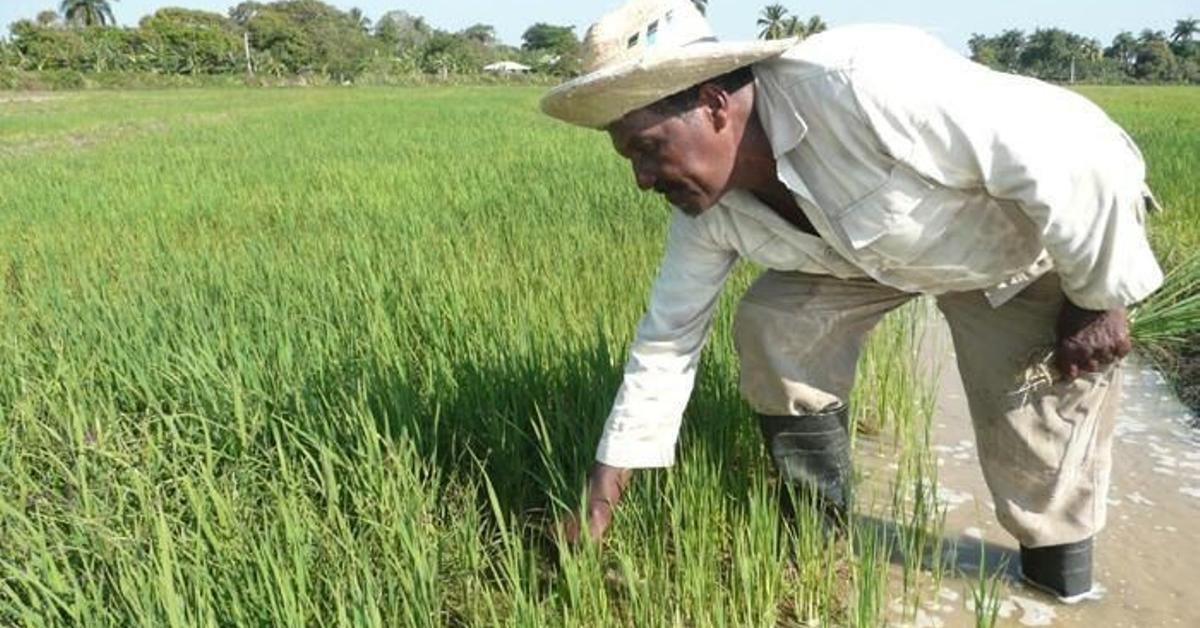

Madrid/Eliecer Silva, head of a state agricultural company in Consolación del Sur, Pinar del Río, is today the involuntary protagonist of a news in Vietnam.vn. The government portal reviews the history of this man from Pinar del Río, originally published by Granmawhose base unit – Agrícola Caribe – has seen its yields multiply since it became associated with the rice cooperation project between Cuba and Vietnam. What in the Cuban version is titled Renacer en Caribe, Hanoi presents it with a long headline that praises Asian work.
“Vietnamese experts arrive and help Cuban farmers plant rice using an ‘unusual’ method, resulting in half-meter-tall seedlings that increase yields tenfold.” No more and no less than 33 words that, yes, well summarize the benefit of collaboration. The Cuban base unit has gone from producing 0.8 tons per hectare to 8 tons per hectare.
“The Vietnamese have come to give us great help. They have gotten us out of a tremendous situation,” says Silva. María de las Nieves Sánchez, director of the company, describes the situation of recent years as “desperate.” “Each campaign, yields went down, we planned for a certain number of hectares and we didn’t arrive,” he points out. The minimum was reached in 2024, with the mentioned 0.8 t/ha. In 2025, little improvement: 0.9.
Agrícola Caribe then decided to join the bilateral rice project – it is the second company of its type to do so – and plant, last September, 21.7 hectares, on an experimental basis. The result has been like the multiplication of the loaves and fishes. The eight tons of yield “had never been achieved here before,” says Sánchez.
“So far, we have 158 hectares of flat terraces and we must reach 295,” they say. The expansion was carried out in spring after the impressive data achieved, but in the next cold season they aim for 2,000 hectares, the result of uniting the 473 with those owned by independent producers who are associated with the entity.
Sánchez explains how it works to the press. The Cubans provide the land, the machinery and the labor, while the Vietnamese provide the advice and inputs. The latter has been essential, in the opinion of farmers, since they had not had access to the technological package –fertilizers, fuels, pesticides and other products necessary for cultivation– for years. “We had never had it,” they say, praising the quality of the inputs. “That’s why this rice is almost 1.80 meters high. The personnel who go in there to fumigate are not even seen.”
The alliance has also provided employment. The sowing and fertilization of this type of extensions was previously done with airplanes, but the shortage of fuel – in the oil field – has forced it to be done by hand, with the hiring of 200 people from Alonso de Rojas. “Thanks to this project today we have work,” says one of the employees, Osberto Pedroso.
The bilateral cooperation project between Cuba and Vietnam was born in 2002 and had one of its relevant chapters in La Sierpe, in Sancti Spíritus, where production was successful for years and helped many basic units improve their performance. However, in 2023, Asian technicians withdrew of the place tired, according to testimonies, of Cuban inefficiency. Fuel shortages and labor shortages officially ended the partnership. There, at the time, five tons per hectare were reached when three were the norm in the area. Just one year later, production fell by 62% and in 2025 they returned to resume the project. although in a way more controlled.
The experience does not make the people of Pinar del Río fear, focused on their own territory. Silva is proud that Cuban staff did both the planting and fertilization and believes that, and the results, break the myth that Cubans can’t do it well. “In work where there is no organization and discipline, there are no results, even if you throw whatever you throw at the field,” he warns.
The project – at the country level – differs from that carried out in Los Palacios, where a private company, Agri VMA, was the first foreign company to obtain a lease contract for 1,000 hectares, with the intention of reaching 5,000 in three years. Very high results are also being achieved there, with more than 7.2 tons per hectare, compared to 2 or 2.5 for producers on the Island.