-
By Hollie Younger / Staff writer
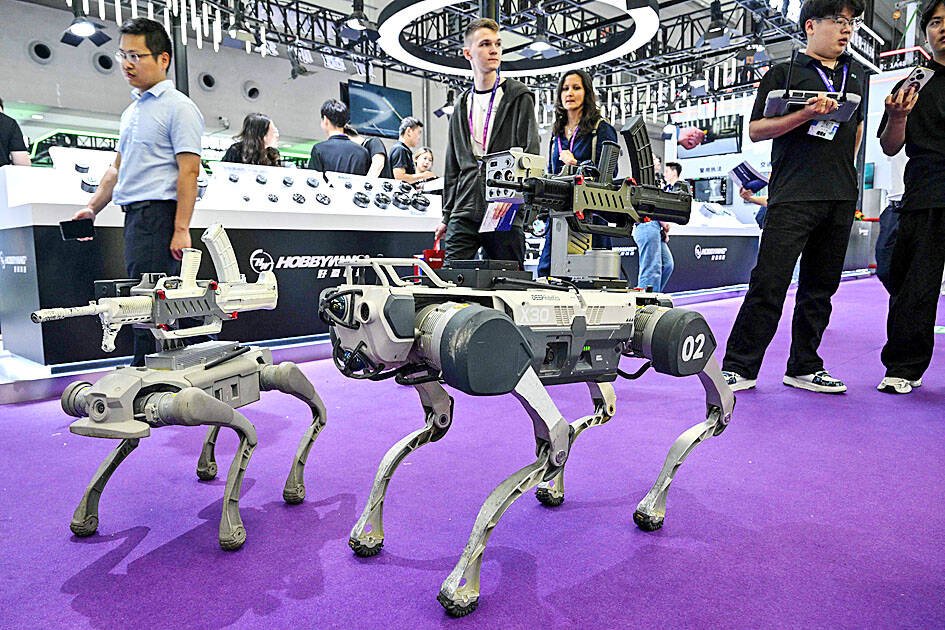
China is developing quadruped robots, which Beijing has been calling “robotic wolves,” as part of its push toward “intelligentized warfare,” the next stage of its military modernization, a report by the Foundation for Defense of Democracies said last month.
The article, China’s War Wolves: From Commercial Tech to Combat Power, said Beijing’s use of scalable robotic systems could lead the People’s Liberation Army (PLA) to “adopt a more aggressive risk calculus in a crisis,” as these technologies are used to simulate conflict in Taiwan.
“Robotic wolves” are “only the first wave of a much larger Chinese effort” to integrate AI-enabled autonomous systems and data-centric operations into combat, it said, urging the US and its allies to “act now” to counter the threats of autonomous and semi-autonomous combat systems.
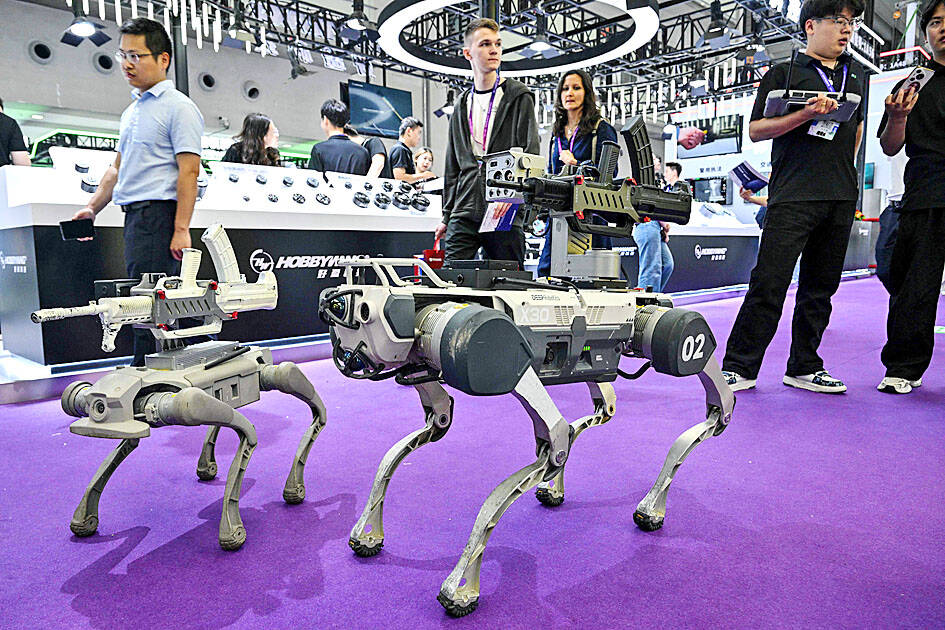
Photo:: AFP
Any decision for China on when to invade Taiwan would largely depend on whether the PLA could field the platforms required to execute an invasion, including robotic wolves designed to operate in the most attrition-intensive phases of the fight, it said.
Chinese state media and PLA training footage have already shown the robots in field exercises, the Washington-based research institute said.
The robots, the size of large dogs, are equipped with cameras, sensors, lidar and, in some cases, weapons, it said.
They can be used on the front line to reduce risk to human, move through explosive or hazardous areas, deliver supplies and operate in coordinated swarms, while relaying intelligence to support logistics, the article said.
They can operate for up to two hours, have a range of up to 10km and remain operational after up to 30 minutes in water, while armed variants can be equipped with small arms or rockets, it added.
The robots require human approval for deadly force, it said.
Chinese state-run newspaper the People’s Daily has tied the development to lessons learned from Ukraine, as the PLA moves to address capability gaps in urban combat, with future operations potentially reaching “the streets of a Taiwanese city,” the article said.
These robotic systems are still in development and remain vulnerable to jamming, spoofing or cyber intrusion, require regular battery changes or recharging, and their sensors can be impacted by smoke, fog and lasers, it said.