For the first time in Chile’s democratic history, no state tributes will be held by the government of José Antonio Kast to commemorate another year of the 1973 coup d’état, which overthrew the government of President Salvador Allende.
In anticipation of this date, the Minister of the Interior and spokesman for the Chilean Executive, Claudio Alvarado, expressed yesterday that September 11 “is a day in which all Chileans approach it with different types of sensitivities and feelings.”
“We are concerned and working every day on people’s priorities. And thinking about how this work contributes to building a better Chile moving forward, where political differences do not take us to the extremes of the past,” he added, quoted by the Spanish newspaper El País.
The Chilean president, on the other hand, assured last week that, if anyone wanted, they could pray at the mass celebrated every Friday at the presidential palace of La Moneda.
“We are today praying for the Chile of today and the Chile of the future,” said Kast during his speech last week at the Madrid Forum meeting of far-right leaders, held in Santiago.
The president did not explicitly refer to the break in the constitutional thread that gave way to a 17-year dictatorship, headed by Chilean Army General Augusto Pinochet, and which left hundreds dead, missing and politically persecuted.
On the other hand, the Chilean opposition criticized Kast’s silence and criticized the words of Argentine President Javier Milei, who praised the coup d’état on Chilean soil.
For example, the Socialist Party of Chile considered Milei’s claim “unacceptable”, who called the leftists “filthy lefties.” The party described these expressions as “epithets and rudeness” directed against those who think differently.
Even a leader of one of the traditional parties of the Chilean right, the Independent Democratic Union (UDI), Iván Moreira, criticized Milei for his interference in the historical account of September 11.
“For a sector of the extreme right, President Milei is a genius, he is a crack. But the majority of Chileans cannot accept that a president of Argentina has the right to be rude and insult Chilean political history, with its lights and shadows (…) From left to right we have to have some dignity and say: ‘Enough, Mr. Milei,'” he declared, quoted by El País.
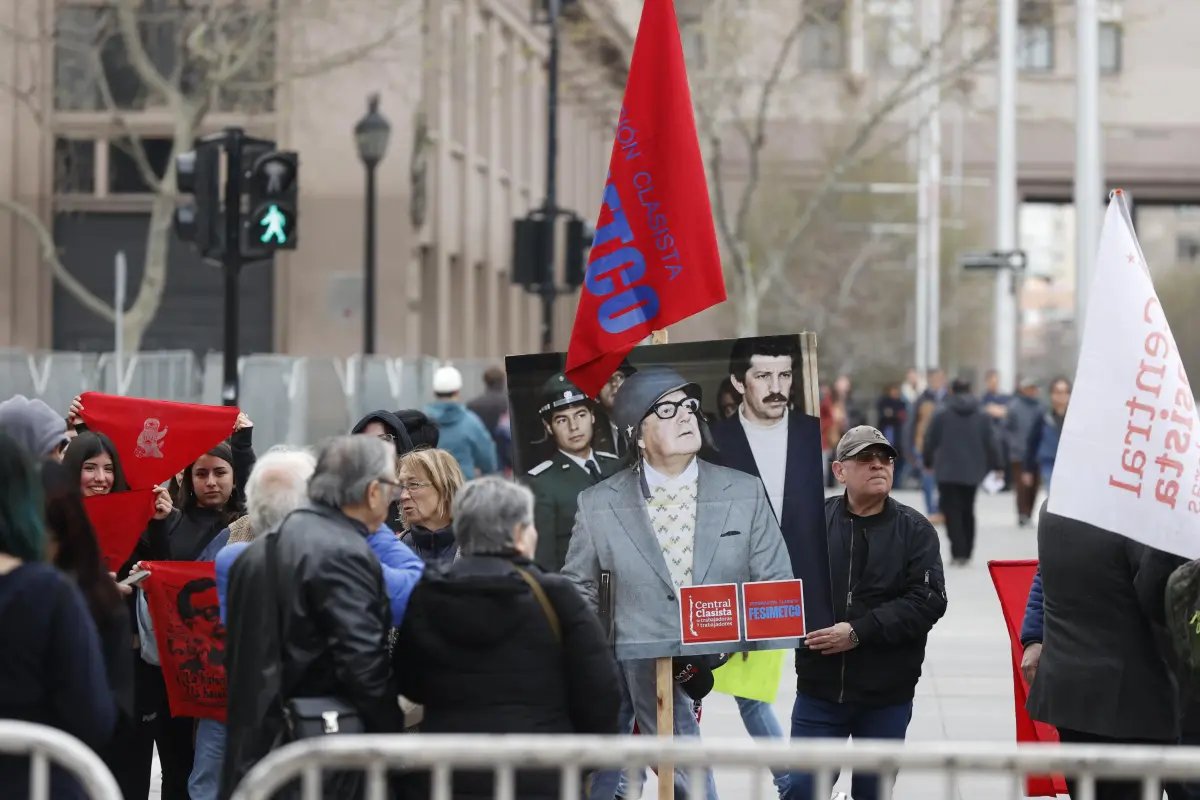
Although there are no state tributes as such, more than a hundred people—including opposition leaders and former Chilean president Gabriel Boric (2022-2026)—gathered this morning at the tomb of Salvador Allende to pay tribute to the deceased president.
Salvador Allende’s daughter, former senator and socialist leader Isabel Allende, criticized the Kast Executive’s decision not to commemorate this date.
“A country without memory has no future. Memory not only means accompanying, it also means dignifying the victims, knowing what happened, knowing deeply and projecting ourselves towards that society that will never again see violence used to resolve any political division,” he stated.
On the other hand, former Chilean president Gabriel Boric maintained that “official ceremonies are not needed to remember history.”
“It is a memory that is engraved in the very essence of the heart of the people of Chile and that is transmitted from generation to generation,” he added.