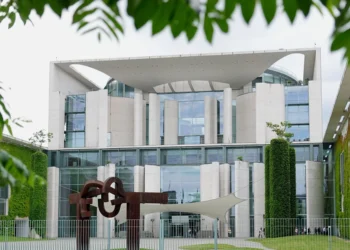
When the coalition committee meets in the Chancellery on Wednesday afternoon, attention will primarily be focused on the question of whether the Union and SPD can agree on tax reform and, if so, who benefits from it and who loses. At least as important for parts of the economy are the points on the agenda under the heading “labor market”.
Verena Pausder, CEO of the German Start-ups Association, increased the pressure again before the crucial meeting before the summer break. “The relaxation of protection against dismissal must be the top issue of this year Coalition Committee “, she told the FAZ. The study situation is clear: “Countries with a flexible labor market are more innovative. And without innovation there is no growth.”

Only 0.3 percent growth since 2019
Growth is the declared goal of Chancellor Friedrich Merz (CDU) and also of Finance Minister Lars Klingbeil (SPD). The bottom line is that German economic output has only grown by 0.3 percent since 2019. Countries like France, Italy and Spain have more than five percent, and the United States even has 15 percent. However, the CDU primarily wants to relieve the burden on companies, the SPD on consumers. It is still unclear how the different approaches will become a common line.
The appeal of more flexible labor law rules is that, unlike tax reform, the finance minister does not have to raise money in the budget. However, the left wing of the SPD does not want to give up any more of its positions after the Pension Commission’s unpleasant proposals. On Tuesday, several MPs warned of “attacks on employees” on the issues of the right to strike, protection against dismissal and sick leave. They want to continue to rely on “organized solidarity” instead of more private provision.
“The cost of failure breaks many people’s necks”
The German Start-up Association, on the other hand, is calling for far-reaching relaxations to be anchored in labor law for young companies. “The cost of failure breaks the necks of many start-ups,” said Pausder. “Protection against dismissal is the number one obstacle for the start-up scene. Almost every case ends up in the labor court. There you often wait eight months for an appointment for a settlement. This paralyzes the entire company.”

Pausder, who has founded several start-ups herself, worries her about what she observes among her colleagues: “A number of German companies are currently setting up their software teams in Switzerland, even though wage costs there are up to 70 percent higher. They accept this because they need flexibility in terms of protection against dismissal.”
Last reform in 2004
The dismissal protection law was last relaxed in 2004 under the then red-green government of Gerhard Schröder. Since then, it has not applied to companies with more than five employees, but only to more than ten. Employers have to lay off notices either personal, behavioral or operational reasons. The number of disputes before labor courts has recently increased significantly in the wake of the economic crisis.
The start-up scene is therefore calling for a “start-up protection zone”. In the first four years after a company was founded, it should be completely exempt from protection against dismissal. There will then be exceptions for top earners. Pausder is envisioning a “garden leave” based on the British model: “No protection against dismissal, but six months’ salary severance pay.” If the limit were an annual salary of 150,000 euros, the association estimates that this would apply to up to ten percent of employment relationships in start-ups. “100,000 euros would be better, then around 25 to 30 percent of employment relationships would be affected.”
Denmark as a role model
At the beginning of the year, the CDU promoted the Danish model, which combines less protection against dismissal with higher social security. The idea: High earners should be able to individually agree with their employers whether they would forego security for more money. However, this was controversial within the party, also because many CDU supporters with good incomes certainly value the security of German labor law.
Well-known German economists see protection against dismissal in its current form as an obstacle to more dynamic economic development. Moritz Schularick, President of the Kiel Institute for the World Economy, had already questioned the model in February: “Why are we sticking with protection against dismissal for people who earn more than 100,000 euros a year?” A paternalistic protective idea is being carried forward into the 21st century, even though it was already outdated at the end of the 20th century.
Protect biographies, not jobs
This month, labor economist Simon Jäger, who researches at Princeton University, and several co-authors followed up in a joint article. The German protection against dismissal has a design flaw. “It protects the job, not the working life,” write the economists.
In a relatively stable economic environment, German protection against dismissal worked successfully. In a time of technological and geopolitical upheaval, it is crucial that employees can easily switch to more productive and innovative employers. That’s exactly a problem in Germany: employees only change employers about half as often as in Sweden or Switzerland. This lack of flexibility in the labor market is considered to be an important reason why productivity in the United States has increased much faster than in the EU since the mid-1990s.
Jäger and his co-author, the Berlin economist Manuela Barišić, do not want to remove protection against dismissal without replacing it. They recommend opening up above an income limit of 77,000 euros, which corresponds to the compulsory insurance limit. Above this threshold, employees should be able to choose: either they conclude a contract with protection against dismissal, as before, or they choose a contract without protection against dismissal. However, a higher wage must then be offered in this contract; Economists speak of a flexibility premium.
The demand for easing only for high earners is politically more realistic than a general abolition. Economist Jäger also believes the limit makes economic sense, among other things because high earners can better absorb a loss of earnings. It is also important that people who work particularly productively do not end up in the “wrong” place. “There are significant costs when highly qualified employees do not work where they can best develop their potential,” says Jäger.