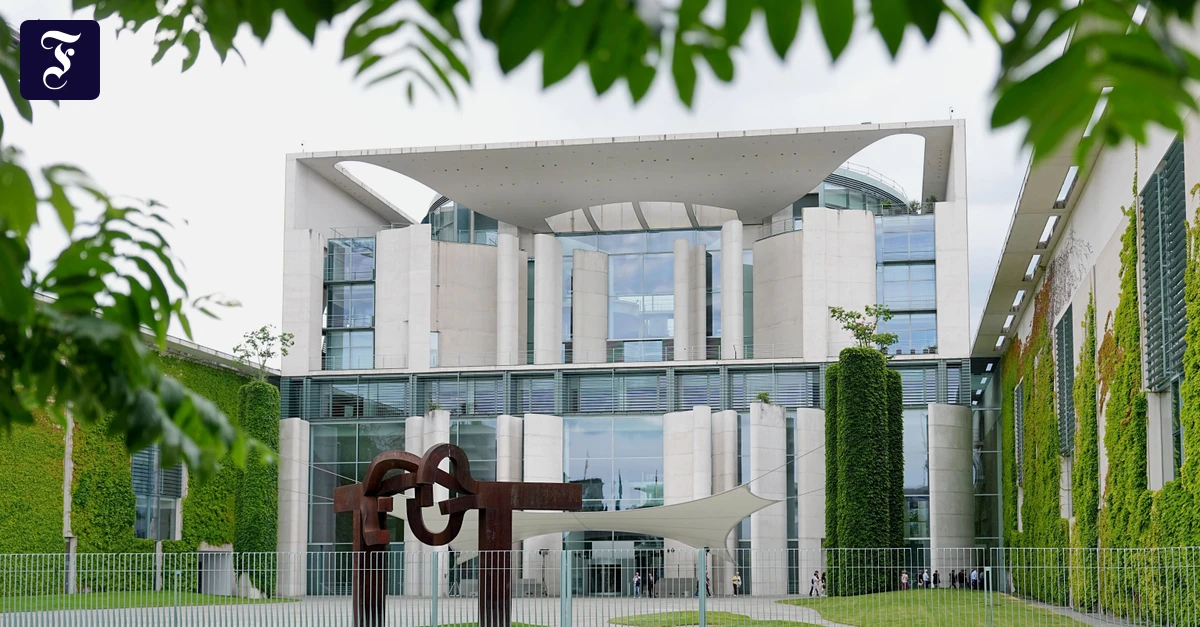
The coalition committee meets on Wednesday evening. The Union and the SPD could continue their reform course – or get stuck again.
Why is the meeting so important?
The meeting of the coalition committee on Wednesday should have both more and less significance than other meetings of this kind. More because it is intended to crown one of the few phases of productive harmony in this coalition, which otherwise often publicly argues, before the parliamentary summer break. A year ago, after the first joint resolutions and a recognized appearance by Chancellor Friedrich Merz (CDU) with American President Donald Trump, the coalition members slipped into a summer of discontent and the downward slope of falling poll numbers due to a failed election of judges.
Now, within a few weeks, the Union and the SPD have initiated reforms for the first time, as Merz had promised, by consolidating health and pension insurance. If an income tax reform with noticeable relief were passed at the coalition meeting on Wednesday, it could be a more enjoyable summer this time. That’s why some people downplay the importance of the coalition committee meeting in advance: If the results are only mediocre, this shouldn’t diminish the good impression of a functioning reform government.
Were the preparations better this time?
The meeting in Villa Borsig a few weeks ago, which was also about reforms, also failed due to a lack of preparation. That’s why a new committee was set up early this time, the so-called Sherpa Round. It consists of the parliamentary group leaders Jens Spahn (CDU) and Matthias Miersch (SPD), Chancellery Minister Thorsten Frei (CDU), Finance State Secretary Björn Böhning (SPD), Interior Minister Alexander Dobrindt and regional group leader Alexander Hoffmann (both CSU). The group sat together nine times before the meeting on Wednesday, often until late in the evening. Apparently the trust is so great that all topics were put on the table and discussed.
The group managed to draw up a paper with several agreed points for Wednesday. This time, not only guard rails should be described, like for the meeting in Villa Borsig, but it should be concrete. Objective: Strengthen Germany’s economic power. In order to achieve this, both the Union and the SPD apparently had to move away from some cherished projects. But every Sherpa knows: In the end, the party leaders decide, and the Chancellor has the authority to make directives.
Is income tax reform coming?
The work order is undisputed: “We will reduce the income tax for small and medium-sized incomes in the middle of the legislative period,” agreed the Union and the SPD in their coalition agreement. Finance Minister Lars Klingbeil (SPD) says he wants to reduce the burden on 95 percent of employees – by several hundred euros per year. Such a reform would be very expensive for the tax authorities, and the federal states are not prepared to do their part.
The federal government, in turn, has such large gaps in its financial planning that it would not even be able to cope with its own shortfalls without counter-financing. Klingbeil has therefore decided that “high incomes and high assets should make a contribution”. The Union has indicated that it is prepared to support a slightly increased taxation of very high incomes. The so-called rich tax today starts at 270,000 euros and amounts to 45 percent plus the solidarity surcharge. But even if the tax on the rich were to start earlier and become more stringent, it would still not be enough to noticeably reduce the tax rate at the bottom and in the middle. The Union is skeptical about an increase in the top tax rate from currently 42 percent (from around 70,000 euros).
The correction of the tax rate is likely to cost the tax authorities at least ten billion euros. If there is to be significant relief for the general public, it would be closer to 20 billion euros. In order to keep the costs of the planned tax reform within limits, a small coalition working group looked for tax breaks that could be eliminated in whole or in part. Depending on what is agreed upon in the counter-financing, the relief may be greater or less significant. It is constitutionally mandatory to increase the basic allowance at the turn of the year. A shift in the tariff would also be common in order to compensate for the devaluation of the currency (cold progression). That too costs several billion euros.
Recently there was talk of relief in the order of 10 to 14 billion euros – that would be less than Klingbeil had suggested (17 or 27 billion euros, depending on the model).
What role do the other reform projects play?
The pension is expected to be one of the biggest reform projects in the next few months. But in the coalition round there is actually only the schedule for implementation to be negotiated – provided that all those involved accept the overall concept recently presented by the Pension Commission as a basis. The main points are the introduction of a new capital pension and the exit from the tax-free “pension from 63”.
The planned health insurance reform raises new questions. The law for this is already in the Bundestag. But now new financial holes are opening up that need to be closed. It must be clarified whether this should be done through additional cuts – or whether high-earning contributors should be asked to pay even more than previously planned. This should also be discussed in connection with the tax reform.
In addition, the coalition leaders have a lot to clarify in the area of labor law: Labor Minister Bärbel Bas (SPD) has not yet delivered the relaxation of statutory working time regulations agreed in the coalition agreement. At the same time, other relaxations are being discussed, such as protection against dismissal for high earners.
Is there still a big political dispute?
Last but not least, the disputes over tax reform show that the ideological differences between the CDU/CSU and SPD still exist, and no amount of preparation can help. The negotiators have therefore installed several airbags: First of all, the systematic downplaying of the importance of the meeting on Wednesday, and on Sunday the four party leaders were informed about the Sherpas’ plans in order to be able to identify possible conflicts with a time buffer. The Chancellor was apparently dissatisfied with the scope of the planned reforms; He wanted more, they said. This caused further unrest in the preparation process.
Even if everything goes smoothly with the topics mentioned so far, there could still be one thing on the agenda that has the potential to be a party crasher: electoral law reform. The Union parties, especially the CSU, are fighting against the fact that a constituency winner in the next federal election could find himself in a position of not getting his mandate. This is the result of a law passed by the traffic light government. The major coalition partner is significantly more affected by this than the SPD.
The coalition agreement therefore agreed to change the electoral law accordingly; one of the commissions that worked so well in the case of health care reform and pensions was even set up. The Union rejects the introduction of a parity regulation, like the one the SPD wants to have to balance things out. Anyone who is completely optimistic hopes that the SPD will be able to buy its consent to return to the old electoral law by making concessions below a parity regulation. Whether that will work on Wednesday remains to be seen after the long standstill in this field.