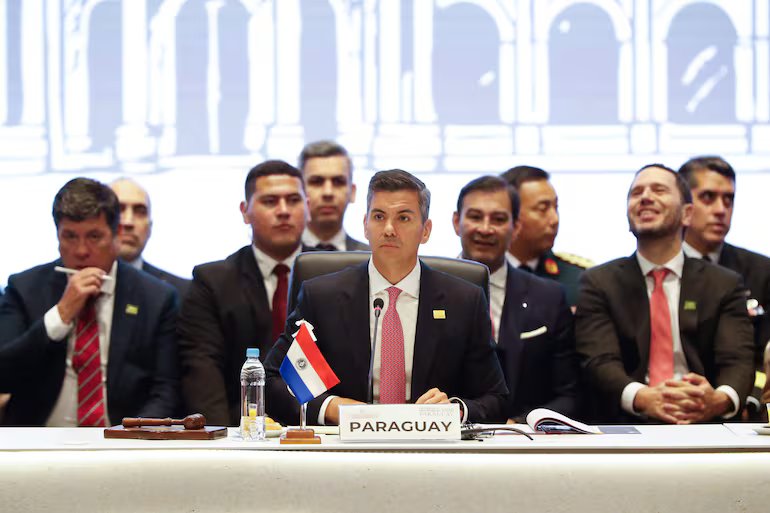
In his speech at the LXVIII Summit of Heads of State Mercosur and Associated States that is carried out at the Conmebol Convention Center, in Luque, the president Santiago Pena raised a series of questions about the functioning of the regional bloc that turned 35 last March.
Firstly, he thanked the leaders present, with Luíz Inácio Lula da Silva (Brazil), Yamandu Orsi (Uruguay); and Rodrigo Paz Pereira (Bolivia). They were also present José Antonio Kast (Chile) and Daniel Nova (Ecuador).
The semi-annual meeting of Heads of State is marked by the absence of the Argentine president Javier Milei, who also did not attend the July 2024 Summit that took place in our country.
Grief He said that “there is a feeling of dissatisfaction.” “It’s the feeling I have. But that dissatisfaction is never frustration, it’s never anger, it’s simply the desire to be able to do a lot more,” he expressed.
He said that over the last few months, the signing of the historic trade agreement with the European Union stands out. after 25 years of arduous negotiations.
However, Peña pointed out that South America needs greater integration but added that It must be based on clear rules and mechanisms that give us predictability in the process.
In this vein, Peña referred to the commercial agreement signed by the Mercosur with the European Union last January in Asunción, after more than 25 years of negotiations. He referred to the equitable distribution of Mercosur quotas, which is still under negotiation.
“With our lights and with our shadows, let me tell you that Mercosur, by far, is today the largest integration tool that our continent has. I want to tell you, as you know, I always like to speak the truth. I believe that the truth is a fundamental value in building genuine relationships, and that truth is sometimes hard, that truth is sometimes uncomfortable, but I am convinced that in the long run that truth is what gives us the freedom to continue building. That is why I have to tell the truth today about an issue that concerns us and that after the enormous satisfaction that came with the signing of the agreement with the European Union, Paraguay has had a bitter taste about the implementation of that agreement. At times I felt that Paraguay signed so that all the countries could win, but as soon as we signed the agreement we began to realize that the unity was not that strong, it took a lot to get here, and I am glad that we have gotten here,” he said.
Read more: With Milei’s absence, the Mercosur Summit begins today in Paraguay
Next, Peña asserted that “unfortunately” he did not lend Paraguay’s vote so that the bloc could benefit and then we would leave integration aside.”
“I lent it because I believe in this, because I believe in all of us, together. That’s why, Paraguay maintains its position on the distribution of quotas. Many have already told me, but Paraguay is very hard, it would seem that it is a whim. This is not a whim, this is a matter of justice. As a great political philosopher, John Rawls, said, justice is the first virtue of institutions,” he said.
Peña added, in his speech: “Therefore, justice must be the first virtue of Mercosur. Today it is Paraguay, tomorrow it is Bolivia, tomorrow it will be another member state. A Mercosur without justice is anything but a fraternal integration bloc. And I ask you, where was the justice in the distribution of the quotas? Is our union founded on true equality, on true justice? For Paraguay, this agreement has a different weight. We are a landlocked country. And I make this reservation because today it is Paraguay, tomorrow it will be the turn of the sister nation of Bolivia.”
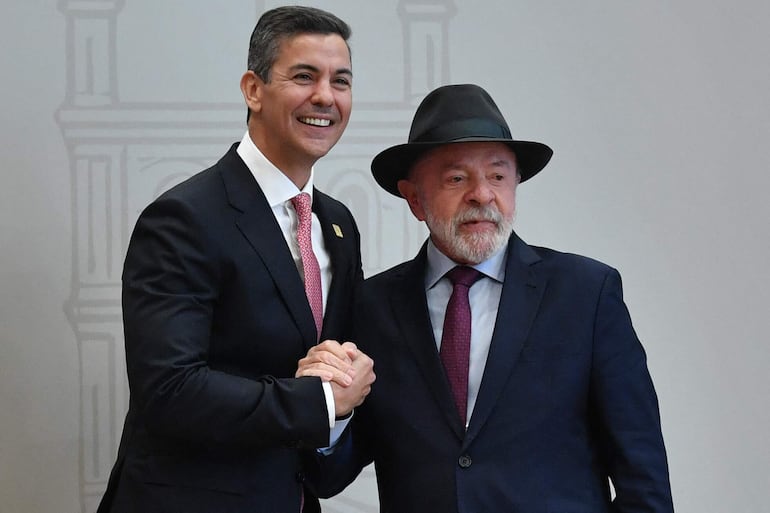
“We are a landlocked country and that condition imposes much higher logistical costs on us than any other member of the bloc. Each container that leaves Paraguay carries hundreds of kilometers and an extra cost that the rest do not pay. That is the asymmetry that we recognize. When Mercosur was signed in 1991, it recognized the asymmetries of two large countries, such as Brazil and Argentina, about two less large countries, not small ones, like Uruguay and Paraguay”, stated the head of state.
Peña’s position was already advanced yesterday by the national chancellor Rubén Ramírez who indicated that Paraguay expresses “its concern about the proposed criteria for the allocation of export quotas to the European market”. He argued that the volumes proposed for the country do not reflect adequately their productive capacities or the commitments assumed within the framework of the agreement.
Read more: Mercosur Summit: Peña and Noboa discuss cooperation against organized crime
“Paraguay does not ask for privileges; it demands equity,” stated Foreign Minister Ramírez. He insisted that the credibility of the bloc It depends on what benefits of integration reach actually to all its members.
Read more: Mercosur Summit: Paraguay calls for “equitable distribution” of benefits with the European Union
After more than 25 years of negotiations
He trade agreement between the Mercosur and the European Union (EU) It was signed on January 17 in Asunción, and four days later, on the 21st of that same month, the European Parliament sent the agreement to the Court of Justice of the European Union (CJEU) for the Community Court to review whether it is compatible with the treaties of the European bloc.
This association agreement is divided into two sections: one commercial and the other policy. The pact was sealed during a ceremony held in Asunción last January, after more than 25 years of negotiations.
The agreement between the EU and Mercosur (Brazil, Argentina, Uruguay and Paraguay) It involves the creation of a market of 700 million people in which more than 90% of current tariffs will be liberalized, some immediately.
Brussels calculates that the agreement will increase annual European exports to the countries of the Mercosur 39% in 2040, up to 50 billion euros.
“Asymmetries did not disappear”
At another point in his speech, Santiago Peña referred to the asymmetries in Mercosur. “These asymmetries have not disappeared. Therefore, the asymmetry that we demand to have is a matter of justice. As a common citizen I want, wish, dream, but, mainly as president of Paraguay I demand a fair Mercosur. And I allow myself some questions that deserve an honest answer between us. Why do we negotiate with Europe if access to new markets is not to be used to develop what is not yet developed? What purpose is a free trade agreement that reproduces the asymmetries that already exist instead of correcting them?“, critical.
“When we talk about quotas we do not ask for privileges, we ask for equity and that is why we ask that this difference be recognized, the one that separates us today and the one that I am sure together we can close. And I say it with all letters. Mercosur has to allow Paraguay to grow. And I know that many say, but Paraguay is already growing. It is true. Paraguay is the economy that grows the most. But we are running from behind in the development race. History shows us too many cruelly painful examples in which our countries prevented Paraguay from growing. Things can and should be different, today for Paraguay, but tomorrow for other members of Mercosur. Today we are going through the process of industriality. Today Paraguay is experiencing the industrialization process that all of you, the large economies of this bloc, already experienced 30 years ago. We do not ask for advantages, we ask for the space to develop, the same that you had at the time. “What happened at the time with the Hilton quota leaves us a great lesson,” said the Paraguayan president.
Read more: Regional panorama: leaders “exchange adjectives today, and not objectives,” regrets Aladi secretary
“Asymmetries are not resolved with statements”
At another time, Santiago Peña said that the asymmetries are not resolved with declarations of principles but are resolved with concrete results. “They tell me that the Paraguayan position is inflexible. And I return the question. Where was the spirit of integration? Where was the solidarity? And even more so, where is the justice? That justice for which President Lula fought and did so much in Brazil, which I recognize and forgive me for mentioning it, but it is an example that justice It must ensure that the smallest are not crushed by the largest, that the strong and the weak are placed on equal terms. Without justice there can be no Mercosur, there can be no integration, there can be no genuine friendship between us. We had flexibility when we put our shoulders to it to close the agreement,” he said.
Pena said that “Paraguay was the one that gave up the most in its position due to negotiations that had been undertaken in previous governments.” and added that “we accept”.
“It is neither more nor less what I am asking for today. I tell you this with a simple conviction. If Mercosur wants to be credible on the outside, it must first be fair on the inside. Because today we are not just saying how to administer quotas. We are deciding what kind of Mercosur we want to leave to the next generations. Do we want a Mercosur where the strong trample on the weak, the largest can suffocate the smallest? Or do we want a Mercosur that is truly recognized for the generosity of integration? And all this leads us to the heart of the matter, which is the asymmetries. And this is not just another concept. It is a fundamental concept and was key in the birth of Mercosur. I make my own the words of a great man of Paraguay, Manuel Gondra, who said that justice consists of the following fundamental idea: Not being able to ensure that the righteous person is always strong, we must strive to ensure that the strong person is always just. Because that is justice,” he questioned.
He added: “The strong is just, the just is strong. The playing field is not level for everyone equally. “We do not have the same market, nor the same industries, nor the same logistics.”
They ask for more supportive Focem
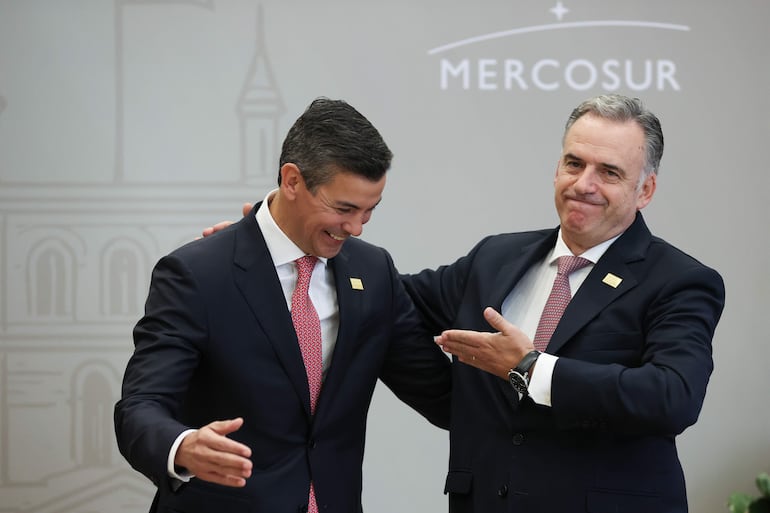
Peña also alluded to the anchoring of the Mercosur Structural Convergence Fund (Focem). He said that Paraguay, as a landlocked country, disputes this match with a weight and a backpack a little heavier than the rest. Indian that it is unacceptable that Focem’s funding is less than since its founding more than 25 years ago.
He pointed out that this fact would be a setback. “Quite crudely, calling would be a shame for Mercosur. That is why today I want to celebrate that there is a will for the new fund to be at least 50% larger than the one we had previously,” express.
Agreement with other countries
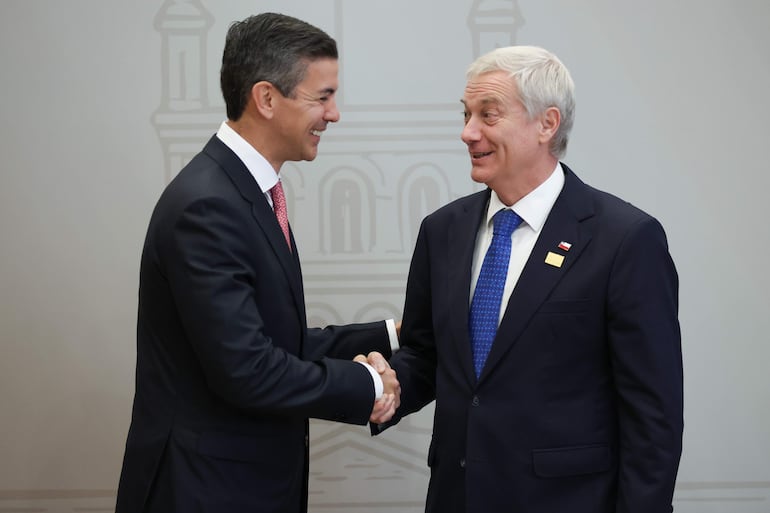
Lastly, President Peña listed the current free trade agreements and negotiations with Arab Emirates and Japan. He recalled the validity of the trade agreement with Singapore. He pointed out that Mercosur must conclude the current negotiations and explore more understandings with other nations.