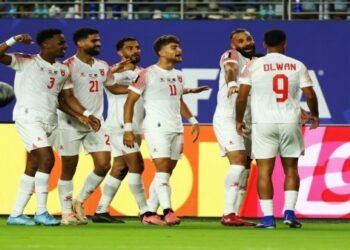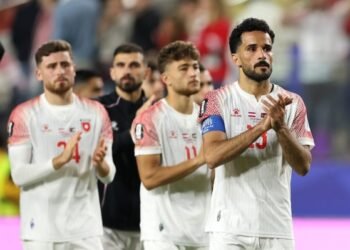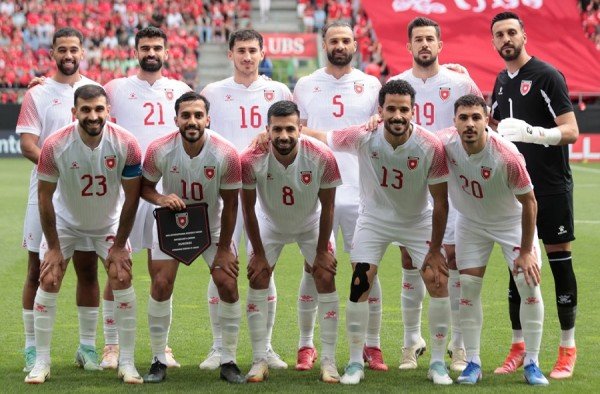
The technical staff of the national football team continues to work hard and intensely before facing its Algerian counterpart at six in the morning next Tuesday at the San Francisco Bay Area Stadium in the United States in the second round of Group Ten matches in the 2026 World Cup.
Following the loss to Austria in the first round, Al-Nashama seeks to rearrange the cards through a series of exercises currently being held in the American city of Portland, in addition to focusing on psychological support with the aim of getting the players out of the effects of defeat and overcoming the series of criticism that affected some of them.
From a technical standpoint, the agency is focusing on a comprehensive review of the team’s performance, as the analytical reading of the last match showed the presence of some negatives. On the other hand, some of the positives that emerged were appreciated, such as tactical discipline in certain periods and the ability to create opportunities across the parties, which prompted the agency to intensify practical training to correct mistakes and enhance strengths.
On the psychological level, the technical staff pays special attention to the mental aspect of the players, realizing that the first loss in the tournament may leave a significant moral impact. Therefore, the camp is witnessing serious attempts to rebuild confidence, while emphasizing that criticism is a natural part of the first World Cup experience, and that what is important is to learn from it, not surrender to it.
The technical staff also emphasizes enhancing team spirit, and emphasizing that responsibility is shared among all team members and is not limited to a specific player.
Al-Nashama is preparing to face Algeria, which also lost to Argentina 0-3, a match that is considered a new test to prove his ability to rise quickly, as any positive result during it will return him to the acclaimed image, and enhance the chances of him remaining in the competition circle and entering among the options for moving to the second round, which witnesses the presence of 32 teams from the champions and runners-up of the 12 groups, in addition to the 8 best teams that occupy third place.
In light of this, the technical staff’s mission appears to be double, combining technical correction, investing in strengths, and psychological support to transform public pressure into a positive motivation that gives players the incentive to perform better.
It is hoped that the loss to Austria will be the beginning of a more solid journey for Nashama, who is waiting to enter the confrontation with Algeria with a new spirit.
Support campaigns
At a time when social networking sites witnessed criticism of the national team and a number of players and the technical staff following the loss to Austria, the Jordanian fans were humiliated by launching broad support campaigns aimed at keeping the ranks united behind the “starchy” and emphasizing that defeat is not the end of the road but rather a passing stop on the journey of achievement.
Social media platforms were filled with supportive messages, turning into a solidarity space that refuses to hold the players individually responsible, and stresses that the national team represents all of Jordan, that criticism must be constructive, and that psychological support is the most important weapon at this stage.
It is noteworthy that these campaigns were not limited to the local level, but rather extended to Jordanian communities abroad, as expatriates published pictures and videos from the last match confirming their support for the team, considering that the first World Cup participation in itself is an achievement worthy of pride and continued support.
The public support campaigns after the loss embodied the image of Jordan united behind its national team, and proved that true sportsmanship is built on trust and solidarity, not on criticism and blame, so the question remains: Will Al-Nashama succeed in converting this popular support into an additional force on the field against Algeria?
Public anticipation and a balanced history
The Arab fans are anticipating a confrontation that is not devoid of club and excitement, in a match that carries more than one title, between the ambition to qualify and the desire to prove oneself on the largest football stage in the world.
According to a report published by the “Ultra Algeria” website, observers of sports affairs classify this confrontation as one of the most prominent Arab summits in the tournament, as it is purely Arab, and the fact that the two teams enter the match with the aim of compensating after their loss in the first round, which increases the intensity of competition and pressure on both parties. Algeria was defeated by Argentina 3-0, while Jordan was defeated by Austria 3-1.
It is also expected that each team will seek to impose its style from the beginning in a match that does not accept complex calculations, as it may be decided by small details inside the green rectangle, in light of the close level and the desire of each party to revive its chances in the group.
Historically, it appears that the paths of the two teams have not crossed much, which adds more mystery and excitement to this meeting, as they have only had three confrontations over many years, all of which were friendly and did not bear the character of an official competition.
The beginning dates back to 1974, when the Algerian national team won with a huge score (6-0) in the friendly Kenitra Cup tournament in Syria, in a match that at the time revealed a clear advantage for the “Greens” offensively.
But the Jordanian response came later in 1988, when “Al-Nashama” was able to win (2-1) in the Arab Cup Championship in Amman, in a confrontation that demonstrated the Jordanian team’s ability to confront the “Desert Warriors.”
The last stop was in 2004, when the friendly confrontation in Algeria between the two sides ended in a positive draw (1-1), so that this relatively balanced record remains the only reference before entering history through its official door for the first time in a major tournament.
Algerian complaint
The Algerian newspaper “Competition” revealed that the President of the Algerian Federation, Walid Sadi, requested an official explanation as to why the match referee did not resort to video technology, despite the serious intervention made by Lionel Messi against Issa Mandi.
Although Simon Marciniak was near the shot, he contented himself with announcing a violation against the Algerian national team, without giving even a warning to Lionel Messi, and his colleagues in the video room also refused to invite him to review the shot.
The Algerian Federation’s complaint was not limited to Messi’s shot, after which he scored two more goals that decided the match for his team, but it also included a reference to an attack that Ibrahim Maza was subjected to with an elbow strike from Alexis McAllister, without the Liverpool midfield being subjected to any penalty.
The Algerian Federation believes that the referee’s decisions significantly changed the course of the match, because the “Greens” were able to return to the forefront if the opponent completed the match numerically inferior for more than a full half.