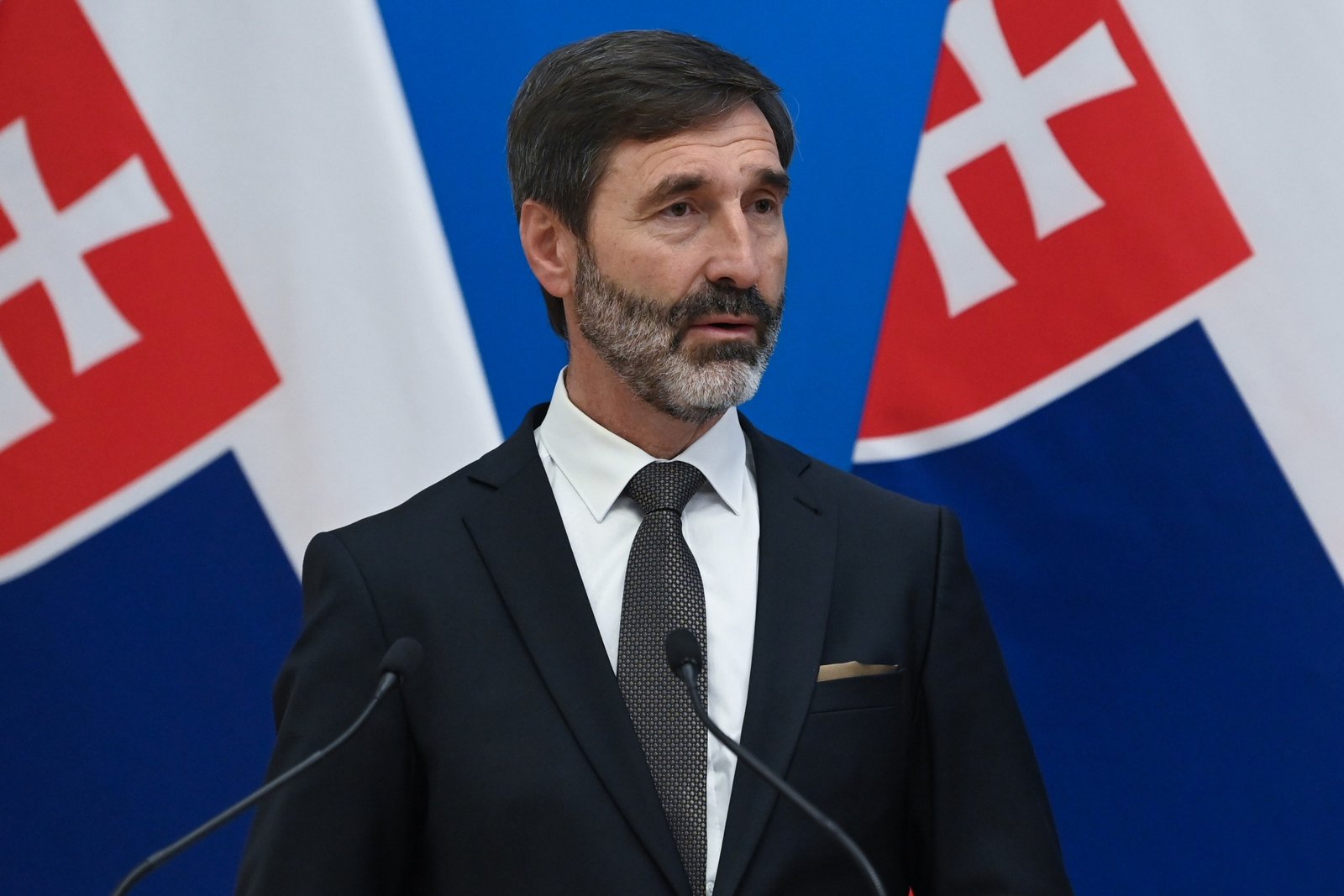

Minister Juraj Blanár
In an interview with journalist Anka Zitná, Slovak Foreign Minister Juraj Blanár has reflected on the rising tension between the government of Robert Fico and Péter Magyar. He also criticized the European Commission for applying double standards with regard to granting previously withheld European grants to Magyar’s pro-EU left-wing government.
Minister Blanár has pointed out that the Visegrad 4 Alliance countries (Slovakia, Czechia, Hungary, Poland) have, in the past, rejected the EU’s Migration Pact, among them Hungary most vehemently. He also hinted at the fact that the new Péter Magyar government has not yet revealed its hand in terms of where they stand regarding this issue. The Slovak government is waiting for them to make their policies towards migration clear, the minister said. Their position is that no migrants from other EU countries will be accepted, as Slovakia has already welcomed a large number of refugees from Ukraine. In his words, Bratislava is against the exploitation of the asylum system by economic migrants.
When asked about the TISZA party’s handling of its own constitutional majority in Hungary, he said that changing the constitution in Hungary will be a sensitive matter, as this process must remain within EU rules. Magyar’s attempts to remove the president through changes to the constitution can be especially problematic as, in his view,
these attempts are based on the presumption of guilt, not that of innocence, and therefore they are not in line with the principles of rule-of-law.
To the journalist’s question about the EU’ release of previously withheld billions of euros for Magyar’s government without any tangible reforms having been completed so far, and despite the fact that he may not be in line with the rule of law, the minister replied that this is not the first time we are witnessing such double standards from the EU. This exact scenario unfolded in 2023 after Donald Tusk’s left-wing government was formed in Poland.
Minister Blanár also criticized Prime Minister Magyar’s earlier statement in which he said that “Hungary borders only with itself.” He called these remarks unacceptable. He has reminded the Hungarian PM that Hungary borders with sovereign countries such as Slovakia or Romania. The Slovak politician has said that on June 23 there will be a Visegrad 4 Alliance meeting in Hungary called by Magyar, where the Slovak prime minister will discuss these issues with his Hungarian counterpart.
The head of Slovak diplomacy also pointed out that in his view,
the Hungarian elections in April have been cross-connected with the activities of the radical left-wing Progressive Slovakia party and their partners, the Hungarian Alliance, the largest party of the Hungarian minority in Slovakia.
Blanár accused them both of opening up the sensitive issue of the Benes Decrees. Albeit the first half of the minister’s statement does correspond to reality, the latter party is somewhat inaccurate. The issue of the WWII decrees has in fact been opened by the Slovak Land Fund when in 2025, it unilaterally decided to start to confiscate land belonging to Slovak citizens of Hungarian nationality on the basis of them being branded war-criminals and collectively guilty by the post-war decrees. The Slovak government has therefore been condemned a number of times by international organizations, such as the Venice Commission or, more recently in May, by the European Parliament.

Leader of Progressive Slovakia Michal Šimečka (L), and László Gubík, President of the Hungarian Alliance. Photo: Facebook Michal Šimečka
The minister nevertheless said that the largest opposition party, Progressive Slovakia, has exploited what he called, the “Hungarian card,” because they viewed positive bilateral relations between the Fico and Orbán governments in the past as a problem. Therefore, even though Magyar’s strong opinions about the Benes Decrees was regarded by the Slovak government as merely a pre-election rhetoric, and to some extent understandable as post-election euphoria, now that he is the PM this is going to be viewed very differently, warned Blanár.
He has also called on the Ukrainian government to apply the same reforms towards the Slovak minority in Ukraine negotiated by Hungarian Foreign Minister Anita Orbán that would apply to the Hungarian minority, should these be ratified by the parliament in Kyiv. So far though, the Slovak diplomacy has not been engaged in any tangible negotiation with the Zelenskyy government regarding the issue of indigenous minorities. Up until the elections in Hungary, both Bratislava and Warsaw left this sensitive issue solely on the shoulders of the previous Orbán government.

Via Teraz Takto s Ankou Zitnou; Featured Photo:MTI/Máthé Zoltán