SINGAPORE – The universal legal framework that governs sea routes should be updated to account for the added functions of waterways today, Defence Minister Chan Chun Sing said on June 23.
The United Nations Convention on the Law of the Sea (UNCLOS) was conceived in the 1970s, when the focus was on how to keep trade flowing and to make sure that the rights for activities like fishing and mining were fairly accounted for for different countries, he noted.
Since then, critical waterways have gone beyond being just an avenue for trade, with the world increasingly connected through undersea cables for data and energy, said Chan.
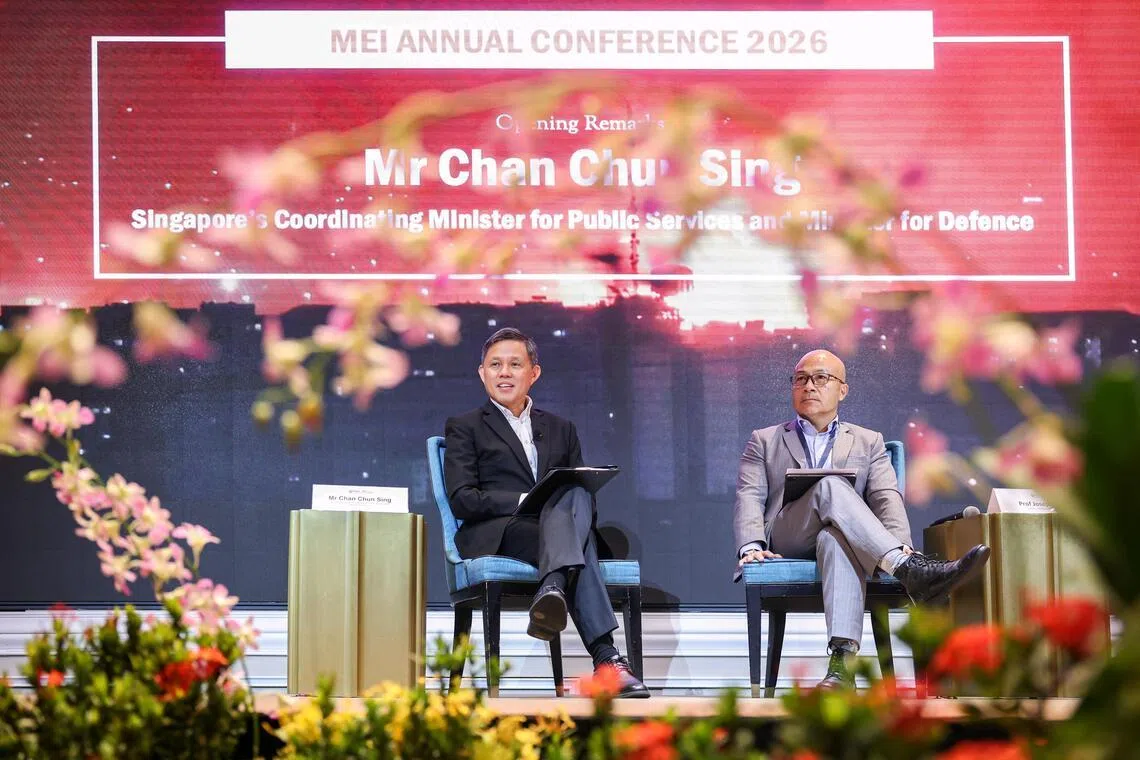
He was responding to a question on whether UNCLOS should be updated given advancements in technology during a dialogue at the Middle East Institute’s annual conference.
The war in Iran and the resulting restrictions on the Strait of Hormuz have cast a spotlight on the effectiveness of the international maritime agreement, which is meant to provide for the right of transit passage through straits used for international navigation.
UNCLOS was adopted in April 1982 after nine years of negotiations and came into force in 1994. Currently, 172 parties have ratified the convention.
Chan said the changing functions of the waterways were one reason Singapore tried to gather like-minded countries to think about the issue at the recent Shangri-La Dialogue.
The Guiding Principles for Underwater Infrastructure Defence Exchanges (GUIDE), which was started by Singapore, was launched on May 30 on the sidelines of the dialogue held in Singapore and involves 17 countries.
It is the first framework that cuts across regions to deal with undersea security challenges and will facilitate the sharing of information to support early warning for security incidents.
Chan said: “Today, any attack on one part of the (critical underwater) infrastructure is an attack on the network, and that is why we have a shared and common interest to work together to deter and to prevent such things from happening.
“So, from our perspective, I think we need to sit down and talk about some of these new issues, besides managing the existing ones.”
This year’s Middle East Institute conference held at Orchard Hotel focused on the global geopolitical and economic fallout following the war in Iran.
In a session moderated by the institute’s chairman, Joseph Liow, Chan said that while there is impact on the global economy because of the conflict, governments and businesses will adapt and that “this alone is unlikely to be fatal in the long term if the issue is largely price-driven”.
What is of greater concern is the conflict’s impact on the global rules and the respect for international law, such as UNCLOS, he said.
Beyond the maritime domain, he said the conflict also raises broader questions about the justification for war and the threshold for initiating one. Chan said: “The impulse to resort to force to resolve disputes reflects a worrying trend of a breakdown in diplomacy.
“If the world moves towards a fractured global order where might increasingly becomes right, the remnants of the rules-based order could be further eroded to all our detriment.
“All states will pay the price, even if we have done the least to cause it.”
Chan highlighted the potential longer-term consequences of the erosion of the strategic deterrence held by major powers.
For decades, the international rules-based order had been undergirded by major powers projecting their power and influence for the common good. But supposedly weaker actors have shown in recent conflicts that they can hold up conventionally stronger ones, he said.
He also pointed to the weaponisation of the world’s hyperconnected economic supply chains and geography.
“If strategic deterrence by major powers is eroded, others might be tempted for greater adventurism,” he said.
Chan was also asked how he thought Lebanon had factored into ongoing discussions between the US and Iran.
While talks between the two have provided for a cessation of war in Lebanon, this has been deemed unacceptable by the Israeli government.
Chan said the reality is that in the Middle East, it is a complex region with many issues intertwined geopolitically and historically.
It is difficult to come to any peaceful settlement for the region unless all stakeholders set aside conflicts and focus their energies on developing the economy and creating opportunities, he said.
“If any one party decides that my very existence cannot be taken for granted unless your very existence is diminished or extinguished, then I think we will never be able to find any solution.”
Turning to energy security, Chan said regardless of the wars in the Middle East and Ukraine, energy transition is something that has to be taken seriously.
For Singapore, energy will be the defining challenge for the next 50 years, just as water has been for the last 50, he added.
There should also be great impetus for ASEAN countries to come together and work on a regional grid in order for countries to moderate prices for cleaner and more sustainable energy, said Chan.
The Asean Power Grid to connect the electricity networks of member states has been in the works for decades.
“The question for us is: Can we work together to overcome some of the near-term political challenges, and for us to all enjoy the benefits of this more integrated (grid)?
“This effort must continue, regardless whether we think there is a war or there is not a war.”