mid the overwhelming number of art exhibitions attempting to interpret the world through science and technology, artist Antonius Kho chooses instead to revisit memory through the tactile language of stitching and embroidery.
Using the age-old stitching mechanism, Antonius’ solo exhibition, held to celebrate his 68th birthday in the Year of the Horse, offers a visual dialogue with the Chinese zodiac through a mosaic-like technique exploring themes of identity. Displayed at the Hadiprana Gallery in Kemang, South Jakarta, the exhibition, which runs until May 26, arrives as a refreshing antithesis to the digital saturation dominating contemporary artistic discourse.
Applying color combinations that soothe both the spirit and the contemporary eye, his memories unfold in mosaic formations, a technique he acquired during his studies at the Fine Arts FH, now the Technical University of Applied Sciences in Cologne, Germany, from 1984 to 1992. The exhibition reveals how deeply this educational background continues to shape his visual vocabulary.
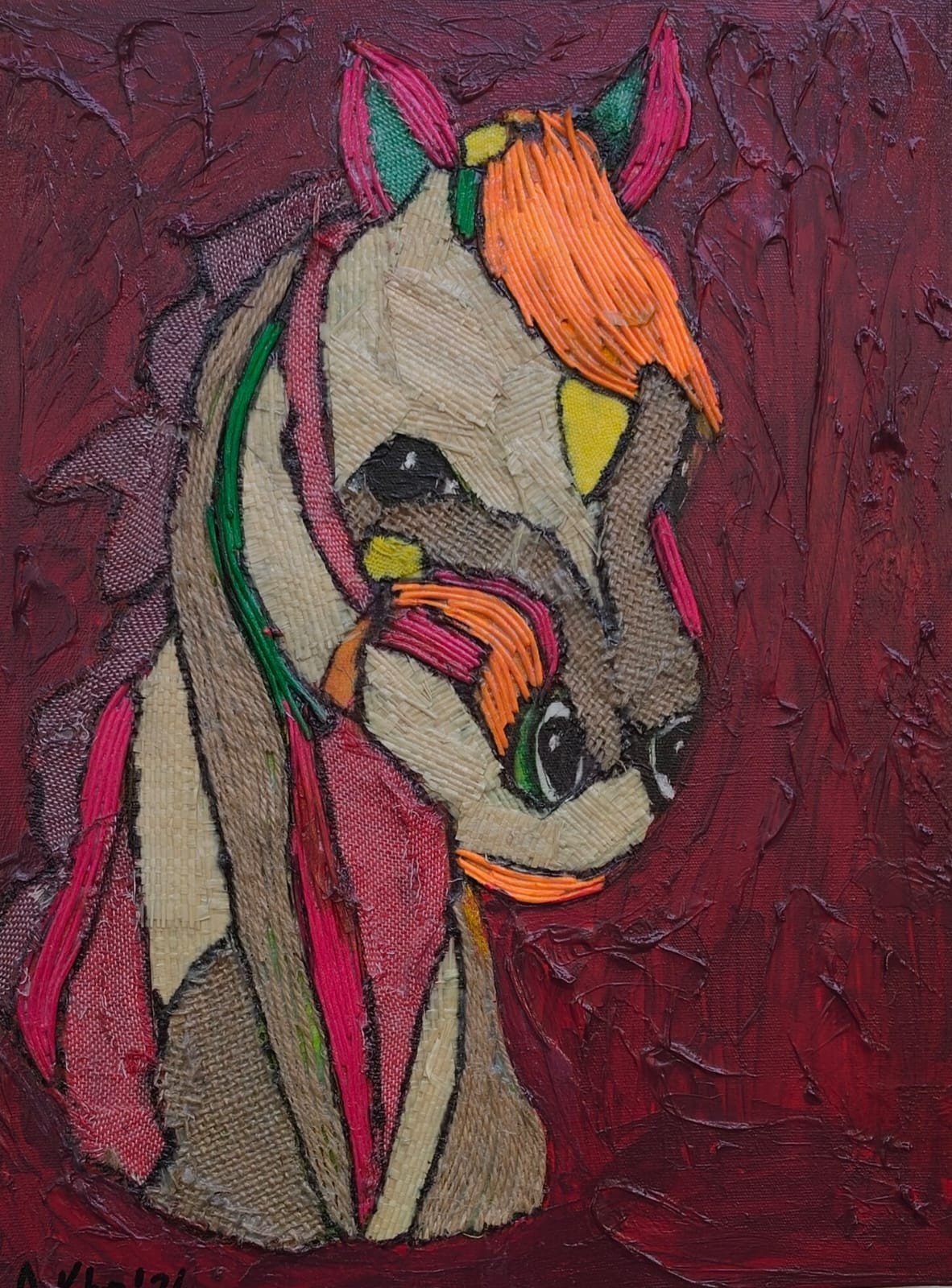
Drawing from his training in glass painting, Antonius treats the canvas like a mosaic surface, arranging fragmented patterns of fabric and paper together with organic materials such as jute, rope and embroidered cloth. The resulting textured surfaces resemble woven tapestries, at once delicate and structurally firm.
The combination of rigid mosaic construction with soft tactile materials creates a style that feels simultaneously ancient and contemporary. His works carry the warmth of handcrafted traditions while maintaining a distinctly modern visual rhythm. In an era increasingly fascinated by artificial intelligence and virtual experiences, Antonius’ works return viewers to touch, patience and material intimacy.
Small paintings featuring abstract little figures and monsters emerging from fantasy or pure imagination fill the exhibition with a playful current. These tiny characters seem to drift freely across emotional landscapes, exploring life and feeling in a humorous and lighthearted manner. Their distorted forms and unusual expressions recall childhood imagination, where innocence and anxiety often coexist in curious harmony.
Yet it is the image of the horse that commands particular attention throughout the exhibition. As the horse-inspired works amount to nearly one-third of the total 53 works on display, the motif emerges as a central emotional and symbolic thread.