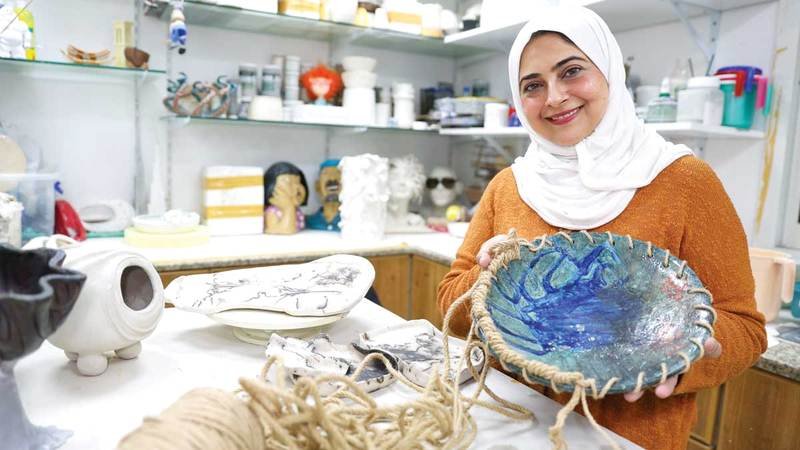
The illness in the life of the Emirati artist, Hoda Al Rayes, was not just a passing stage of pain, but rather constituted a turning point that reshaped the paths of her life. From the heart of the harsh experience and during the treatment journey, she opened the doors of deferred dreams, to discover in the material of clay a world that shaped her psychological balance and brought her back to life. She turned the clay into a companion for treatment, and formulated a long story of passion, from which her various works were born. Then she began learning the art of “raku” and worked to reformulate it in a local spirit. She combined his complex techniques with elements of Emirati heritage, giving her works a special imprint that goes beyond the limits of form to the depth of local identity and heritage.
Hoda Al-Rayes studied project management strategies, and worked in her field in more than one job, but the disease led her to the art of ceramics. At the beginning of her interview with Emirates Today, she recalled the beginnings of the stage, saying: “My relationship with clay began in a different way, specifically after I contracted cancer, and the doctor asked me not to focus on the idea of illness during the treatment period, which was very tiring. I was happy to search for what would get me out of the feeling of suffering, and I returned to my list of dreams written down when I was young. One of them was learning clay, so I decided to enter this world.”
She added: “I searched a lot for artists to learn from them the basics of this art, and I went through moments when I did not have the ability to hold clay, until it began to give me strength. Man is created from it, and there is a strong bond that unites him with this material, which over time began to give me peace, calm, and answers, so much so that I recovered in record time compared to others.”
Related technologies
After Hoda Al-Rayes completed the treatment stage and mastered the various techniques related to clay, she began searching for new challenges in the field of ceramics, so she came up with the art of “rako” in which she works today, which depends on burning clay in a different way. She explained that she searched for several months for a place she could join to study it, until she received a response from an academy in Italy, and she finished studying its techniques in 2024.
She pointed out that to this day she still buys the components and materials of this art from Italy, because its materials are different from traditional ceramics, as it contains soft pottery that can withstand shocks, in addition to the presence of materials that make it more consistent than regular clay. As for the techniques, she pointed out that the “raku” pieces can be designed with many techniques, in addition to the introduction of organic materials, including banana, lemon and corn peels, copper and some other metals, in addition to the presence of different techniques in drawing, including drawing with smoke, or painting. Rain water, or even shaping with paste materials, all of which affect the colors that appear on the pieces.
Hoda Al-Rayes stated that she worked to add some materials related to the local environment, including date pits, which give the pieces their black color, in addition to burning coffee and sugar, horse hair, and falcon feathers, which she noted are not easy to obtain at all, as the fallen ones are collected to be used to repair their wings when they are broken, so what you get from it is from the feathers of dead falcons, and these materials decompose and turn into colors.
In addition to these various materials, the artist was keen to combine “rako” with the Emirati heritage. After feeling routine at work, she decided to introduce features of her homeland’s heritage into this art. She began using ropes in some pieces to give them a local identity. She also decided to learn the craft of wickerwork in order to introduce it to this art at a later stage, as ceramics began to bring her back to traditional crafts.
She explained that clay is a traditional material that is part of the local heritage, as women worked in various fields, including wickerwork, burqa, and clay, which dates back to ancient times and developed over time.
Wish List
Working on the art of “rako” carries many challenges, but the most prominent of them is fire, according to Hoda Al-Rayes, who admitted that when she began her journey in Italy, she felt afraid of fire, especially since she places the pieces inside it, and needs to deal with its high temperature, or even its movement with the air, and this requires speed in how to deal with it, but she overcame this challenge with time, and stressed that this fire requires adherence to some safety-related measures, including wearing special glasses and aprons, as well as anti-paws. For heat, as the temperature is much higher compared to ordinary clay, and varies according to the nature of the materials, and she saw that this art carries a lot of beauty as well as challenges, as it is what brought her back to life, as she put it, and she wishes that she had returned to her wish list that had been postponed for a long time, as this would have changed her life greatly.
Dreams and a special imprint
Hoda Al-Rayes considered that her mark in art, so far, is not specific, as she rejects the principle of specialization, and seeks to explore all types of clay arts. She also wants to teach clay arts, in order to provide the opportunity for those who want to know this field to explore it, noting that she aspires to create a place that brings together those working in the field of clay, because there is a need for an umbrella that includes artists in one place, especially since each of them works individually, and everyone is in a challenging stage, and she saw that such a step would constitute support for the artist. Emiratis in the field of ceramics, especially since there is a great need to market their work.
• 2024 is the year in which Hoda Al-Rayes finished studying the techniques of the art of “raco” in Italy.
Hoda Al-Rayes:
• My relationship with ceramics began after I was diagnosed with cancer, and the doctor asked me not to focus on the idea of illness during the treatment period, which was very tiring.
• I searched for what would get me out of the feeling of suffering, and I returned to my list of dreams written down when I was young, one of which was learning clay, and I decided to enter this world.