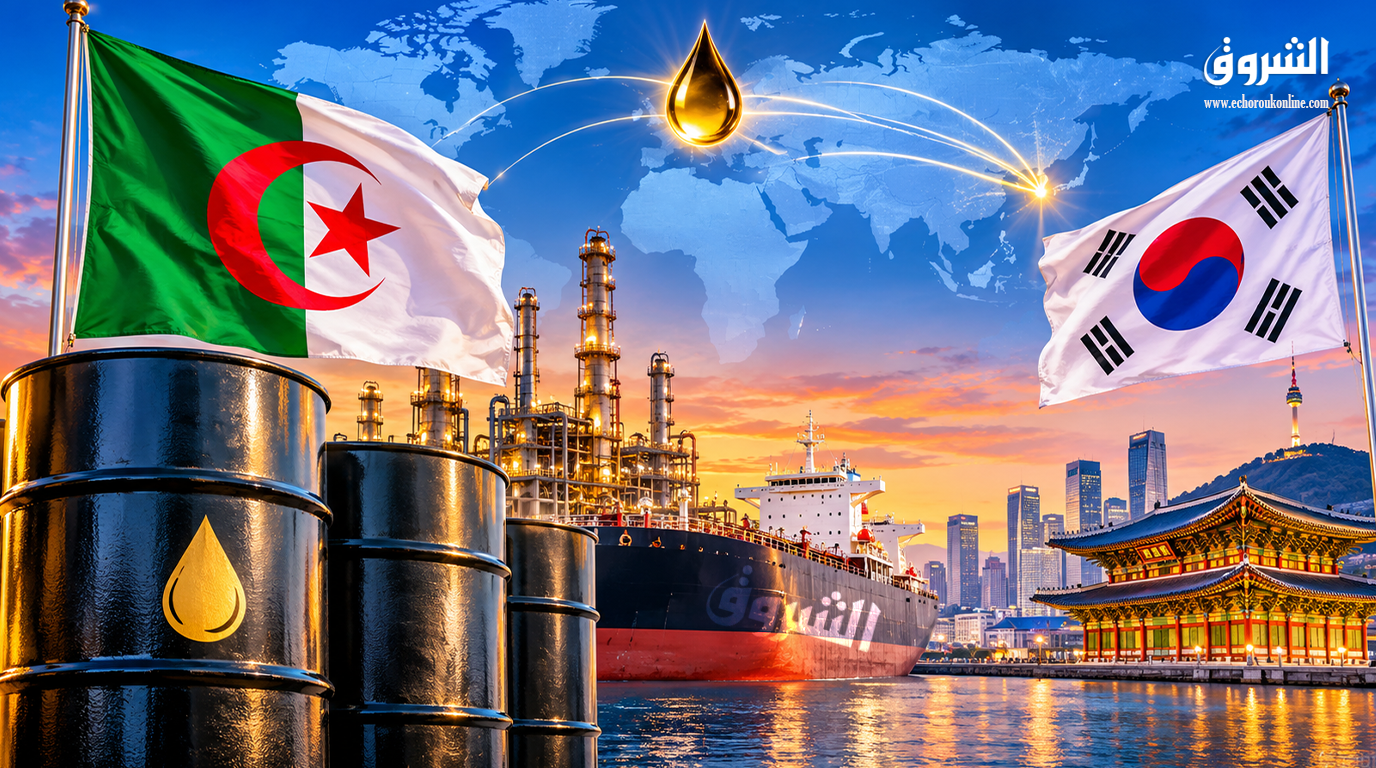
Algeria ranked third among the largest exporters of petroleum products to South Korea during the first nine months of 2026, with average exports reaching 67 thousand barrels per day, according to Data Energy Research Unit.
Japan came at the top of the list of suppliers with an average of 74 thousand barrels per day, followed by the UAE with 72 thousand barrels per day, while the United States ranked fourth with 59 thousand barrels per day, and India ranked fifth with 47 thousand.
The list of the top ten suppliers also included Malaysia with an average of 45 thousand barrels per day, the Sultanate of Oman with 42 thousand, Qatar with 30 thousand, Singapore with 27 thousand, and Kuwait with 22 thousand barrels per day.
According to the report, South Korea’s average imports of petroleum products amounted to about 706 thousand barrels per day during the period from January to September 2026, recording a decline of 29% compared to the same period last year, when it reached 995 thousand barrels per day.
The total average exports of the ten countries reached about 485 thousand barrels per day, equivalent to approximately 69% of South Korea’s imports, while the average exports of the five Arab countries included in the list, namely the UAE, Algeria, the Sultanate of Oman, Qatar, and Kuwait, reached about 233 thousand barrels per day, representing 33% of total imports.
South Korea’s imports of petroleum products recorded a continuous decline on a quarterly basis during the first nine months of the year, as their average decreased by 16% in the first quarter to 851 thousand barrels per day, compared to 1.01 million barrels per day during the same period in 2025.
The decline continued in the second quarter by 27% to 608 thousand barrels per day, compared to 838 thousand in the corresponding period last year, before the average decreased by 33% in the third quarter to 661 thousand barrels per day, compared to 981 thousand during the same quarter of 2025.
The sharpest decline was during the third quarter, with imports declining in August by 46% to 545 thousand barrels per day, compared to more than one million barrels per day in the same month of 2025. They also fell in September by 38% to 637 thousand barrels per day, compared to 1.02 million barrels per day during the corresponding period.
Regarding Arab suppliers outside the list of the top ten, Libya’s exports of petroleum products to South Korea amounted to about 21 thousand barrels per day during the first nine months of the year, close to the level of Kuwait’s exports, while Saudi Arabia recorded an average of 18 thousand barrels per day.
The report also indicated that Egypt recorded rare shipments of petroleum products to the Korean market, and that Syria appeared for the first time on the list of countries exporting to it.