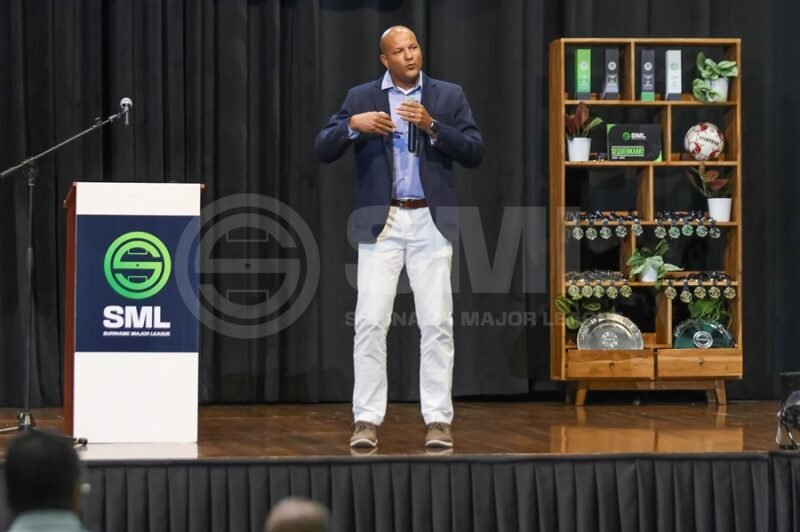
The Suriname Major League (SML) does not think it will be possible to immediately become completely financially independent during the initially planned transition period of four years. Chairman Rolf Verwey thinks that approximately two additional seasons will be needed for this. The SML is now approximately halfway through its four-year transition process. During that period, the competition must become less and less dependent on external financing and earn a larger share of its income itself.
Text Marinio Balsemhof
Image FB Suriname Major League
“We started with approximately 15 percent of the budget from our own income. We are now around 50 percent,” Verwey says. the True Time. The aim is to grow towards full financial independence within the next three seasons. However, according to him, achieving that goal will depend heavily on the further development of the participating clubs.
“We cannibalize our own audience by playing five matches at one location”
An important change is planned for the 2027/2028 season. From then on, clubs must organize their home matches themselves. This currently happens with both home and away games by the SML. As a result, they pay a large part of the costs, such as accommodation, match decorations, arbitration and medical facilities. This construction will change when clubs actually act as home teams again. The associations must now prepare for this organizationally and financially.
Even in larger professional competitions, competition organization and accommodation are among the significant cost items, Verwey explains. SML has managed to keep its head above water in recent years thanks to sponsors, commercial partners and the Surinamese Football Association (SVB). Verwey says the association’s contribution has been important in getting the competition started and developed, but that support is being gradually reduced, as originally planned.
It started with around 550,000 US dollars, which has since been reduced to around 240,000 US dollars until the last season. Approximately the same amount is expected for the coming season. The SML must increasingly make up the difference through its own commercial activities. Verwey emphasizes that not only the league, but especially the clubs, must become more commercially viable. Sponsoring, marketing and developing your own support base must become part of daily business operations.
Stadium visit
The limited number of spectators at matches is regularly mentioned as a point of criticism. Verwey states that this problem must be viewed in a broader context. He points out that other countries in the Caribbean are also struggling to attract large numbers of supporters to club matches. He cites the Dominican Republic as an example, with approximately eleven million inhabitants, of whom only a few hundred attend some regional competitions.
The SML chairman mentions the central organization of almost all competitions as one of the problems in Suriname. “We cannibalize our own audience by playing five matches in one location.” Matches should return to the clubs’ neighborhoods and home bases, which can lead to local marketing and a stronger bond between club, neighborhood and supporters. The responsibility for getting the public to the stadiums should ultimately lie with the associations.
Verwey does not believe that live broadcasts will deter supporters from going to the stadium. The challenge lies mainly in how one experiences a match. “We must work with the clubs to ensure that people want to come to the stadium. The experience must be there.” That is why activities must be developed around matches that make a visit to the stadium more attractive.
With more independence for the clubs also comes more responsibility. One of the license conditions is that every association affiliated with SML must submit proper financial statements annually. This includes looking at the financial health and solvency of the association. “After all, it is a professional league. The quality must be high and remain high. If you cannot meet the conditions, you cannot play in the SML.”

Different approach
Since its short existence, SML has built up a position that is also noticed regionally. The Suriname Major League has started a development that is being followed with interest within the region. “We have to keep raising the bar. It’s hard work and it’s not always fun, but it does pay off. We have started a new industry that we are further developing.”
Also from a sporting point of view, SML’s wish remains clear that a play-off system would be part of the competition. The starting point was to maintain the tension during the season for as long as possible. Various models have been submitted to the clubs for the coming season. The general meeting ultimately opted for a system in which only the six strongest teams continue after the first phase. The chairman expects that many mutual matches will be played between the stronger teams, especially in the final phase, which should improve the tension and the level.
The fact that the SML has acquired a permanent place in Surinamese football after a few seasons is evident not only from the investments by clubs, but also from the online interest, says Verwey. He also sees an upward trend in the level of football. According to him, this development should ultimately also become visible when Surinamese clubs participate in regional Concacaf competitions.
Fully professional football ultimately also means that players can earn their income from the sport. According to Verwey, Suriname is not yet at that point. He does not call this an exceptional situation for a young professional competition. “It has never been the case at any start-up that players could immediately make a living from football alone. That is a development that can take years.”
He does see a positive trend. More and more players are focusing entirely or largely on football. For Verwey, this is also an important indicator of professionalization. The coming years will therefore determine the next phase of the SML. “A strong league can only exist if the clubs themselves are professionally organized.”