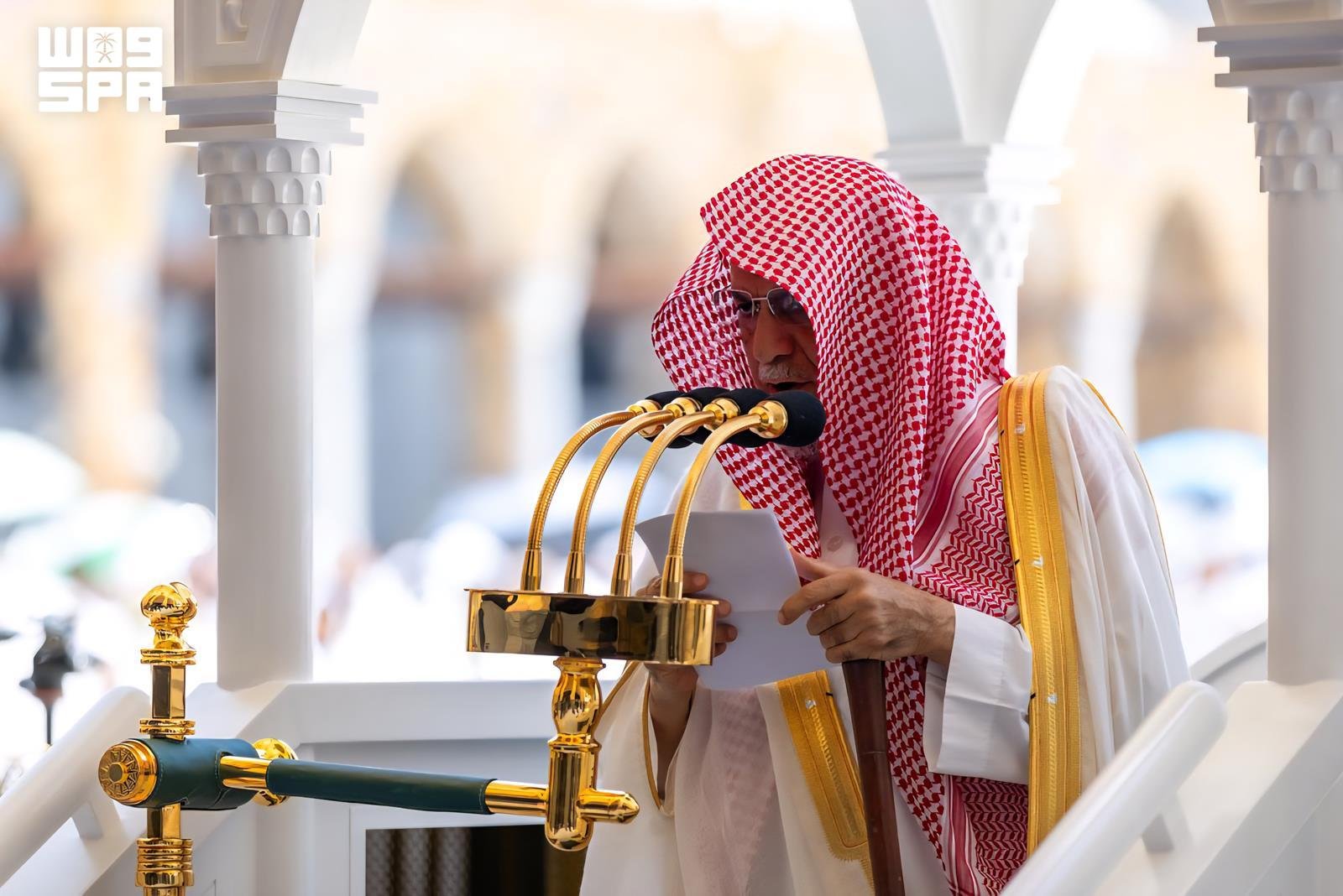
Imam of the Grand Mosque: Lack of God is the path to happiness and true wealth
The imam and preacher of the Grand Mosque, Sheikh Dr. Saleh bin Abdullah bin Humaid, advised Muslims to fear God Almighty, warning against being deceived by wishes and hopes, and that every living person is about to leave and move on, and that a person will have nothing left after his death except the good deeds he has done. God Almighty said: “So how will it be when We gather them together for a day in which there is no doubt?” And every soul will be fully repaid for what it has earned, and they will not be wronged.
His Eminence explained during the Friday sermon at the Grand Mosque that times pass quickly, and lives pass little by little, and that when the deadline comes, it will not be possible to make up for what has passed. God Almighty said: “On the day every soul will find present all the good it has done, and whatever evil it has done, it wishes to Indeed, there is a long time between it and Him, and God Himself warns you, and God is Most Compassionate to His servants. Genie.
He pointed out that Muslims are welcoming a new Hijri year, calling for taking advantage of this occasion to review the soul and renew repentance and turning to God, and asking Him, Glory be to Him, to bless lives, deeds, livelihoods, and offspring, and to open for His servants the doors of mercy and answers, stating that the gains of this world are cut off with the feet, while the wins of the Hereafter are cut off with the hearts, and that the most beloved of hearts to God is the heart that has the ability to submit to its Lord and be broken before its Lord. The Almighty said: “He who is obedient during the night, prostrating and standing, fearing the Hereafter and hoping for the mercy of his Lord.”
Dr. Bin Humaid emphasized that lack of God is one of the greatest stations of servanthood, and that the sincerity of lack is achieved when the servant contemplates his weakness, poverty, misery, need, inability, and shortcomings, and then raises all of that to God Almighty, and that according to the servant’s lack of his Lord, his success, sustenance, wealth, and happiness will be.
He added, “The reality of lack is represented by the servant’s knowledge and firm certainty that he is indispensable to his Lord for the blink of an eye, and that God Almighty is the Sufficient, Supporter, and Supporter. The servant has no help, power, or ability except with God’s permission, His will, His ability, His facilitation, and His assistance,” adding that the one who lacks God is constant in supplication, supplication, and asking God not to leave him to himself for the blink of an eye.
His Eminence explained that the more humble a servant is towards his Lord and the poorer he is toward his Master, the closer he is to Him, the more dear to Him, and the more beloved he is to Him, and that knowledge of God increases its owner’s awe and fear of Him, citing the words of Al-Fudayl Ibn Iyad, may God have mercy on him: “The people most knowledgeable about God are the ones most afraid of Him,” and his saying: “A servant’s awe of God is proportional to his knowledge of Him.”
Sheikh Bin Humaid confirmed that fear of God leads to keenness, diligence, and a desire to obey. The Prophet, may God’s prayers and peace be upon him, said: “Whoever is afraid will enter, and whoever enters will reach the station,” and that one of the universal rulings in this matter is that “if it is true to lack God, it is true to do without Him, and if it is true to do without Him, then it is true to lack Him,” and that supplication, help, trust, monitoring, humility, desire, turning to God, fear, love, constant remembrance, seeking forgiveness, fearing God in secret and in public, and glorifying His commands. His prohibitions are among the greatest things that raise a servant to the position of needing God.
His Eminence emphasized that lack of God is a reason for wealth, mercy, favor, and provision, and that true happiness and great victory are achieved by complete submission to God Almighty and lack of Him, and that the servant has two positions in the hands of his Lord: a position in His hands during prayer, and a position in His hands on the day he meets Him, and that whoever fulfills the right of the first position, the second position will be easy for him, and that the servant fluctuates between the provisions of commands and the provisions of calamities, and to the extent that he fulfills the commands, God’s kindness to him will be when calamities come, and that the validity of lack of God is cleared. Worship removes worries from the heart and makes its owner find the pleasure of obedience and the sweetness of closeness to God.
His Eminence said: “The captivity of the heart is greater than the captivity of the body, and the enslavement of the heart is worse than the enslavement of the body, and the greatest misguidance and loss of people is the one whose heart is attached to other than God. God Almighty said: “Have you seen him who takes his own desires as his god?” And the Prophet, may God’s prayers and peace be upon him, said: “Unhappy is the servant of the dinar, miserable is the servant.” “The dirham,” explaining that the greatest waste is wasting the heart and wasting time. Wasting the heart is by preferring this world over the afterlife, and wasting time by longing for hope, and that corruption is by following desires and longing hope, while righteousness is by following guidance and preparing to meet God, and that lack of lack of God leads to arrogance, and that the obstacles that prevent a servant from his Lord are three: polytheism, heresy, and disobedience, and that polytheism is removed by monotheism, and heresy is removed by adhering to the Sunnah, and disobedience. It is removed by sincere repentance.
The imam and preacher of the Grand Mosque called on Muslims to welcome the new Hijri year with repentance and good deeds, stressing that days are the decrees of deadlines and timings for deeds, and that the work of a believer does not end until his time comes to him. God Almighty said: “And worship your Lord until certainty comes to you,” and that there is not an hour of life except that God has in it one of the functions of obedience, and that the servant He approaches his Lord between hope and fear.
He urged His Eminence to fast on the day of Ashura, citing what was narrated by Anas, may God be pleased with him, that the Messenger of God, may God bless him and grant him peace, said: “Fasting on the day of Ashura, I hope that God will atone for the year before it,” and he mentioned what was reported on the authority of Ibn Abbas, may God be pleased with them both, with a chain of transmission traceable to the Prophet: “Dissent from the Jews, fast the day before it or the day after it,” referring to his saying, may God’s prayers and peace be upon him: “If I remain until the end of the month, I will fast on the ninth with the tenth.”