 7 minutes reading‘
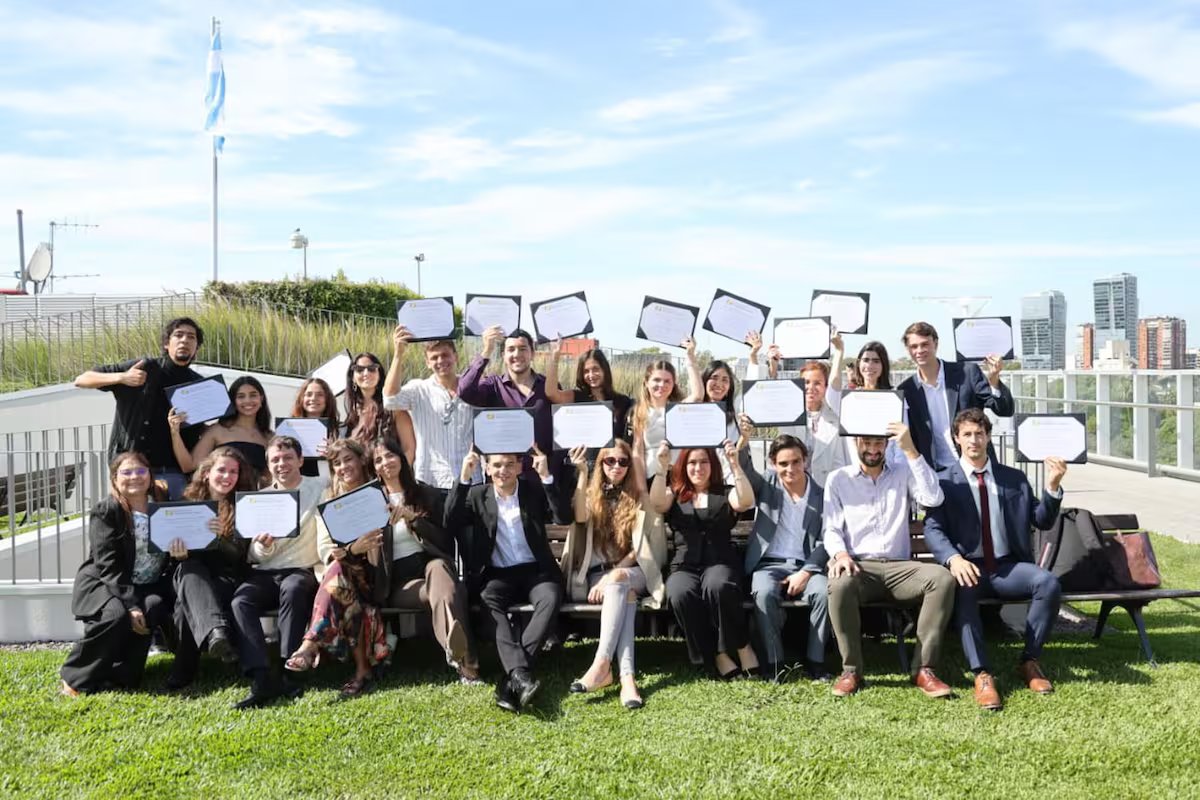
The Master in Journalism from LA NACION and the Torcuato Di Tella University held its traditional graduation ceremony and welcomed the new students, 26 years after the creation of the study program most prestigious postgraduate degree in journalism in the region.
It was a warm ceremony in the Aula Magna of the Alcorta Campus of the UTDT, which was opened by the rector of the university, Juan José Crucesthe director of THE NATION, Fernan Saguierand the co-director of the Master’s Degree Camila Perochena. After the welcoming words, the journalist gave a master class Gail ScrivenPro-Secretary General of Editorial THE NATION.
In his speech, Cruces highlighted the importance of the alliance between Di Tella and THE NATION in the construction of the study program. “It is a pride for both institutions to support this program. Also our gratitude to our donors for making possible a scholarship system that helps many students,” said Cruces, and thanked Camila Perochena for her two years of management in the Master’s Degree, and Karina Galperín, who returns as co-director of the master’s degree. The other co-director for THE NATION It is the journalist Carlos Reymundo Roberts.
Fernán Saguier, director of THE NATIONsaid: “We have 156 years of history and we have gone through many milestones in this long journey. But if there is something that we have done well, it was 26 years ago when we decided to do the Master’s Degree in Journalism with the Torcuato Di Tella University, a house of studies that is in full expansion, with a long history and great academic quality.” The journalist said goodbye to the recent graduates and also to the new entrants: “To those who are leaving, some of them doing internships in the future at the newspaper, we also welcome them with open arms. You think that we teach you; it is you who make us learn a lot. So welcome and move on.”
Meanwhile, the deputy director of the graduate program, Camila Perochena, greeted the new entrants and congratulated the graduates for their “perseverance and dedication.” Furthermore, he maintained that “freedom of the press is a historical, fragile and valuable construction, which cost a lot to build and which must be sustained every day.” The historian recalled that Argentina knew how to be a world reference in terms of the press because for decades it “committed to freedom of expression as a founding value of the republic.”
However, he warned that this pact could be broken – and in fact was broken – when “the State began to monitor, close and restrict journalism.” That is why he stated that “freedom of the press is not a finished conquest, but rather a permanent practice and constant surveillance.” And he closed his speech with a central idea: “When journalism weakens, public life loses; when it is well done, democracy breathes better.”
Next, Gail Scriven, Pro-Secretary General of Editorial THE NATIONtaught this year’s master class titled “Journalism in Turbulent Times.” The journalist spoke of the “complex moment that professional activity is experiencing, not to discourage them, but to challenge them.” Scriven said that you have to have “courage to practice journalism” in the context of autocracies that use the manual of attacking the media and journalism because it is the institution that challenges their power.
Scriven asked: “Why would anyone today want to be a journalist?” And he rehearsed a response: “To observe the exercise of power in the name of those who do not have it. There is no technology that replaces the trust that readers place in us.”
“Artificial intelligence cannot replace the work of journalists in their proximity to sources,” said Scriven, and recalled the great investigation of the last decade in LA NACION: The bribe notebooks. “It was one of the most exciting nights of my journalistic life, there is no algorithm capable of making decisions at such a transcendent moment, how to tell the information, what title to put.” On the other hand, he stated: “It may be that AI is more efficient than a journalist for some work processes, it is a reality, not a threat. At LA NACION we are at the forefront, to analyze, for example, the President’s speeches, but it was not just the AI. There was control by an editor, we worked with journalistic criteria.”
Journalism will always need eyes on the ground, journalists who transmit not only the data, but the atmosphere, the gestures, the tension in the place, the looks, the details that are missing or superfluous. The smell, the temperature, the noise. Everything that cannot be achieved with a prompt”
— Gail Scriven
The journalist said that the media has another function, which is to record the phenomena and topics of conversation in everyday life. “Journalism will always need eyes on the ground. Journalists who are standing in front of something and transmit not only the data, but the atmosphere, the gestures, the tension in the place, the looks, the details that are missing or superfluous. The smell, the temperature, the noise. Everything that cannot be achieved with a prompt.” And he challenged the new generations of journalists: “You must debate how to use these emerging technologies like AI.”
“I return to the question at the beginning: why would anyone want to be a journalist today in this ecosystem? Because journalism has a function that no other institution can fulfill in the same way: observe the exercise of power on behalf of those who do not have it. Verify the facts, check, publish what needs to be known even if it is not convenient,” Scriven concluded.
For her part, Maia Had, one of the best averages of the 2024 class, said goodbye on behalf of the group of graduates. He remembered step by step every moment of the course and the practice in the Editorial Office of THE NATION.
“Journalism is a job and it is a profession, and an indispensable element is also added: passion. In that combination, journalism makes sense,” Had said. “Because at the end of the day, journalism is not just telling what happens, but understanding it, questioning it and giving it meaning, assuming the responsibility and commitment that we carry out in doing so,” he concluded.
For his part, Héctor Guyot, academic coordinator of the Master’s Degree, invited those who come to the master’s degree and those who leave (“although never completely”) to persevere in the craft of telling stories. “Real stories that, instead of adding more noise to the noise (whether in the field of politics, culture, sports or art), reveal to us how we are, how we live… and above all how we are changing, since journalism, with its own weapons, tells the film live and direct, as it is projected. And that is why it is an exciting task,” said Guyot.
Gastón Roitberg, Editorial Secretary of THE NATION and digital coordinator of the Master’s Degree, and Graciela Guadalupe, teaching coordinator and deputy secretary of Editorial, who presented the academic profile of those entering the study program.
Journalism is a job and it is a profession, and an indispensable element is also added: passion”
— Maia Had, graduate of the LN/UTDT Master’s Degree
Students have the help of a scholarship fund made up of contributions from the following companies: Pan American Energy, Capital Management ExplorerLa Anónima, Philip Morris Argentina, Techint and Quilmes.
This week begins 2026 school year which is taught at the Alcorta Campus, headquarters of the Torcuato Di Tella University, and in the modern Editorial classroom located at the headquarters of THE NATION in Vicente López.