For some, Brexit felt like a divorce, for others the exit was a reason to change nationality. Brexit not only had serious economic, geopolitical or policy consequences.
Tuesday marks ten years since the United Kingdom went to the polls on whether or not the British should remain a member of the European Union. It became leave, with 51.9 percent of the votes.
Three and a half years later, at the end of January 2020, the withdrawal was a fact. Another year later, all newly agreed rules and agreements between the UK and the EU came into effect. During those messy transition years, British people, but also EU citizens, had to make decisions about their lives. Three interviews.
:format(webp)/s3/static.nrc.nl/wp-content/uploads/2026/06/22123113/230626BUI_2034083494_trijbits2.jpg)
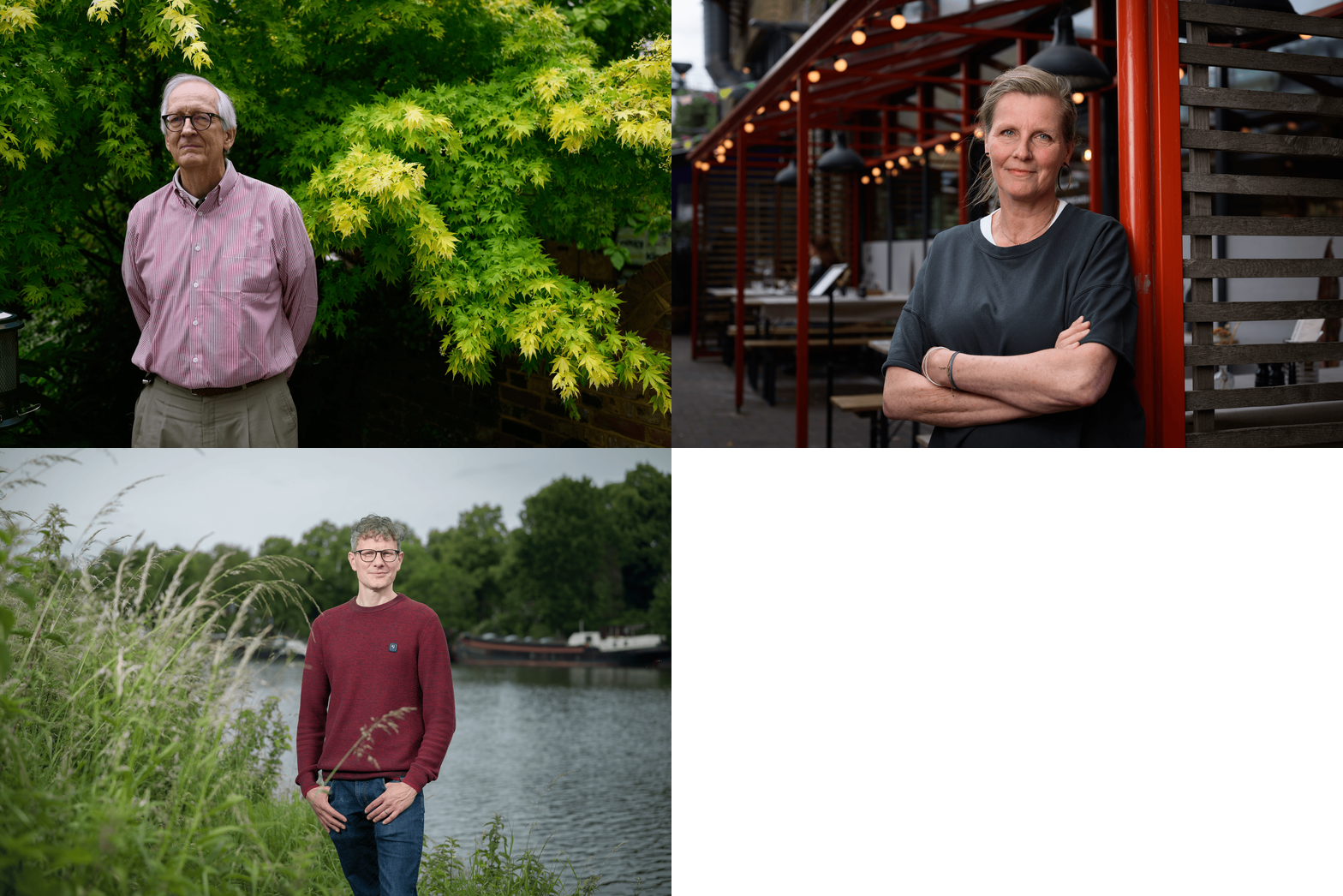
Patricia Trijbits opened her pancake restaurant in London shortly after the Brexit referendum. The UK’s exit from the EU resulted in a lot of extra paperwork.
Photo Justin Griffiths-Williams
Patricia Trijbits (57) from London‘Our mushrooms suddenly came from China’
A week before the Brexit referendum, Patricia Trijbits had signed the lease for the building where her pancake restaurant Where the Pancakes Are would be located. On the day of the referendum, her Dutch designers were on their way to London to measure and draw everything. “The next day we sat around the table and we had no idea what to say. We had no idea that Brexit would become such a turning point in changing the world order.”
In 2016, Trijbits had lived in London for seventeen years. Thanks to the free movement of people and goods within the European Union, things like work permits, visas or rules on import and export had never crossed her mind. “You never had to think about anything, everything was always possible.” At her first restaurant – near London Bridge, under a railway bridge – she was lucky that the British government still had to negotiate Brexit with Brussels. Things were different at the second branch in Battersea. She hired the same designers, but this time had to have everything made in England.
The first years after the exit we had to find what worked with all that extra paperwork, for example with suppliers of fruit and vegetables. “In the beginning we got mushrooms from China instead of the Netherlands, which I found difficult.” For her company it is important that everything comes from nearby: eggs from Cornwall, meat from Yorkshire. “Fortunately, things have now been straightened out. We get strawberries from the Netherlands when the British ones are not yet available.”
About a third of her employees are British, she estimates, and that would not have been different without Brexit. “Only then might the rest all have come from Eastern Europe. What I like most is that we now have a real mix. We have team members from countries such as Lithuania, India, Pakistan and Malaysia. A real enrichment.” Visas remain a problem. The rules change often and that creates uncertainty for employees.
Trijbits and her husband received permanent residence permits. After an initial rejection from the British Home Office, that is. “They made it very complicated and left it entirely up to us to provide evidence. Plenty friends were also rejected.” Their children have dual nationalities because they were both born in the United Kingdom. She and her husband do not because the Netherlands only allows dual nationality in exceptional cases.
Before the referendum, she had sometimes considered becoming British. “This is where I feel at home, what I call home, and then I could vote and contribute to society. But that feeling became very shaky after Brexit.” Despite all the disadvantages of Brexit and the high costs of daily life, people whine and complain less here than in the Netherlands, says Trijbits. “They take things as they are, life goes on. Like, Keep calm and carry on. That’s a bit exaggerated, but true.”
:format(webp)/s3/static.nrc.nl/wp-content/uploads/2026/06/22110705/230626BUI_2034083494_dolmans2.jpg)
Lawyer Maurits Dolmans saw the bureaucracy only increasing after Brexit.
Photo Justin Griffiths-Williams
Maurits Dolmans (66) from London‘Brexit only meant double work’
For Maurits Dolmans (66), Brexit was emotional and involved grieving. “It was an attack on my identity. It felt like a divorce or a death in the family.” That’s what you get when you’re a Europhile and an Anglophile at the same time, like him.
Dolmans studied law and chose a job in European law in the 1980s, out of full conviction of the importance of European cooperation: “This is one of the major political and legal projects of our time, I thought. They must be protected and further developed.” Now, forty years later, he still works for the same international law firm. This interview is in a personal capacity.
In 2010, Dolmans and his wife Erika moved to the London district of Hampstead, close to the famous heathland with sweeping views of the capital. “A very nice neighborhood, full of eccentrics. Everyone knows each other. There is music, there is theater, we have discussion groups.” Not a place where you spend much Leavevoters would expect. “Even here, some people turned out to be incapable of reason. They came up with nonsensical arguments about sovereignty, fishing, immigration. So I could already see the mood brewing.”
Together with his wife he took to the streets in 2016, campaigning for Remain. He a sign with “EU = Peace, prosperity, people and power“, she with a sinking ship with SOS letters. But the Remainers did it wrong, he says now. “We paid too little attention to identity. That you can be as English as you want within Europe.”
In his notebook, Dolmans has listed the consequences of Brexit for the competition law department of his office. In 2020, before the United Kingdom officially left the European Union, they had thirteen lawyers in their London department. Last year there were 28, more than twice as many. And that only because of Brexit: “It concerns mergers, takeovers and matters that now have to be checked in both England and Brussels. All of this is double work, without any benefit to society or the economy.”
For example, a few small sectors benefited from Brexit, while the British population only lost, says Dolmans. “Customs officials won, phytosanitary inspectors, lawyers. I say this to emphasize the irony, right? Everyone was talking about less red tape. Well, it’s more red tape become.” Not less, but more bureaucracy.
Nigel Farage is reaping the benefits of his own mismanagement
In their neighborhood, Brexit is no longer a topic. “In such a polite society as here, you don’t talk about it anymore. And they say: we already have enough divisions in society, with Nigel Farage and so on.” That’s the sour thing, he thinks, Farage campaigned for Brexit and against the free movement of people within the EU. Now he is popular again, by agitating against immigration from continents other than the EU. It rose after the borders with the EU closed. “He is reaping the benefits of his own mismanagement.”
Dolmans has now processed his trauma. He does not think that rejoining the EU is realistic for the UK for the time being. “It continues to muddle along.”
:format(webp)/s3/static.nrc.nl/wp-content/uploads/2026/06/22110834/230626BUI_2034083494_klaveren2.jpg)
Henk van Klaveren, who had lived in the United Kingdom since 2004, suddenly felt like an outsider due to the Brexit referendum.
Photo Merlijn Doomernik
Henk van Klaveren (40) from Utrecht ‘Suddenly I was the other, the outsider’
For Henk van Klaveren (40), something already changed during the campaign for the Brexit referendum, even before the result. Suddenly, he says, “I was the other,” an outsider. He had always taken his place in the United Kingdom, as a Dutchman, for granted. He had been there since 2004, when he came to Glasgow to study.
When he returned to the Netherlands in 2022, to a residential area in Utrecht, he came with a partner from Scotland, Struan Campbell (39), a British twin, and British nationality. Not because he wanted that nationality so much, but because he had to.
Of course he hadn’t planned to stay that long, but that’s how it turned out. After his studies, he went to work in parliament for the Liberal Democrats, “the British sister party of D66 and the VVD”. “People from the Netherlands often asked me: gosh, you work in parliament there, how is that possible?” But he was not the only foreigner there, that is what he liked about the UK: “It doesn’t matter who you are, where you come from. The attitude was: you speak English, you want to participate, come join.” There were also Americans walking around, he had a German colleague. Sure, it was partly British politeness, he says, but “you’re unlikely to feel unwelcome.”
Until that obviousness disappeared. He wanted to get involved in the referendum campaign, but he did not think it was appropriate. “To campaign for Europe there as a European, I thought: this would come across better if it came from the British.” He also had no right to vote in the referendum. But when he heard how some politicians talked about the EU, he thought: “What are you talking about?”
He knew he had to take British nationality when they decided to exchange their rental house in London for a home in the Netherlands. They went to his home country because the children there “have more independence than they could ever have had in the UK.” Because they can play in the street and walk to friends in the neighborhood. Because what if the children couldn’t settle in? What if they wanted to return a few years later, or after a while, if his parents-in-law became indigent? Then it would become too complicated to have to get a temporary visa every time, or to have to go through the time-consuming process of obtaining a residence permit.
He received his citizenship during a very British ceremony, during which he had to pledge allegiance to the late Queen Elizabeth. In some ways, he says, that was an experience. “On the other hand, I also thought it was a shame,” because it was necessary to continue his bond with the country.
Suppose the Netherlands and England were to face each other at the Football World Cup, then his children would be in favor of England, they said recently. They were seven years old when they moved. “They are just English children who happen to be in the Netherlands now.” But they are, he sees, “becoming more and more Dutch”.
Also read
How Brexit is affecting the village of Meriden: everyone is still in their Brexit camp
:format(webp)/s3/static.nrc.nl/wp-content/uploads/2026/06/15115825/190626WEE_2032153257_8.jpg)