Bekim Fehmiu as the most successful Albanian actor in world cinematography was commemorated by 15 people in Prizren on Monday afternoon. The memory and honor of his contribution is fading every year. The central institutions do not even deal with this issue, despite the signs of initiatives. But those who faithfully remember it are concerned with the fading of this activity
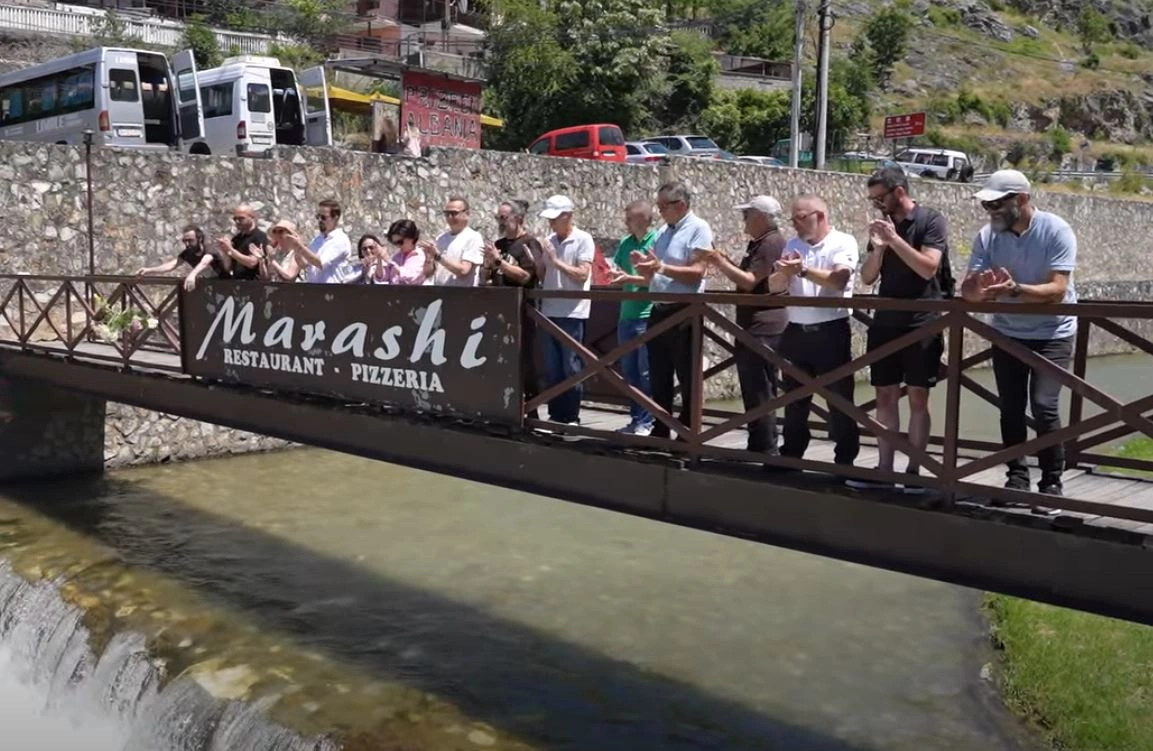
The throwing of flowers in Lumbardh and the applause marked the 16th anniversary of Bekim Fehmi’s death. Fehmiu as the most successful Albanian actor in world cinematography was commemorated by 15 people in Prizren on Monday afternoon. The memory and honor of his contribution is fading every year. The central institutions do not even deal with this issue, despite the signs of initiatives. But those who faithfully remember it are concerned with the fading of this activity.
Actors and another part of the staff of the city theater “Bekim Fehmiu” in Prizren and some citizens joined at noon on Monday on the bridge of Marashi. Through the activity “A flower for Bekim Fehmi” they marked the 16th anniversary of the actor’s death. They have honored the life, work and creativity of the world-renowned Albanian actor. The initiative of the staff of the City Theater named after Fehmi is weaker every year.
“This form is not accidental. I say this as one of the originators of this event. This was born out of the impossibility of participating in the funeral of Bekim Fehmi… That year we invited the citizens to pick flowers in their gardens and honor him by throwing them into the river…. A significant symbolism that unfortunately is fading…” said Prizren actor Xhevdet Doda.
The director of the “Bekim Fehmiu” theater, Burim Mustafa, told the local media that for many years the theater has been remembering Fehmiu by inviting the community and citizens to honor him with flowers that they bring from their yards.
“For us, participation is not satisfactory. We constantly try to remind him and not forget his values and contribution. We need a greater awareness for people who have contributed to art and culture”, he said.
Bekim Fehmiu died on June 15, 2010 in Belgrade. His bequest was that his ashes were brought from Belgrade in an urn to be thrown in Lumbardhi of Prizren, which is also his city. Then the state launched various initiatives. The last one was five years ago.
On the first day of June 2021, the Ministry of Culture had organized an event. The ceremony of awarding the national award for lifetime achievement to cinematographer “Bekim Fehmiu” was moved from the cabinet of the Minister of Culture, Hajrulla Çeku, to “Kino Armatë”. There, the institutional leaders, led by Prime Minister Albin Kurti, had shown that the state will turn its head from the creativity of the unparalleled actor in these parts. But in reality, the derivative so far is just a list of proposals to document the activity of Bekim Fehmi, which has remained in the drawers of the Ministry of Culture. The process has not progressed further, as is likely with many other cultural initiatives that the Government presents with pomposity.
On the 85th anniversary of the birth of world-renowned Albanian actor Bekim Fehmiu, Prime Minister Albin Kurti summarized the biography of the artist from Kosovo. But it had gone even further.
“The Government of Kosovo together with cultural institutions will carefully curate an annual and permanent program in honor of Bekim Fehmi”, he said. But five years later, let alone that there was no “annual and permanent program”, nor was the “Bekim Fehmiu” prize awarded, the only symbol with which the government honored the actor once a year.
On the day of great promises, it was announced that the then Minister of Culture, Hajrulla Çeku, has made a decision to appoint a working group for the drafting of the state plan for honoring, protecting, documenting and promoting the activity of the world-famous Kosovar actor. Fadil Hysaj, Milazim Salihu, Fahri Musliu, Melihate Qena, Agon Fehmiu, Vlora Nikqi, Jehona Shyti, Bislim Bislimi, Ilir Gjocaj, Lum Çitaku and Burim Susuri, were members of the working group.
At the end of 2021, this group would propose to the Ministry of Culture to establish the cinema of Kosovo, “Bekim Fehmiu”, part of which will be the Bekim Fehmiu Pavilion, an international student film festival and the corporal “Bekim Fehmiu”, the English translation of the autobiographical volumes “Splendor and Horror” and also the monograph “Bekim Fehmiu – Odysseus of Kosovo”, with the author veteran journalist, Fahri Musliu. It was then proposed that the Presidency award the highest post mortem state decoration to Bekim Fehmi, a foundation named after the actor that would support the education of students abroad, as well as the showing of films starring Fehmi on public television, including “Odyssey”.
But the group had never received an answer. The Ministry of Culture has not responded to TIME’s questions about the initiative to document the activity of the actor with nam.
At the 2021 ceremony, the film “Feather Collector” directed by Aleksandar Petrovic, winner of the “Grand Prix” award at the Cannes Festival, 1967, was shown. With Bekim Fehmi as the main protagonist (Beli Bora), the film revealed the tensions of a Roma community, where a local feather seller falls in love with a much younger girl.
Bekim Fehmiu was born in Sarajevo, on June 10, 1936, from a well-known Gjakova family, while he spent his childhood in Prizren. He became famous in 1966 precisely with the film “Feather Collectors” and then enriched his career with films such as: “The Adventurer”, “Red and Black”, “Odysseus” and “Forever Julia”, performing in several languages and alongside the greatest artists of the time. In 1987, Fehmiu demonstratively left the show “Madame Kolontine” by Anete Playel, where he played Lenin and Stalin, saying goodbye to artistic activity in Yugoslavia.
In 2010, he had committed suicide in his apartment in Belgrade, while his wife Branka Petriq, together with his two sons, Uliks and Hedon, and other family members, had brought the bequest of the deceased actor to the place by throwing his ashes in Lumbardhi of Prizren.