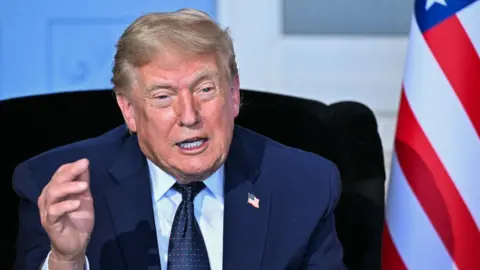
The President of the United States, Donald Trump, has announced that the preliminary agreement between Washington and Tehran to end the conflict in the Middle East has already been signed, while the official signing ceremony is expected to take place on Friday in Geneva.
The news was made public during the G7 summit in France, where Trump declared that the document has been completed and is an important step towards reducing tensions in the region. According to him, the agreement is a strong document that aims to end a long period of clashes between the United States and Iran.
American sources report that the agreement was signed electronically by President Donald Trump, Vice President JD Vance and the Speaker of the Iranian Parliament. However, its full text has not yet been made public, leaving open many questions about the content and details of the commitments made by both parties.
US Vice President JD Vance himself has stated that the memorandum of understanding is relatively short and contains only the basic framework of the agreement. According to him, most of the important issues will be resolved during the technical negotiations that will take place in the coming weeks.
One of the main points of the agreement is related to the Iranian nuclear program. Washington wants verifiable guarantees that Tehran will not develop nuclear weapons, while Iran wants sanctions relief and a gradual return to normal economic relations.
According to the information published so far, the agreement envisages the end of the US naval blockade of Iranian ports, the reopening of the Strait of Hormuz and the start of a 60-day period of intensive negotiations to reach a final agreement.
The Strait of Hormuz remains one of the most important elements of the process. This sea route is considered vital for global energy trade, as a large part of the world’s oil exports pass through it. However, there is still no full clarity on how the navigation regime will work in the area, as there are different interpretations between American statements and Iranian positions.
The US administration has announced that any lifting of sanctions or the release of frozen Iranian funds will depend on the fulfillment of obligations that Tehran undertakes during the negotiation process.
On the other hand, the Iranian authorities have welcomed the agreement as a result of long negotiations conducted with the mediation of Qatar, but have emphasized that mistrust of the United States remains high. According to Tehran, the agreement represents only a first step towards reducing tensions and not the final solution to the disputes between the two countries.
The developments have sparked reactions in Israel as well. Prime Minister Benjamin Netanyahu stated that Israel will not under any circumstances allow Iran to acquire nuclear weapons and stressed that, although it cooperates closely with the US administration, it does not necessarily agree with every aspect of the deal.
Netanyahu also made it clear that Israeli forces will continue to remain in areas Israel considers strategic to its security, including parts of Lebanon, Syria and Gaza.
Meanwhile, tensions on the ground have not completely subsided. New military incidents have been reported in southern Lebanon, while Hezbollah has announced rocket and drone attacks against Israeli targets. American authorities have clarified that the ceasefire included in the agreement does not automatically mean the withdrawal of Israeli forces from Lebanese territory.
The agreement has also received support from European leaders. Great Britain, France, Germany and Italy have declared that Iran should never acquire nuclear weapons, but at the same time have left open the possibility of easing sanctions if Tehran takes concrete and verifiable steps.
British Prime Minister Keir Starmer described the development as a very important step towards stability in the Middle East and towards restoring security in one of the most tense regions of the world.
As the official signing ceremony approaches, the attention of the international community is focused on the negotiations that will follow. Many analysts estimate that the real challenge will not be the signing of the document, but its implementation and the ability of the parties to maintain the agreement in a region where balances remain extremely fragile.