Saturday, May 2, 2026 10:53 AM –
Jerusalem time

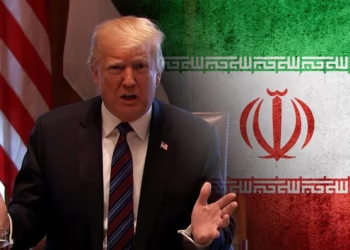
US President Donald Trump faces an increasing political and military impasse more than two months after the outbreak of the confrontation with Iran, as the operations did not result in any clear diplomatic or military victory. Washington finds itself facing an open conflict that threatens global stability and increases the complexity of the American domestic scene ahead of the midterm congressional elections.
Despite the confidence that each party is trying to express, the gap between Washington and Tehran is still wide, as Trump recently rejected a new Iranian proposal for calm. The White House insists that any agreement must begin by radically addressing the nuclear issue, which is rejected by Tehran, which demands an end to the conflict first before returning to the nuclear negotiating table.
Reports indicate that the continuation of the crisis has cast a heavy shadow on the American economy, especially with gasoline prices rising to record levels exceeding four dollars per gallon. This rise in turn led to a sharp decline in Trump’s popularity to 34%, which puts the Republican Party in an awkward position before voters next November.
At the field level, the American and Israeli air strikes failed to achieve the major strategic goals announced by Trump, most notably regime change or complete paralysis of nuclear capabilities. Despite the weakening of Iranian military power, Tehran still maintains its ability to threaten global energy corridors, especially the Strait of Hormuz.
Sources reported that Tehran sent a modified proposal through Pakistani mediators, which led to a temporary calm in global oil markets that witnessed severe turmoil. However, Trump expressed his dissatisfaction with the offer, noting that phone calls continued without reaching a formula to end the current stalemate.
Experts in Middle East affairs believe that the failure to regain control of the Strait of Hormuz represents a strong blow to Trump’s political legacy. The waterway, through which a fifth of the world’s oil flows, has become a strategic weapon in the hands of Iran, which it uses to put pressure on the international community and raise the cost of the war on the United States and its allies.
On the other hand, White House spokeswoman Olivia Wells confirms that military and economic pressures are beginning to bear fruit and pushing Iran toward despair. The US administration claims that Trump has all the winning cards to conclude the “best agreement,” despite field indicators that suggest the opposite, as the Iranian challenge continues.
People will remember Trump as the American president who made the world less safe with this unresolved conflict.
Leaks from within the White House indicate that Trump is considering escalatory options, including imposing a prolonged naval blockade on Iranian oil exports. This approach aims to completely strangle the Iranian economy and force the new leadership, dominated by the Revolutionary Guards, to yield to American demands related to the nuclear program.
On the other hand, the US Central Command has prepared plans for “short and strong” military operations aimed at seizing vital parts of the Strait of Hormuz to reopen it to navigation. These moves come in light of escalating tension with European allies who criticized Washington’s exclusivity in making the decision to go to war without prior coordination with them.
Strategic analysts believe that Iran has emerged from the current confrontation with a new awareness of its power, as it has proven its ability to disrupt global energy supplies even in a state of military weakness. This realization makes Tehran bolder in its future negotiations, as it realizes that the weapon of ‘stifling the Strait’ will remain effective in its hands.
Regarding the nuclear file, doubts still remain about the success of the air strikes in destroying the stockpile of highly enriched uranium. Intelligence services believe that large quantities of nuclear materials are still hidden in fortified underground facilities, which means that the path to possessing a nuclear weapon has not been completely closed, as the White House claimed.
At the regional level, the war did not succeed in reducing the influence of groups allied with Iran in Lebanon, Yemen, and Palestine, as these forces continued their military and political activity. US Defense Secretary Pete Hegseth denied that the conflict had turned into a ‘quagmire’, despite the fact that the time period that Trump expected for a resolution had exceeded.
There is a state of concern among European diplomats and Gulf states about the possibility of Trump accepting a “flawed” agreement at a moment of internal political pressure. They fear that any unilateral American withdrawal would lead to Iran declaring a strategic victory that would strengthen its position as a dominant regional power despite the human and material losses it has incurred.
In conclusion, it seems that the war is heading towards a “frozen conflict” scenario that drains American resources and prevents Washington from reducing its military presence in the region. As the hard-line Iranian leadership adheres to its positions, the bet on the time factor remains the main driver for Tehran, which hopes to exhaust Trump politically until the end of his term.