Saturday, May 2, 2026 1:38 pm –
Jerusalem time

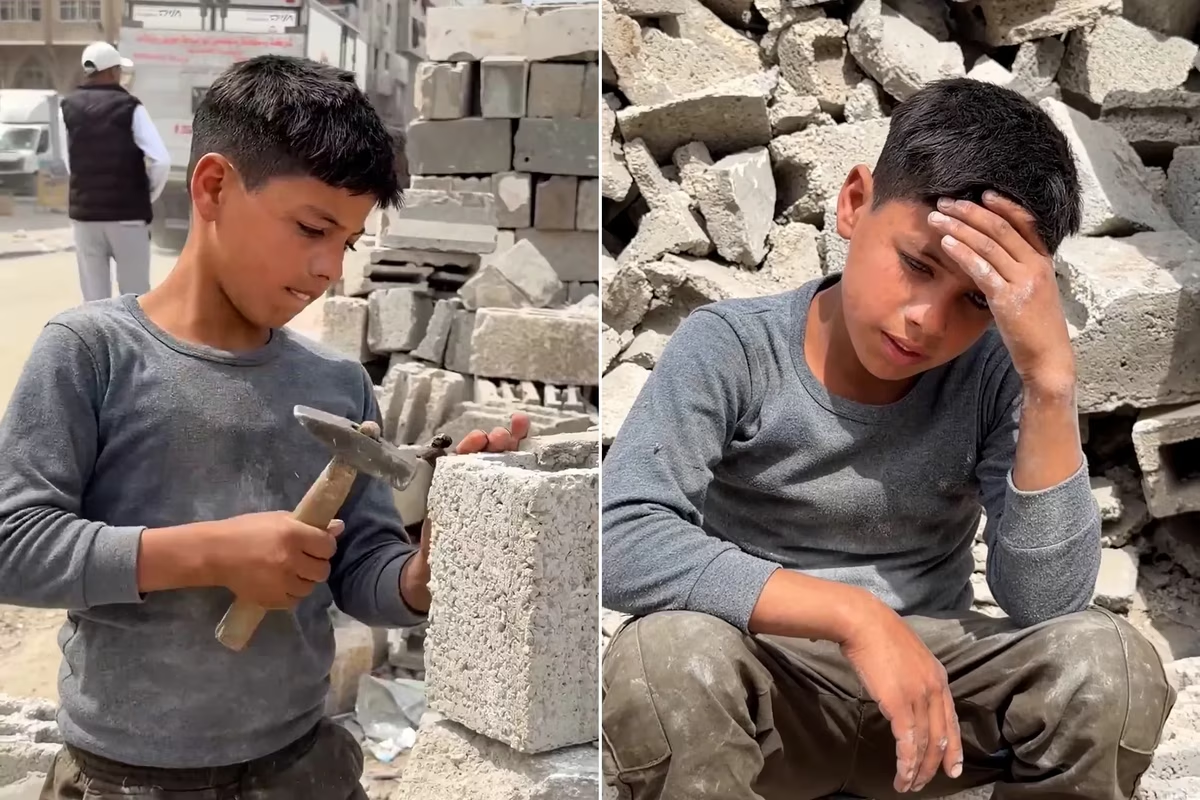
The child, Hassan Saad, who is only ten years old, found himself forced to play the role of head of the family overnight, as he became primarily responsible for supporting nine individuals in the Gaza Strip. In light of the war, which has entered its thirtieth month, there is no longer a place for a normal childhood, as Hassan spends his days among piles of rubble and rubble in search of a living.
Hassan’s daily mission is to move between the destroyed neighborhoods of Gaza, such as Al-Shuja’iya and the Al-Zaytoun neighborhood, to collect what can be repaired in terms of stones and bricks resulting from the bombing that affected 90% of the buildings in the Strip. The child uses his hammer and chisel to clean the stones of cement residue, in preparation for reusing them in primitive and temporary construction operations.
In return for this hard effort, which drains his little energy, Hassan receives a small wage that does not exceed 20 shekels a day, an amount that is barely enough to cover his family’s livelihood in light of the wave of excessive prices hitting the markets. The child confirms that this work is not appropriate for his age, but the absence of an alternative and the extreme need pushes him to continue despite the physical dangers facing him.
His mother, Yousra Saad, speaks bitterly about her son’s condition as she pours water on his head to relieve the scorching heat of the sun to which he is exposed for long hours. The mother says that what Hassan receives is the only income for the family, noting that she lives in a constant state of anxiety for fear of heavy stones falling on his thin body.
Hassan suffers from chronic back and head pain as a result of the heavy loads he carries on his small shoulders to the trucks. He has already suffered several injuries and fractures in his hands and feet. The child describes his suffering, saying that he finds it extremely difficult to sleep because of the pain that afflicts his body, stressing that these arduous tasks are intended for adults, not children.
This work is not for children like me, but for adults. I sleep with difficulty and complain of pain throughout my body.
The tragedy is not limited to Hassan alone, but extends to the owners of destroyed homes who are forced to sell the stones of their demolished homes to secure the price of food and drink. The child pities these people who face miserable conditions, considering that everyone in Gaza has become hostage to a bitter reality imposed by the war machine that has been going on for two and a half years.
Hassan’s family lives in a dilapidated tent with water leaking into it, which increases the child’s determination to continue working despite physical and psychological fatigue. The mother says that the harsh conditions left them with no other choice: either hard work or hunger in light of the lack of sufficient aid and the destruction of the economic infrastructure of the Strip.
Despite all this trouble, Hassan still dreams of returning to school and living in safety and peace like the rest of the children in the world, away from the noise of hammers and the weight of stones. The little boy hopes that this war will end so that he can return to his normal life, where he can sleep without pain and wake up to go to school instead of the rubble sites.
Hassan’s story comes in a broader tragic context, as data from the Palestinian Central Bureau of Statistics indicate that more than 18,500 children have been killed in the Gaza Strip since the start of the aggression. Forced child labor is one of the harshest repercussions of the war that deprived an entire generation of their basic rights to education, protection and a decent life.