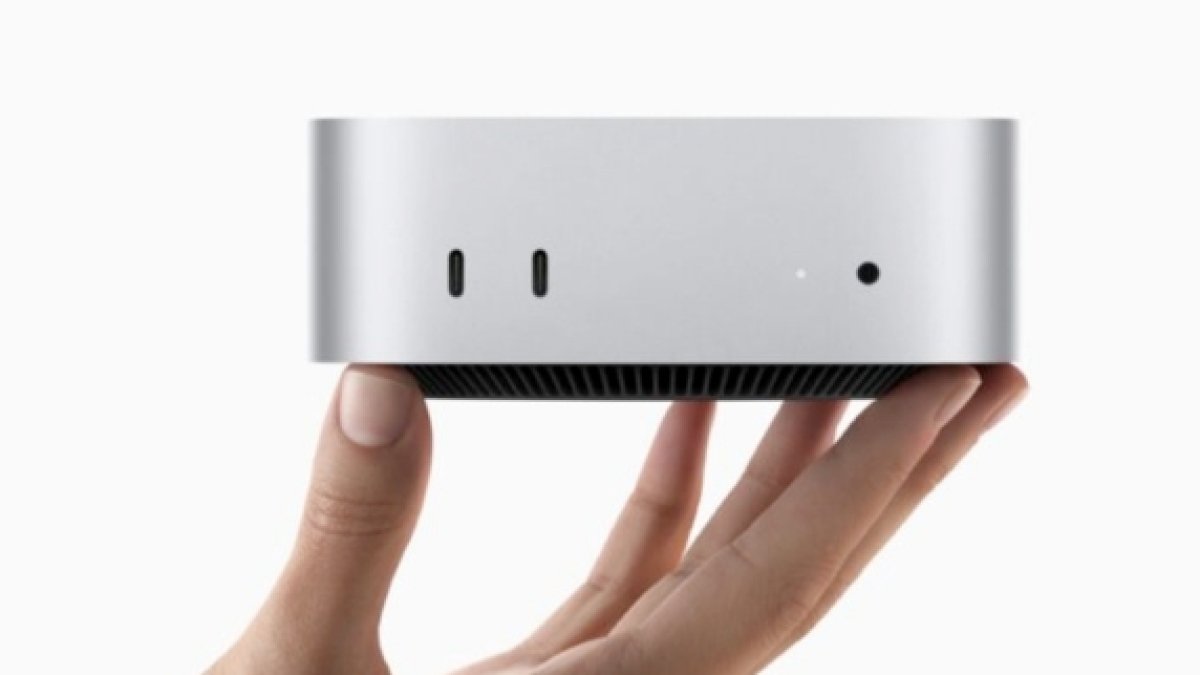
It happened without announcements, without press releases. At a certain point, browsing the official website, the Mac Mini with 256 gigabytes of storage stopped existing. It is no longer on sale, it no longer appears in the configurator, it is no longer among the available options. In its place, as the obligatory starting point, there is now the 512 gigabyte version, the one that until a few days ago already represented the basis for the model with the M4 Pro chip. The consequences on the price are immediate and far from negligible. Until a few days ago, the Mac Mini with M4 chip it could be purchased in Italy starting from 729 euros. Today, to take home the most compact computer in Cupertino, you need to put at least 979 euros on the table. A jump of 250 euros which, in percentage terms, corresponds to an increase of over 34 percent on the entry price. It is not a small change, especially for a product that had conquered a segment of the public attentive to the quality-price ratio.
A spring déjà vu
Who closely follows the moves of Apple he had already witnessed something similar a few weeks earlier. In March 2026 it was Mac Studio’s turn to suffer the same treatment: the starting configuration had been redesigned, the lower storage denominations had disappeared from the price list and the minimum price had risen accordingly. Two different products, the same logic: fewer SKUs available, fewer variants to manage, and a simplification of the offer which however translates into a greater outlay for the buyer.
In light of what happened before with the Mac Studio and now with the Mac Miniit’s hard not to read an overall strategy, rather than two isolated decisions. Apple is evidently recalibrating its offerings for compact desktop computers, and it’s doing so at a time when these products have become more than just desktop machines.
The key to understanding this decision is to be found in the words of Tim Cook. During the conference call on the results of the second fiscal quarter 2026, the outgoing CEO of Apple (now close to passing the baton to John Ternus) had sent out a signal that perhaps had not received all the attention it deserved at the time.
«We believe that, looking ahead, it may take several months for the Mac Mini and the Mac Studio achieve a balance between supply and demand,” Cook said. And he explained why: «Both are excellent platforms for AI and agency tools, and customer recognition of this value is happening faster than we anticipated. This is why we recorded higher-than-expected demand.”
It’s a statement worth analyzing carefully. Cook wasn’t talking about a particularly successful quarter or a successful promotional campaign. He was describing a scenario in which demand had taken an unexpected direction, driven by a use of Mac minis that Cupertino itself had not fully anticipated. The M-series chips, with their ability to process language models directly locally, transformed these computers into something other than what they were designed for in the minds of Cupertino’s product managers.
OpenClaw and the new era of agent computing
To understand the extent of the change, you need to look at the ecosystem that has developed around the Mac Mini over the last year. Tools such as OpenClaw (an AI agent that runs directly on macOS and allows you to automate complex tasks by exploiting locally running language models) have found the ideal platform in the Mac Mini. The relationship between performance, energy consumption, silence and price made it almost naturally predestined to become a domestic or small office “AI node”. It is not a niche phenomenon. Thousands of users, including enthusiasts, developers and professionals who want to experiment with artificial intelligence without resorting to cloud services, have purchased one or more Mac minis specifically for this purpose. Some use them as local servers for models like LLaMA or Mistral, others integrate them into automation pipelines, still others combine them with solutions like Perplexity’s Personal AI Computer, which aims to transform macOS into a permanent operational assistant.
In this context, the choice of storage configuration is not trivial. At 256 gigabytes, space for language models and working data runs out quickly. The jump to 512 gigabytes, therefore, is not just a “range” upgrade in the traditional sense of the term: in many real-world use scenarios, it represents a significant practical difference. And Apple knows it.
However, the disappearance from the official Apple list does not mean that the Mac mini with 256 gigabytes is already unobtainable. At least for now, and at least until stocks run out in the warehouses of third-party retailers, those who still want to purchase the original configuration can do so through independent sales channels.
On Amazon Italyfor example, at the time of writing the 256 gigabyte Mac Mini M4 it is still available for 689 euros, a price even slightly lower than the one it had on the Apple website before the withdrawal. Other authorized resellers may also still have units available, at least in the coming days or weeks, as long as supplies hold.
It’s a temporary window, and anyone interested would do well not to wait too long. Once these drives run out, the 256 gigabyte version will definitely become a thing of the past, at least in the new market. For those who have smaller storage needs or simply don’t want to spend almost a thousand euros on the access model, this could be the last opportunity available.
Each review is independently edited by the editorial staff. If you make a purchase through our links, Corriere della Sera may receive a commission. Read more