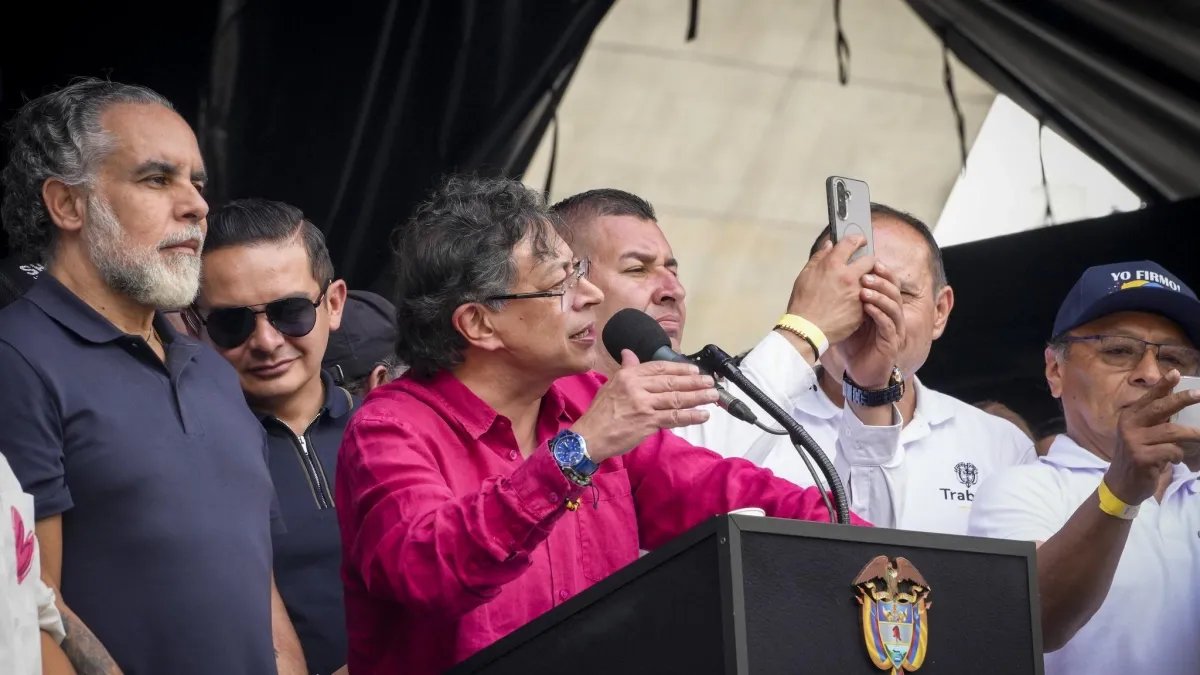
Although the presidential candidate of Ivan Cepeda (Historical Pact) maintains that it does not seek the convening of a National Constituent Assemblye, several facts have already raised doubts about whether this refusal is real: President Gustavo Petro himself, the head of this political project, gave it his signature, promotes it and even asked citizens for money so that in three months five million signatures can be gathered; In several political events of his campaign, people have been seen with forms and pens in hand and in the recent speech he gave from the Plaza de Bolívar he pointed out that it is time to “be constituent power“.
After the Government’s support for the Constituent Assembly was made official, the number of people gathering signatures increased in the streets, as the head of State maintained that at least minus five million by July 20the date on which he hopes to file this initiative before Congress to close his period in power with a tough bet.
This presidential support for reforming certain things in the 1991 Constitution, although it has generated a wave of reactions and questions, would have the purpose of awakening a certain emotion in the bases to seek victory in the first presidential round on May 31, since in the second round, say those close to the campaign, things could get complicated. But today, according to all the polls, the second round is a reality.
President Gustavo Petro from Medellín. Photo:Presidency
Several militants had been unofficially recognizing that Cepeda’s campaign did not provoke the same emotion as Petro’s in 2022 and that therefore a flag was needed that would make the electorate vibrate.
The move has been rejected by the majority of candidates, who do not see it convenient to take the country to a constituent process in the middle of the elections and close so that the current Political Charter is applied.
“The Constitution cannot be a weapon of electoral war. We will respect it, President. Don’t have the slightest doubt,” said Sergio Fajardo.
Paloma Valencia was another of those who spoke out against: “Petro believes that Colombia’s problems are solved with a new constitution. No sir, Colombians do not need paper solutions but someone to govern and solve their needs.”
And Abelardo de la Espriella spoke in the same tone, calling the proposal “a horror that we are not going to tolerate.” “The Constitution cannot be changed,” said the candidate, who pledged along with his vice presidential formula “to defend the 1991 Constitution.”
But it is not only a question of the presidential campaign and several analysts see this process as a way to play in the long term in anticipation of an eventual defeat of the left at the polls.
“One of Petro’s big lies during the campaign was that he would not change the 1991 Constitution, but they even opened a bank account. The Constituent Assembly is a plan A and a plan B and Cepeda has said it without blushing, although in principle he sold it as a social dialogue,” says analyst Carlos Arias.
Cepeda, in fact, has emphasized that he is really looking for a National Agreement led by the former Minister of the Interior. Juan Fernando Cristowho precisely landed in his presidential campaign to distance him from the constituent ghost and bring him closer to the political center. With complete confidence, the former Petro official has said on several occasions that the Constituent Assembly is a past issue and that the National Agreement is a real possibility, although he has been shipwrecked in his search during his period in the Home Office.
Furthermore, the Green Alliance Party joined Cepeda’s candidacy with the commitment that he would not support any type of reform to the 1991 Constitution and that, on the contrary, he would defend it and would not seek the extension of his mandate if elected president. Just days later, at a campaign event for the Greens and Petrism, several people gathered signatures, and although the party said it was an isolated case, it stated that the militants are free to support it as citizens.
Alianza Verde officially joined Iván Cepeda’s campaign. Photo:Historical Pact
Apparently, as some sources close to the campaign say, if he wins, Cepeda hopes to fulfill his promise of first trying the paths of the National Agreement, but he would not want to distance himself from the Constituent Assembly in the middle of the campaign to avoid clashes and discomfort with President Petro.
Because the Constituent Assembly, in addition to oxygenating Cepeda’s campaign, which had only just begun to open up to media interviews and to test the terrain of a possible debate, would be a way to keep the leftist project in force and seek the consolidation of the reforms that were not approved in these four years.
“They are really looking for the Constituent Assembly. It is a political project, not just a campaign strategy, since they have been proposing fundamental changes in the power structures for four years. The political project of the Colombian left includes a change of rules to seek majorities that allows them to implement their vision of the State and that involves a Constitution tailored to them,” comments Gonzalo Araujo of the Orza firm.
Petro has mentioned that the Constituent Assembly is the only way for social reforms to be carried out in the face of the refusals and delays of Congress and the Constitutional Court. He said that although he is not seeking profound changes for the Carta Marga, he hopes that the health and pension reforms can be carried out and that the ‘vital’ minimum wage is maintained.
The president insists on the reforms amid the delays of the Constitutional Court to give the green light to the pension and after Congress has already denied the health one on two occasions and his appeal is still pending.
However, the president, who in his speech on May 1 attacked Congress, ignores that it approved two of his three main reforms and the health law can still be revived. The blockade of the Legislature that the president speaks of lacks support considering that the labor reform, which is already a reality, and the pension reform, today in the hands of the Constitutional Court due to procedural defects, were approved.
Likewise, the head of state mentioned that he will seek with the Constituent Assembly a reform to the political and judicial system “that corners corruption in Colombia.”
“The greatest penalty in the penal code should be acts of corruption without any type of release,” said President Petro, who has had to deal during his government with the scandal over the looting of the UNGRD in which several of his officials ended up being harmed, including those Carlos Ramon Gonzalezwho remains a fugitive and would have been helped by the current administration to take refuge in Nicaragua.
In addition to the UNGRD, several statements were made by the former director of DAPRE and current director of the Adaptation Fund, Angie Rodríguez, about schemes to keep the entity’s resources. The official also indicated that she would have directly warned the president about the false title that Juliana Guerrero, who was going to be appointed as vice minister of Equality, would have.
Today President Petro wants to champion the fight against corruption in that constituent when this is one of the great moles of his government.
In any case, Cepeda’s campaign could end up approaching the Constituent Assembly more directly, while Petro will continue in his bid to maintain his project and perhaps his presence in national politics after leaving the Casa de Nariño.
But it will not be an easy issue, because in addition to the skillful signatures that are required, the convocation of a Constituent Assembly goes through other extensive phases that require consensus. If the promoting committee achieves millions of signatures, with the direct support of the Casa de Nariño, the measure will then be in the hands of Congress, a corporation that is very at odds with the left and that by 2026 was divided between the two extreme political shores.
LAURA CATALINA PERALTA GIRALDO
Political Writing.