FOCUS SHIFT:
Taiwan should prepare for the US’ post-war policy shift by building missile stockpiles and expanding cooperation with Japan and the Philippines, a panelist said
-
By Fang Wei-li / Staff reporter
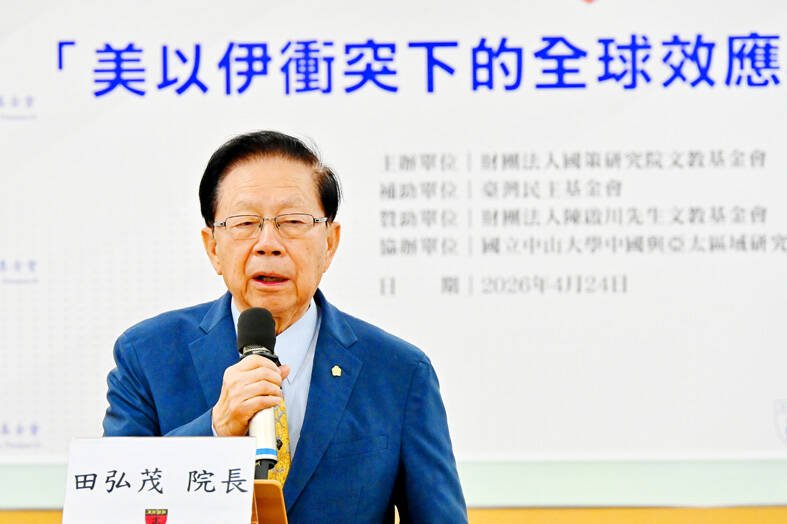
Following the Iran war, the US’ postwar strategy would shift focus to the Americas and Indo-Pacific region, with Taiwan’s importance set to rise rather than decline, Institute for National Policy Research president Tien Hung-mao (田弘茂) said.
Tien made the remarks at a seminar titled “The Global Impact of the US-Israel-Iran Conflict and Taiwan’s Security” hosted by the institute in Taipei yesterday.
In the post-war period, the US would inevitably need to shift its strategic focus to two regions: the Americas — where it would also need to address issues involving Canada — and the Indo-Pacific region, where relations with China require particular attention, he said.
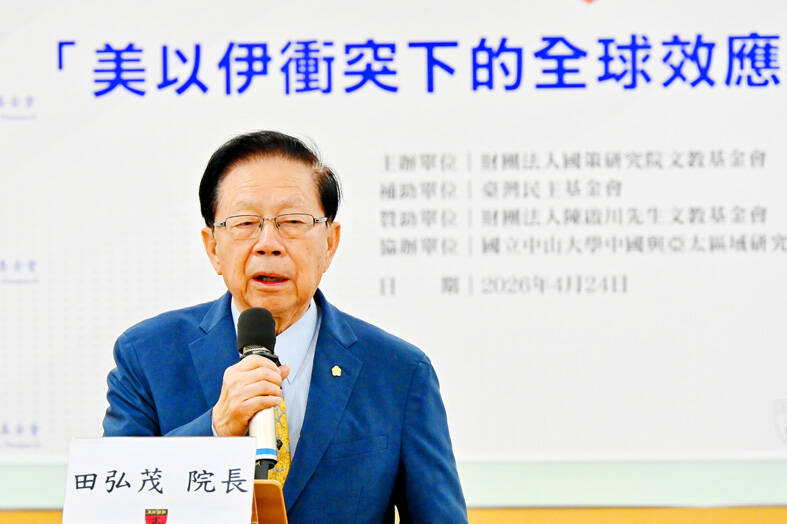
Photo: George Tsorng, Taipei Times
Within this broader global realignment, Taiwan’s strategic importance is likely to grow rather than diminish, he added.
If the US and Israel were to join forces to neutralize Iran’s ability to wage future conflict, Iran-backed militant groups across the Middle East would likely also be dismantled, he said, adding that such an outcome could pave the way for improved relations between Arab states and Washington, reducing the need for the US to keep a strong strategic focus on the region.
Former US Department of Defense official Tony Hu (胡振東) at the same seminar said the US in the first month of the war reportedly used more than 1,000 JASSM-ER stealth missiles and 850 Tomahawk missiles, while only 150 Tomahawks are slated for procurement this fiscal year.
In 2020, the US purchased just 396 JASSM-ER missiles, highlighting that the rate of consumption far exceeds replenishment, he said.
As for whether this would affect Taiwan’s national security, he said that the US Indo-Pacific Command maintains its own war reserves, and that the Iran conflict has limited direct impact on security in the western Pacific.
Taiwan should draw lessons by bolstering energy resilience, increasing on-island ammunition stockpiles and building hardened protective shelters, he added.
Institute vice president Kuo Yu-jen (郭育仁) said that more than half of the US’ rationale for striking Iran is directed at China, with the aim of cutting off China’s access to cheap oil from Iran and Venezuela.
The US is unlikely to launch a ground war lightly, as it would shift its strategic focus back to the Middle East — something that is highly significant for Taiwan, he said.
As for implications for Taiwan, Kuo said that Taiwan’s natural gas and strategic fuel reserves cover far fewer days than Japan’s.
Beyond diversifying supply sources, the precision munitions the US expended in just two weeks cost as much as US$17 billion.
Taiwan should take the opportunity to expand its own missile stockpiles and make use of the US FY2026 National Defense Authorization Act, which allows Taiwan to manufacture precision munitions for the US military, Kuo said.
Former National Defense University Political Warfare College dean Yu Tsung-chi (余宗基) said the US’ effort to deal with Iran is aimed at China and Russia, and could indirectly help bring about a collective defense framework in Asia similar to NATO.
Military exercises such as the US-Japan Keen Sword and Keen Edge drills are intended to deter China and advance the development of such a mechanism in Asia, he said.
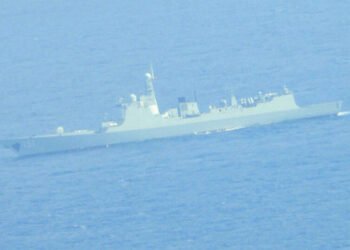
He also cited the Japanese government publicly dispatching a destroyer through the Taiwan Strait last week as a signal of its commitment to the principle that a Taiwan contingency is a Japan contingency, and its corresponding military preparedness.
Taiwan should seize the opportunity by shifting international dynamics to expand cooperation with the US, Japan and the Philippines in areas such as drones and artificial intelligence, he said.