By the afternoon of this Tuesday, May 5, the Government had announced a few days ago that the President Gustavo Petro I would be on the campus National Universityin Bogotá, for the delivery of the new building of the Faculty of Arts. This announcement was enough to unleash a wave of reactions and events of all kinds that reflect the state of agitation and nonconformity that reigns in the most important public university in the country, especially since two years ago the Executive had a relevant role in the election of Leopoldo Múnera as rector (a decision that was declared illegal in different judicial instances).
READ ALSO
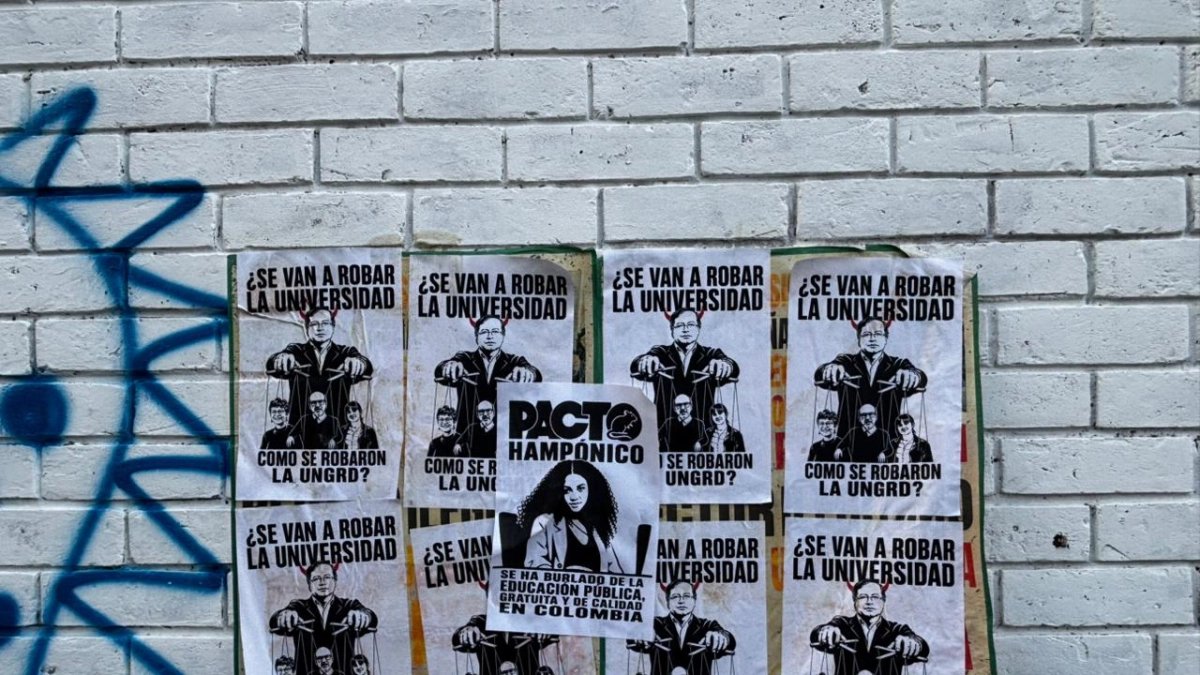
From very early on, Different buildings at the Bogotá Headquarters were decorated with banners and posters against the Government’s actions at the National University, especially his interest in moving forward with the constituent process promoted by the aforementioned Múnera, which seeks, among other things, to modify the statutes of Unal to change the mechanism for electing the rector, so that it is through popular election.
It is worth remembering that this process has been widely questioned because, despite intended modifications that will affect the entire university community, participation in it has been minimal, which calls into question the legitimacy of what this body approves. And, according to the results published on the university website, of the total number of undergraduate students, that is, 46,488, only 3,098 participated in the process to designate the members of the University Constituent Board, that is, a participation of 6.64 percent.
But the posters not only questioned the Government’s role in Unal, but also with the higher education sector. In fact, many of them showed Juliana Guerrero, star civil servant who stood out in recent months after the illegality of her university degree at the San José University Foundation was demonstrated, and, despite this, be representative of the Presidency before the Superior Council of the Popular University of Cesar.
These posters provoked the reaction of the Minister of Education, Daniel Rojas, who pointed out that these signs did not correspond to a feeling of the university community: “10 people from a political campaign that is scared, put up some signs in the National University and get the attention of all the media that headline a false rejection of President Petro. Hundreds of students remove the signs and express their support for democracy.”
Despite this, EL TIEMPO spoke with different student and professor representatives from the National University, who confirmed that they knew first-hand that they were indeed graphic pieces created by members of the educational community.
From that moment on, tension was felt on campus. However, this would increase when at 8:15 in the morning The Ministry of Education called an extraordinary session of the Higher University Council for 11 in the morning. The agenda had a single point: “Consideration of the draft statement related to the university constituent process.”
This fact, for some student and teacher sectors consulted by this newspaper, was intended to use Unal for electoral purposes, given that, although it is not the same thing, the university constituent (due to its similarity in name) always comes to light when President Gustavo Petro also talks about creating a constituent at the national level.
READ ALSO
National University of Colombia. Photo:Google Maps
Political interests in the National University?
The discomfort with University Constituent Table (Mecu) It not only responds to low participation (which increases the risk that reforms to the statutes are approved while appearing to be a broadly democratic process, without being so) but also to possible political interests.
And the case of the controversy over the rectorship at the National University, as well as in other processes such as the Universidad del Atlántico or the Popular University of Cesar (where the Government representatives in the higher councils have sought to impose their candidates) have recently shown that public universities can be the object of interests of political sectors, as the educational analyst explained to this newspaper Francisco Cajiao: “Evidently there is a violation of university autonomy and this could worsen if reforms are approved in universities such as those that the Government itself is promoting within Unal.”
Much of the fear not only lies in the election of the rector by popular vote, but the proposal includes that this mechanism be applied in other instances. In fact, in MECU documents to which EL TIEMPO had access we read: “The vice-rectorships of the headquarters and similar positions in the headquarters of national presence must cease to be a position of free appointment and removal by the rectory. The position must be the result of an election process by the community of the headquarters through a voting system weighted by estates that is similar to that chosen for the rectory.”
This level of transformation is precisely what has aroused the greatest resistance among academics and analysts of the university system. For several of them, the notion of a constituent applied to a public university introduces a language and logic typical of constituent power that does not have clear support in the current legal framework.
This was warned by the analyst and former Secretary of Education Francisco Cajiao, who was emphatic when pointing out that “Talking about a university constituent is already a contradiction”. Next, he added: “You can talk about co-government, about increasing participation mechanisms. But nothing is being established here,” and warned that modifying the election of the rector or the composition of the management bodies “through a means like this can bring very negative results.”
For their part, some analysts such as Ricardo Rodríguez maintain that it would set a worrying precedent for university autonomy: “The election of a rector by direct vote has been proposed many times, but it always raises the same doubts regarding possible political interference within the university. The academy can become a stage for a political campaign that has nothing to do with the reason for being a university. “The election of rector should not be a popularity contest.”
EDUCATION EDITORIAL