 |
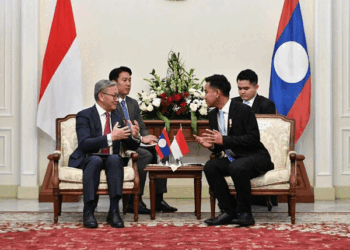
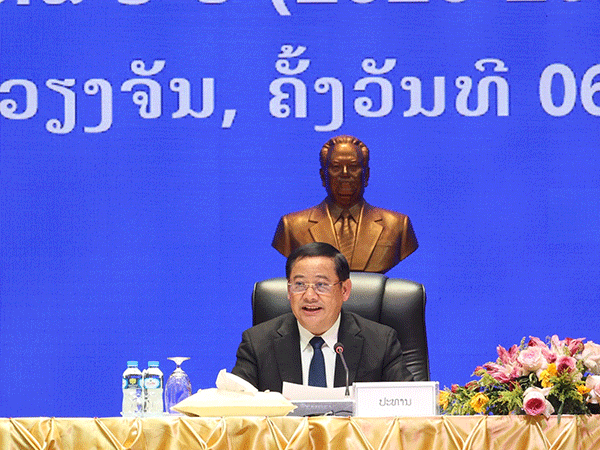
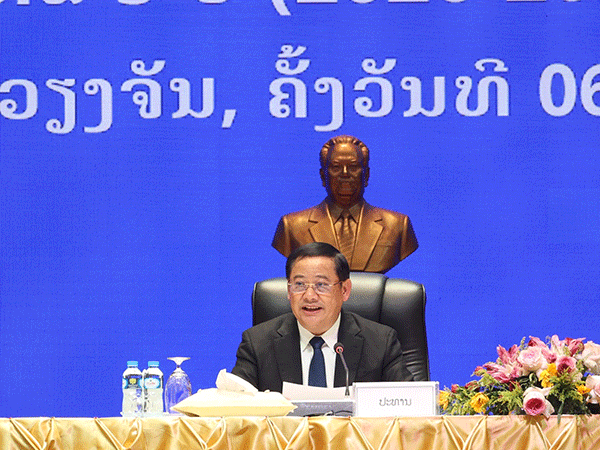
| Prime Minister Sonexay Siphandone addresses the 2025-2026 Annual Conference of the Ministry of Public Works and Transport on Wednesday. |
PM calls for stronger MPWT to drive growth, connectivity
The Prime Minister has called on the Ministry of Public Works and Transport (MPWT) to strengthen its leadership role and accelerate infrastructure development as a key driver of Laos’ economic growth and regional connectivity.
Addressing the closing session of the ministry’s 2025-2026 annual conference on Wednesday, Prime Minister Sonexay Siphandone said the sector is a “spearhead” in the implementation of development priorities.
He noted that the conference was taking place as efforts are ongoing to fulfil the resolutions adopted at the 12th National Congress of the Lao People’s Revolutionary Party and the 10th Five-Year National Socio-Economic Development Plan, particularly to strengthen regional and international links.
Dr Sonexay said success in meeting the government’s target of at least 6 percent annual GDP growth over the next five years will depend heavily on the progress made by the public works and transport sector.
Without strong infrastructure development, he said, it would be difficult to achieve economic growth in line with planned targets.
He called on authorities at all levels to strengthen leadership by promoting unity, responsibility and innovation, while improving working methods and clearly defining roles. He emphasised the importance of self-reliance and proactive decision-making in carrying out assigned duties.
Dr Sonexay also called for continued efforts to build an independent and self-reliant economy by making better use of the country’s geographic advantages, expanding regional and international linkages, and generating revenue through transit-related transport services, while encouraging greater participation by Lao businesses in infrastructure development.
He highlighted the need to upgrade and expand transport infrastructure in a systematic manner, particularly arterial highways such as National Road 13, while enforcing measures to ensure that heavy trucks do not damage roads.
Urban development should be closely linked with environmental protection, he said, including measures to address flooding, improve wastewater and solid waste management, and promote clean energy solutions such as solar-powered street lighting and better management of electronic waste.
At the same time, he called for more investment in hydraulic works and flood control, alongside greater use of waterways such as the Mekong River for transport in order to reduce the pressure on roads and improve efficiency.
Addressing water supply challenges, the Prime Minister urged authorities to resolve shortages in the cities of Vientiane, Luang Prabang, Pakse and Kaysone Phomvihane, while reducing water loss through improved monitoring and encouraging the use of locally-made materials.
He also cited the need for modernisation of the aviation sector including the reform of Lao Airlines and a feasibility study on the construction of a new airport in Vientiane.
Better regulation of vehicles and public transport was needed to ensure safety, he added, as well as further development of the rail network and multimodal logistics systems to boost connectivity and generate additional revenue.
He also encouraged greater use of modern technologies, including artificial intelligence, to improve infrastructure planning, management and transparency, while also stressing the importance of expanding cooperation with development partners and investors.
Greater coordination between central and local authorities was highlighted as essential to ensuring effective development, with an emphasis on accountability, timely problem-solving, and shared responsibility at all levels.
The Prime Minister also called on civil servants to be ethical and professional in all their dealings, noting that shortcomings in infrastructure and public services are immediately visible to the public.
He expressed confidence that under the leadership of Minister Leklai Sivilay, the public works and transport sector will continue to make progress and achieve new breakthroughs.
The Prime Minister reaffirmed the government’s commitment to building infrastructure that is focused, durable, modern, safe, connected and sustainable, ensuring the sector continues to be a driver of the country’s socio-economic development.
By Bounfaeng Phaymanivong
(Latest Update May 7, 2026)