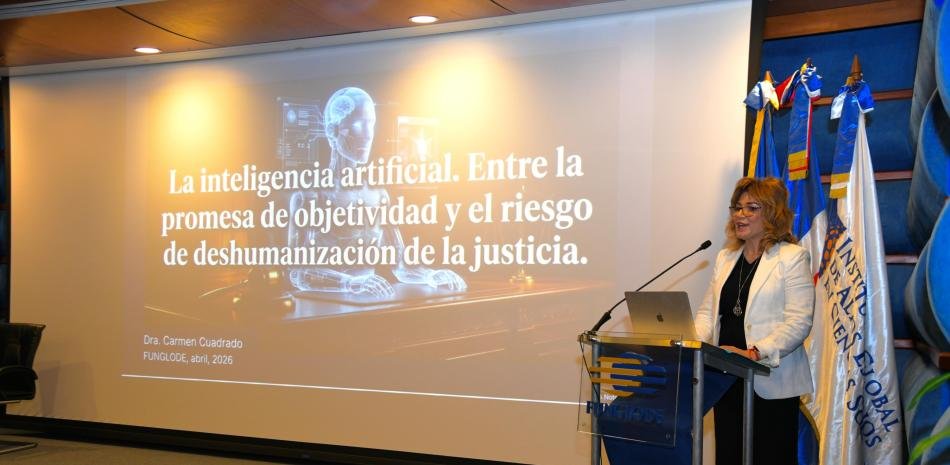
The Spanish jurist Carmen Cuadrado warned that the use of artificial intelligence in judicial systems can affect the rights of the accused if adequate controls, transparency in processes and human supervision in decision-making are not applied.
During a conference held in the auditorium of the Global Democracy and Development Foundation (Funglode), The specialist explained that the incorporation of these technologies in the courts does not respond only to technological advances, but to the need to improve coherence and efficiency in judicial decisions, given the historical difficulty of guaranteeing that similar cases receive similar responses.
However, he stressed that speed and data processing capacity alone do not guarantee fair decisions, since algorithms can reproduce existing biases in the information with which they are trained.
Loomis case and transparency
During his speech, Cuadrado cited the so-called case Loomisconsidered an international reference in the debate on the use of algorithmic systems in judicial decisions, by raising questions about the transparency and understanding of these tools.
He explained that when a person cannot understand how their situation is evaluated within a judicial process, essential principles of the justice system are weakened, such as the presumption of innocence and the right to defense.
He warned that, in these scenarios, technology can become a hidden actor within the judicial process, influencing decisions that affect people’s freedom without there being full knowledge about its operation.
The expert pointed out that one of the main reasons that has promoted the use of artificial intelligence in judicial systems is the need to streamline file management and address the congestion of cases in the courts.
He indicated that these tools make it possible to classify documents, analyze large volumes of information and detect patterns in a short time, which can contribute to improving the administrative efficiency of the system.
However, he warned that the greatest risk arises when the search for speed and productivity displaces fundamental values of justice, such as impartiality, motivation for decisions and institutional responsibility.

The jurist Carmen Cuadrado during her speech at the Funglode auditorium.
“Judging is not calculating”
Cuadrado emphasized that the judicial function involves interpreting norms, evaluating facts, weighing legal principles and justifying decisions, tasks that cannot be replaced by an automated system.
He argued that an algorithm can calculate, classify and predict results, but judging requires offering clear reasons and assuming responsibility for the decisions made, especially when fundamental rights are at stake.
In that sense, he proposed a balanced position in the face of technological advance and that is to use artificial intelligence as a support tool for the organization and analysis of information, but to maintain the final responsibility for each decision in the judge.
Do not replace the judge
The jurist stressed that the current debate should not focus on whether technology is faster or more efficient than humans, but on whether the decisions made through its use meet the standards of legitimacy required by a democracy.
He reiterated that artificial intelligence can be useful to strengthen the functioning of the judicial system, as long as it is used under human supervision, with clear rules and with full respect for people’s rights.
“Democracy not only needs effective decisions; it needs legitimate decisions,” he concluded.
The activity was attended by the former President of the Republic, Leonel Fernández, directors of the foundation, lawyers and jurists.

Former president Leonel Fernández was invited to the conference.