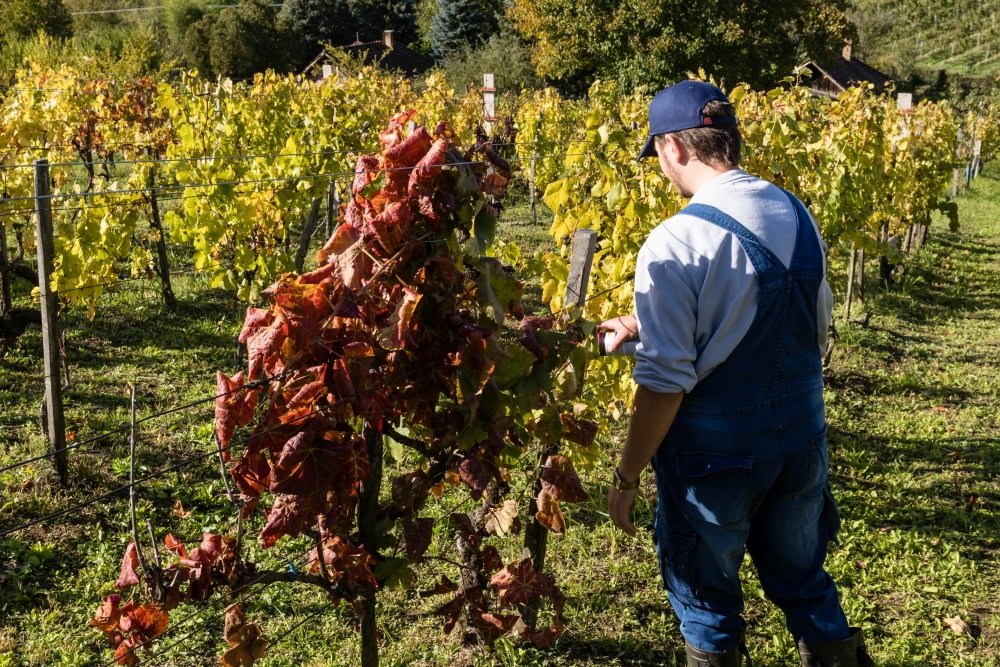

The spring frost caused massive destruction in Hungarian vineyards on the first day of May. In a single night, damages amounted to as much as 30 billion forints (80 million euros), and in many places, virtually total crop failure is expected, Agrárszektor reports.
The severity of the situation stems from the fact that the extremely cold temperature occurred at a time when the vines had already begun to grow. On May 1 in the early morning, temperatures between minus five and minus seven degrees Celsius were recorded in several regions, which is practically fatal for budding vines.
According to initial estimates, the situation is severe on a national level.
Of the country’s approximately 50,000 hectares of vineyards, as many as 20,000 hectares may be affected, representing an unprecedented loss.
If we look at just two regions, we can see that over 1,500 hectares out of the 1,800 hectares in the Hajós-Baja wine region, and 15,000 hectares out of the more than 20,000 hectares in the Kunság region, suffered 100 percent or nearly 100 percent frost damage.
This scale of damage not only complicates the wineries’ operations this year but also foreshadows problems for the coming years, as the damage to the vines does not regenerate overnight. Producers are thus not only facing a loss of revenue this year but also the fact that the next season will not start with a clean slate.
Pálma Koch, president of Junibor—Association of Young Winemakers told Agrárszektor that photos from members kept coming in during the hours following the frost damage. As she said, the same picture emerged almost everywhere: completely frozen vineyards where there was barely any chance of recovery.
There are vineyards “where frost damage is practically 100 percent.” In such cases, the destruction is so extensive that this year’s harvest is almost entirely lost,
Koch stated.
She added that the problem is further exacerbated by the fact that below a certain temperature threshold, protective measures become practically ineffective. Although farmers try to mitigate the damage using various methods and technologies, these can only be effective in the case of milder frosts, she explained. However, this year’s extreme cold has reached a level where these measures no longer provide real protection, leaving farmers virtually powerless against the forces of nature.
Koch also noted that the situation is particularly critical because wineries do not operate in isolation. Producers often buy grapes from one another, therefore a shortfall in any given region affects the entire market. If there are significant crop losses in multiple wine regions at the same time, this is not just a local problem but could lead to a nationwide shortage.
All of this could also cause serious market tensions in the coming period.
In the event of a significant crop failure, the purchase price of grapes is expected to rise, while the increased cost of raw materials can only be passed on to the consumer price of wine to a limited extent.
“There are countless wineries, competition is fierce, and our costs are constantly rising—bottles, labor, everything is getting more expensive, while our prices cannot keep up,” she listed.
“The current situation is particularly hard on young winemakers and farmers, who are already trying to make a name for themselves in an unpredictable, often risky environment. Generational transition has long been a challenge in the sector, and extreme events like these further diminish the appeal of the profession,” said Koch.

Via agrarszektor.hu, Featured image: MTI/Katona Tibor