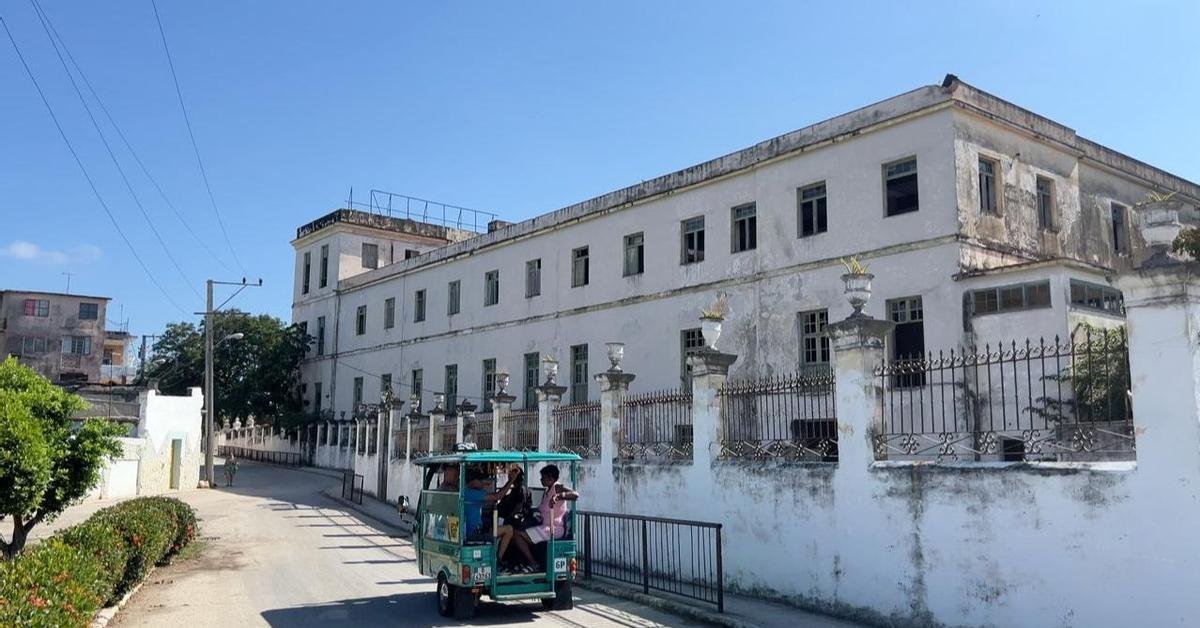
Havana/In any country, the building that occupies the old cloister and school of the Piarist fathers in Guanabacoa would belong to the Church and would be well cared for. It is not like that in Cuba. The property, of high historical value, has not only remained under state control since 1961, when it was nationalized, but has also been abandoned by the municipal authorities. After several robberies, a fire and months of efforts without response from the Government, the priests denounce before 14ymedio an unsustainable situation, and they demand the urgent return of the building to rescue it and put it back at the service of the community.
The complex, in which the congregation is located – officially called the Order of Poor Regular Clergy of the Mother of God of the Pious Schools – includes the church, the cloister – the small square where a Christ stands in the center –, the old school, a theater and museum areas. The school, still marked by children’s paintings, taught primary, secondary and high school classes until 1961, when it was confiscated by the revolutionary government.
“You have to wait, be patient, but patience is running out,” Piarist Father Iván Guerra Álvarez tells this newspaper. “Many times we see ourselves as incapacitated or with our hands tied, wanting to do something too, and our complaints are not heard.”

/ 14ymedio
According to the priest, the robberies began “on October 28 of last year” and since then the community has been affected several times. The situation, he affirms, raised alarms about the need to rescue the property, which the Piarists consider an essential part of their history in Cuba. “Historically it was our home,” he points out. “The cloister was nationalized, which should not have been the case, because it is not an educational institution in itself, but rather our residence.”
Guerra Álvarez emphasizes that the building not only has heritage value, but also spiritual value for the order. “It was the residence of one of the saints of the order, recently canonized, Faustino Míguez,” he explains. Also remember that elements of historical value are preserved in the property, such as busts of Piarists relevant to the scientific history of the country and commemorative plaques.
“It is of great religious symbolism, but also of our history and the history of Cuba,” says the priest, who indicates that personalities from the country passed through there, including veterans of the War of Independence, and regrets that “almost all of the cultural and historical heritage of Guanabacoa is being lost.”
/ 14ymedio
For his part, Ernesto Cuba Martínez, a Piarist religious in his formative stage, remembers that the order arrived in Cuba in 1857 and founded in Guanabacoa the first normal school for teachers in Cuba and Latin America. “For 10 years it worked, and numerous teachers from the Island were trained there, at a national level,” he continues.
“The Piarists were a paradigm in Cuban education,” says Cuba Martínez. Among the figures linked to Piarist education he mentioned Tomás Estrada Palma, first president of the Republic, who had a Piarist in Bayamo as a teacher, and Cardinal Arteaga, “first cardinal of Cuba and the Caribbean”, a student of the Piarists in Camagüey.
The order assures that it has tried to resolve the current situation through dialogue, with meetings and approaches with authorities of the Government and the Communist Party at the municipal, provincial and national levels. Guerra Álvarez acknowledges that the reception, “especially on a national and provincial level,” has been good, but he also asserts that it is no longer enough to listen to the complaint.
/ 14ymedio
“We have to go from receiving the complaint or the request as such, and move on to action,” he says. Despite the communications, he says, the criminal acts “are getting worse” and “it gives the impression that we are talking and that remains in the air.” Among the problems that concern the order are also the young people who have chosen that place to consume the drug known as “chemical.”
The deterioration of the property, in the priest’s opinion, is a direct consequence of the lack of state protection. “The state institutions, in this case Municipal Education, which is responsible for maintaining the property in the best way, should not have abandoned it as was done,” he denounces. “It was even left without custodians and everything, and that led to what we are currently seeing.”
Among the most damaged areas is the museum, with raised tiles, detached wood and signs of theft. The theater, on the other hand, is kept in better condition because it is used by the Oceano theater group for some activities. Its director, Luis Emilio Martínez, also has reported the situation of vandalism and neglect that the space suffers.
The paradox, he says, is that today the order does not have ownership or custody of the cloister and the school, but it is the one who most insists on saving them. Until now, however, he has not received a solution: “We have not had an effective response to say whether it is returned or not returned, or what is going to be done in relation to the cloister.”
/ 14ymedio
“When we talk about rescuing the property it is not to increase our properties, because in the end that does not interest us, but rather the purpose that can be given to it for use within the community of Guanabacoa,” says the priest.
On May 3, the Escolapios Cuba page published a harsh complaint under the title: “The heritage of Guanabacoa is destroyed! We Piarists demand urgent return.” In that text, the congregation accused Municipal Education and the Municipal Government of “absolute apathy” and stated that “state ownership only brought abandonment and now destruction.”
When asked what they would do if they recovered the property, Cuba Martínez responded to 14ymedio that the priority would be to give it an educational and community function again. “The important thing is also to have a structure so that we can teach others, so that we can educate others and so that the little that remains in Guanabacoa can be recovered,” he says.
The Piarist community in Guanabacoa is minimal today if compared to what existed before 1959. As they explain to this newspaper, then there were around 50 priests; After the triumph of the Revolution, eight remained and currently only five remain: three Cubans, a Spaniard and a Mexican. The superior, a native of Navarra, previously lived in Venezuela and has been in Cuba since 2019.
Cuba Martínez insists that there is still time to save the building. “It is abandoned, but it has not yet been completely destroyed,” he warns. “Let them take action and let it not just remain in words, but in actions.” And he warns against a late return: “We are going to take advantage now and be able to raise what needs to be raised before everything is ruined. Because later, who is going to raise it? Nobody.”