Occasion: 85 years since the premiere of “Citizen Kane”
(memory of a film childhood and maturation)
In the early 40s and 70s of the last century, two films shook the film scene – “Citizen Kane” (Orson Welles, 1941) and “Amarcord” (Federico Fellini, 1978), to such an extent that in film encyclopedias these two films have been marked as the best among the ten films in the world for decades. Citizen Kane, which celebrates its 85th anniversary this year, is often cited as the greatest film of all time. For me, these two films are among the best things that happened to me at the transition between childhood and adolescence in terms of intellectual and emotional maturation. I write about this in my book, “Childhood is more than amarcord” – a novel about childhood and coming of age during early socialism, published by “Matica” in 2021.
Why amarcord in the title of the book? Why is childhood more than amarcord?
Amarcord can be considered a word that does not exist. It is not in the official vocabulary. It was born through creative intervention in two verbs – “amare” and “riccordo”. The end result is a mechanical joint that means – “remembering with love”. Amarcord!
Only from the workshop of a skilled craftsman could such a forge have come out. It takes a refined sense to blend sentimentality and melancholy into a powerful word that takes us back to the past in order to express our feelings in the present. That skilled craftsman is Federico Fellini. He coined it to give the title of his famous film – “Amarcord”.
My early childhood in the 1950s can be described as a fond memory. I grew up in the neighborhood of Mlin Balkan, in Skopje, located between the Club of Deputies, Small Station and “Sloboda” Square. But what I went through in the closing circle with the printing house of “Nova Makedonija”, with my eight-year-old “Goce Delchev”, as well as with the Lower Music School, where I studied violin for six years – from today’s point of view, I’m sure, is more than a fond memory. My childhood is more than amarcord.
The events I am talking about in these memories have long been recorded by the hand of fate and coincidences, but no less by my childhood urge to search for myself, from a very young age, in the miracle of life. To wander with passion through the deep forest of life, mysterious and majestic at the same time.
I was encouraged to do so by the events and experiences that took place at those points in which my childhood world spontaneously touched the world of adults. As I grew older, the number of those dots kept increasing. I was not even aware that I was gradually getting into the habit of joining them in a line that marked the border between those two worlds.
I did it out of curiosity and thinking. But most of the time it happened spontaneously, by itself. Searching for myself, I was actively maturing. Often, by force of circumstances, I was forced, and sometimes I myself wished, to move along the thin line in which the world of childhood and the world of adults begin to touch, until the moment when I definitely crossed that line and found myself in the world of adults.
Now, as I put down on paper what fate wrote long ago, I wonder why I do it. To leave a mark behind? From ordinary human vanity fueled by the illusion that, in this way, we can extend our duration even after the inevitability of the definitive physical end? Or because of the belief that a person, and without realizing it, the closer he is to his end, the closer he is actually to his beginning, in which the images of early childhood emerge with surprising clarity and force?
The interpretation of Stevo Crvenkovski from 1969
But didn’t I once already waver in the belief of the convergence of the end with the beginning, when I tried to understand the meaning of the movie “Citizen Kane”? The interpretation of the same film that I heard from Stevo Crvenkovski, in the summer of 1969, on the terrace of the youth hotel in Bečići, near Budva, in Montenegro, was different, but it sounded just as convincing to me. Stevo Crvenkovski was remembered in our social and political public as a famous film director, Minister of Foreign Affairs of Macedonia, Macedonian ambassador to Great Britain. I had invited him to participate in the international summer school organized by the Presidency of the Union of Socialist Youth of Yugoslavia, intended for the youth wing of the Social Democratic Party of Sweden. At that time, as a member of the Presidency, I was in charge of organizing the Summer School, which was attended by officials and prominent Yugoslav diplomats as lecturers, including Leo Mates, Bogdan Crnobrnja, Bogdan Oreshčanin, Dimche Belovski. Koča Popović was also supposed to come, to whom I personally, in his office, conveyed the invitation on behalf of the Presidency. A close associate of Tito, Koča Popović was the brilliant mind of the socialist revolution in Yugoslavia, an intellectual of European format, educated at the “Sorbonne” between the two world wars, during the NOB he was the first commander of the First Proletarian Brigade in 1941, Minister of Foreign Affairs, Vice President of Yugoslavia, one of the most prominent leaders of Yugoslavia. In the 1970s, he broke with Tito and left the country’s political life.
Stevo then reasoned that “Citizen Kane” is not a film saga about a memory of the main character in a childhood picture, just before he loses his soul (the closer we are to the End, the closer we are to the Beginning!), but that “Citizen Kane” is actually a saga about the missing pebble in the mosaic of life. That one cannot simply reconstruct and explain one’s life even when we are sure that all the stones have been placed in the mosaic, except perhaps only one, the only one. Although even without it, the mosaic looks flat and the picture quite clear, it is precisely that missing pebble that prevents us from penetrating the essence of someone’s life. In “Citizen Kane” that pebble is the word rosebud that the protagonist utters just before his soul goes to heaven, in the opening scene of the film. That word is written on the inside of his childhood sled, from the final scene of the film.
Why this obsession with childhood?
It is difficult for me to find an answer because, sometimes, it seems to me that I had a childhood for two lifetimes!
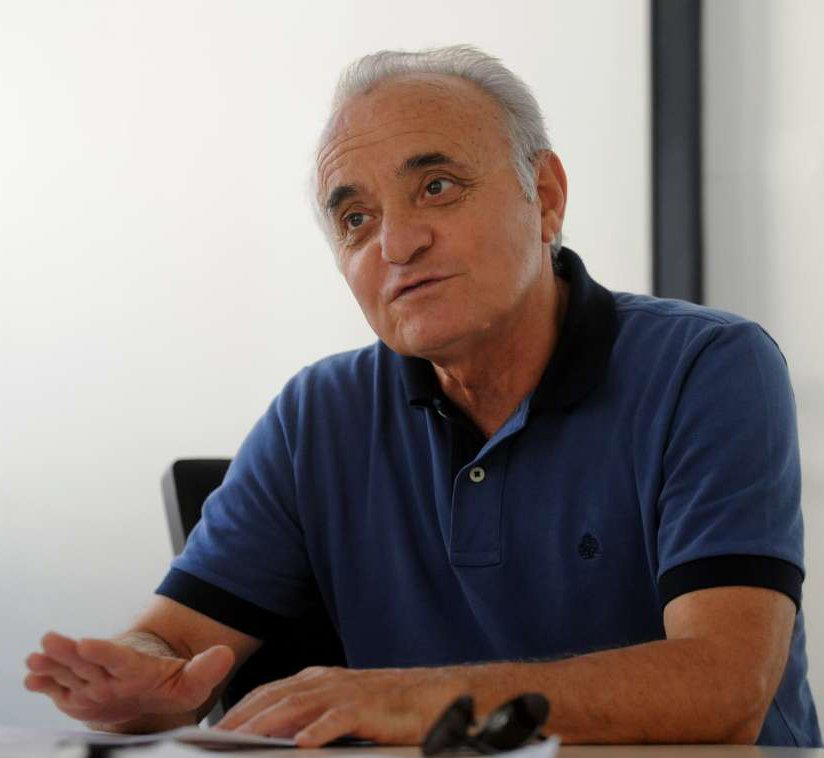
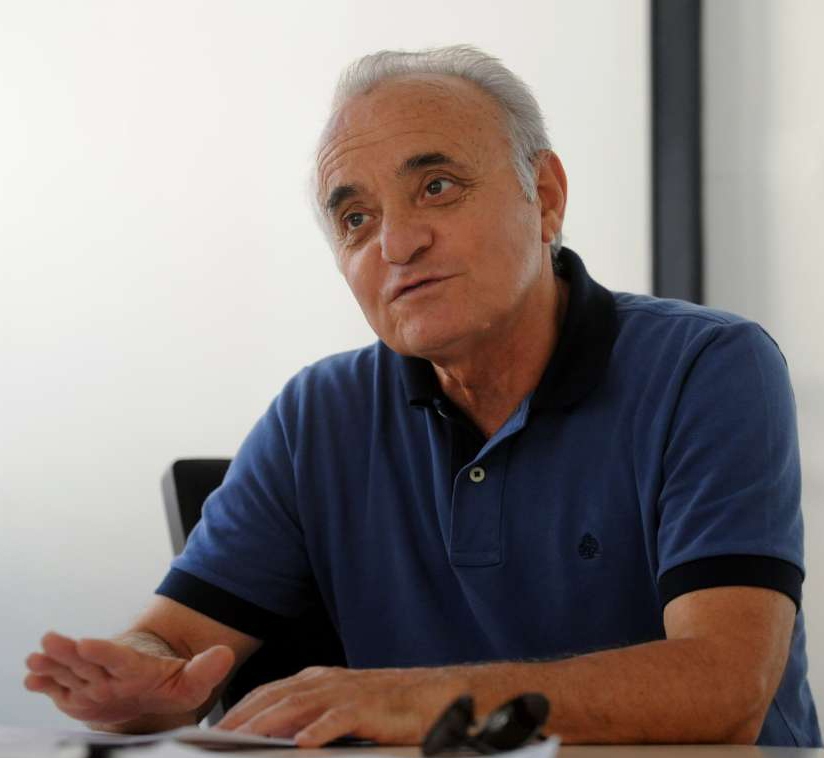
Vladimir Petkovski, university professor and ambassador