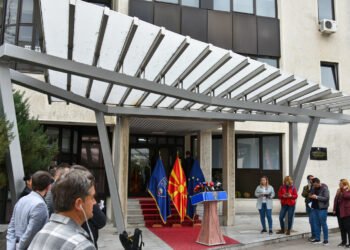
- The commemoration of his death is not only a historical commemoration but also a manifestation of the centuries-old persistence of Macedonians to be their own, to preserve their own history and pass it on as a living memory to future generations. That act is testimony that Macedonian statehood is not a coincidence, but the fruit of sacrifices and visions, of defiance and dignity. It is a celebration of dignity, of resistance to any denial and of the belief that Macedonia is and will remain an equal part of the world cultural competition – but with its own name, its own history and its own soul. In every wreath laid, in every word spoken and in every silence shared on May 4, the vow is reflected that the Macedonian state will continue to exist as a living testimony of a people that chose to be special and dignified
In Macedonian villages and towns, a simple testimony has been passed down for generations: “Goce did not die so that we would forget him, but so that we would remember him as our road sign”. The elders tell that every May 4 is not only a day of sadness, but also a day when Macedonia looks at itself again and reminds itself that statehood is not a gift, but a choice and a sacrifice. So every year, when wreaths are laid and silence is shared, it is not just a ritual of remembrance. It is a living testimony that the Macedonian people embraced their destiny with courage and vision and that the name of Gotse Delchev is more than history – it is a mirror of our self-importance and obligation to remain our own.
On May 4, Macedonia, as a state and a nation, does not only pay respect to one person. It celebrates its own statehood, affirms its own history and expresses the centuries-old insistence on being its own. That day is more than a date in the calendar – it is a living testimony that the Macedonian people did not agree to be an appendage to other people’s ambitions, but chose to exist as special, equal and dignified. The death of Gotse Delchev is more than a tragic historical event. It is the foundation of Macedonia, the cornerstone of national self-awareness and a symbol of the people who embraced their destiny with courage and vision. The entire Macedonian history is reflected in his sacrifice – a history of resistance, of disobedience, of striving for freedom and equality. Commemorating his death is an act of collective memory and national affirmation. It is a solemn moment when Macedonia looks at itself in the mirror of history and speaks its truth again: that it exists as a state, that Macedonians are a people with their own culture and language and that their history is their property, not someone else’s toy.
We must not forget that Gotze is not only a revolutionary. He is an ideologue of Macedonian identity, an apostle of the vision that Macedonia must be independent from other people’s directives and ambitions, a guardian of the thought that freedom is not received as a gift, but is won with one’s own sacrifice and perseverance. His figure is more than a historical figure – it is the spiritual foundation, road map and conscience of a nation that chose to be its own. Therefore, every commemoration of his death is an act of national confirmation, a solemn declaration that Macedonia is a state, that Macedonians are a people with their own culture, language and history and that their past is their property, not someone else’s toy. It is a moment when the covenant is renewed – that Macedonian statehood is not an administrative fiction, but a living historical reality built on the blood and vision of its greats. In Delchev’s character, the entire perseverance of the Macedonian people is reflected – his determination not to melt into other people’s ambitions, his courage to resist denial and his belief that identity is a right, not a privilege.
Hence, any disparagement, underestimation or devaluing of Delchev’s character and work is a direct disparagement of Macedonia as a state and of the Macedonian people as something separate and special. His name is a red line – not only historical but also identity. To deny Delchev means to deny the very existence of Macedonian statehood, to undermine the foundation on which national dignity is built and to question the right of Macedonians to be their own. Therefore, any attempt to devalue his sacrifice and vision is not only an attack on a historical figure, but also on the entire Macedonian history and future. Delchev is more than a symbol – he is a living testimony that Macedonian statehood was won with blood, with an idea and with defiance and that his name remains an indisputable benchmark for national self-awareness.
Let’s remind again! The commemoration of his death is not only a historical commemoration but also a manifestation of the centuries-old persistence of Macedonians to be their own, to preserve their own history and pass it on as a living memory to future generations. That act is testimony that Macedonian statehood is not a coincidence, but the fruit of sacrifices and visions, of defiance and dignity. It is a celebration of dignity, of resistance to any denial and of the belief that Macedonia is and will remain an equal part of the world cultural competition – but with its own name, its own history and its own soul. In every wreath laid, in every word spoken and in every silence shared on May 4, the vow is reflected that the Macedonian state will continue to exist as a living testimony of a people that chose to be special and dignified.
Therefore, the commemoration of Delchev is not only a memory of the past but also a confirmation of the future – a future in which Macedonia will remain its own, unshakable in its self-importance and inviolable in its right to exist.