Greenland Statistics has just published statistics which show the salary for public employees in self-government and municipalities.
The statistics show the average salary within the various subject groups.
Greenland Statistics has just published statistics which show the salary for public employees in self-government and municipalities.
The statistics show the average salary within the various subject groups.
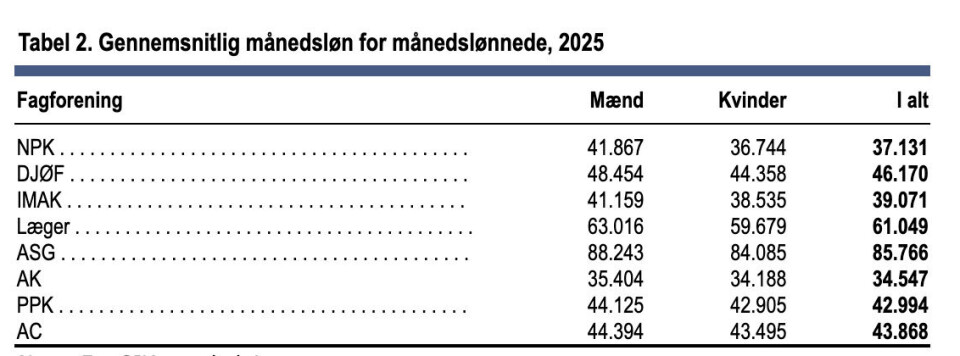
At the very top is the trade union ASG (Association of Academics in Greenland) with an average monthly salary of DKK 85,766.
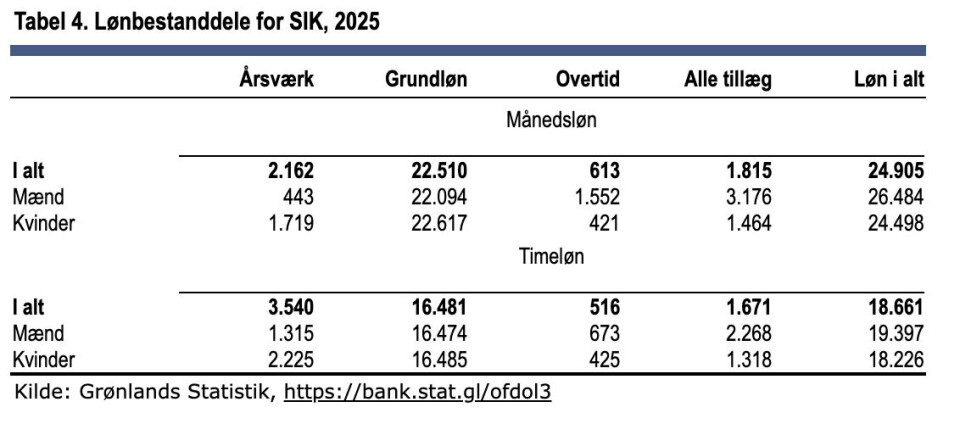
At the other end of the scale is the salary for the hourly workers on SIK agreement.
Here, the average monthly salary is 18,661. Hourly workers’ pay is further detailed in the statistics, where it appears that the basic salary is down to DKK 16,481. With allowances and overtime, the salary comes to DKK 18,661.
Social scientist: Contributing to the understanding of inequality
The statistics show that this is a large group of employees who are employed under the collective agreement.
In total, 3,539 annual weeks are carried out by SIK hourly employees.
Social researcher and emeritus at Ilisimatusarfik, Birger Poppel, says of the figures for hourly wages that they make a contribution to understanding the general income inequality, which is greater in Greenland, for example measured by the Gini coefficient and also measured by some of the other measures of inequality that Statistics Greenland uses:
– We have a group in the population, the hourly wage earners, who are typically unskilled and who are probably also the group with the most insecure conditions, says Birger Poppel.
The real earnings may be lower
He goes on to say that the conditions for the individual may be worse than the statistics show:
– You must be aware that the calculations that have been made, they have been made in relation to full employment for one month.
– It is likely that there are a number of hourly workers who do not have full employment, which means that the real earnings of some of the people we are talking about here will be even lower, says Birger Poppel and continues:
– It is clear that it affects their ability to buy and support themselves and contribute to the support of the family they are members of.
If you look at the average monthly salary for the other professional groups, it is a significant jump from the hourly paid SIKs of DKK 18,661 to monthly paid members of AK, which is DKK 34,547 (see table below).
Education and competition with Danish salaries
Birger Poppel says about the significant difference that, firstly, we are talking about groups that have education.
Next, if you go up to the academic level, salaries can also be affected by the fact that there is to a greater extent a common Danish/Greenlandic labor market, which can affect salaries in an upward direction as a result of the development in Denmark.
– Unfortunately, we are not self-sufficient with, for example, academic labour, and then you have to attract some groups with Danish salaries. That is to say, in order to recruit you must be able to match the salary level that you have in Denmark to some extent. And that is not the situation in the unskilled hourly paid area, says Birger Poppel.
Birger Poppel also points out that it can play a role in the fact that, in the hourly paid area, we are talking about jobs that have had low prestige and have not been considered attractive.
The public sector has a great influence on the conditions
The researcher also points out that the Self-Government and the municipalities as employers and thus also negotiators of collective agreements and agreements have a decisive influence on both wages and other terms of employment.
In addition, through tax policy, Inatsisartut has a central influence on the living conditions of the lowest paid.