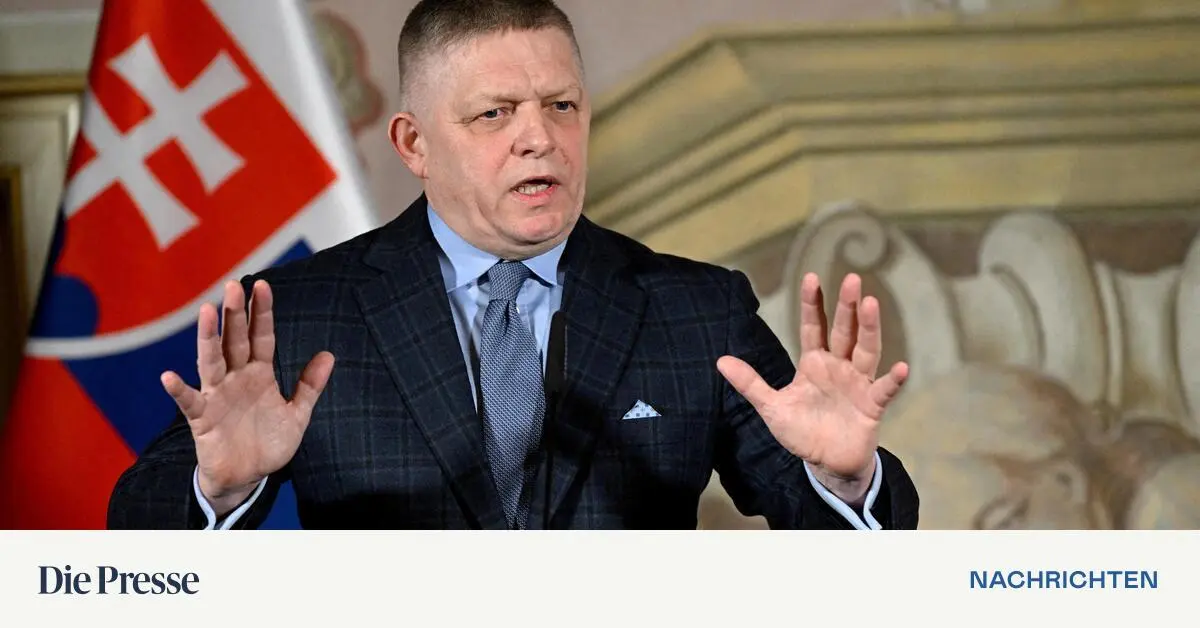
Media critical of the government in Slovakia regularly warn of the threat of “Orbánization” of the country by the left-wing nationalist Prime Minister Robert Fico. This doesn’t just mean that Fico uses arguments similar to those of Hungary’s current Prime Minister Viktor Orban in his criticism of the EU’s Ukraine and Russia policy (but then usually blocks them less radically). It is also about Orban’s method of helping his favorites gain economic power and in return get positive coverage in the media bought up by these “oligarchs”.
But especially when it comes to control over the classic media of newspapers, radio and television, it quickly becomes apparent that the differences between Slovakia and Hungary are greater than the similarities. Fico and his party Smer-SD (in German “Direction – Social Democracy”) have been in power with two – albeit drastic – interruptions since 2006 and thus for a similar length of time as Orban’s Fidesz in Hungary, but have never had such great power and the resulting control over the country’s media. On the contrary: the most internationally prominent media outlets have traditionally been and are owned by staunch Fico opponents; he is not really supported by a daily newspaper, radio or TV station, which is why he always presents himself in a populist manner as a victim of media that is biased or even “hostile” against him (with journalists as “prostitutes”).
Anyone who is really rich in Slovakia has no great natural interest in getting on board with a left-wing populist like Fico, whose electorate is largely made up of pensioners, but instead networks more internationally – and presents themselves as more economically liberal. A prime example of this are the five IT millionaires who became rich with the internationally successful software company Eset. They never felt the need to ingratiate themselves with the Fico party Smer-SD, but instead took part in founding the liberal daily newspaper “Dennik N”, which fiercely fought against Fico, and of which they were the majority owner until the summer of 2025.
The fact that they also gave what is now the largest opposition party, “Progressive Slovakia” (PS), a small start-up aid was less important than the fact that they promoted an environment of anti-government media and non-governmental organizations that was favorable to them. The idea of Smer politicians, but above all representatives of the smallest coalition partner, the Slovak National Party (SNS), to bring public radio and television under party-political control as a “counterweight” to the “hostile” private media, has stalled after the much-publicized dismissal of the former station director by formally dissolving and re-establishing the institution under the new name STVR. In recent weeks, however, fears have grown that the government camp will completely subordinate the station with a view to the 2027 parliamentary election.
At least somewhat reminiscent of Hungarian conditions, two years ago there was a sensational suspicion that even in Slovakia, private media critical of the government could change their stance if it corresponded to the interests of their owners. In May 2024, the prominent TV presenter Michal Kovacic ended his high-ratings discussion show “Na telo” (translated roughly as “Up close”) on the private television station TV Markiza, which has always been considered an opposition medium, with an accusation of censorship spoken live directly into the camera. There is a creeping “Orbánization” of the Slovak media landscape, which is evident at TV Markiza in the efforts of the bosses to influence the content and selection of guests.
Despite all of the company’s official denials, it is actually clear that the Czech company that owns the channel, which was founded in 1996 with US money, may at least have an interest in TV Markiza dealing more gently with the government. The PPF Group not only owns TV Markiza, which is by far the broadcaster with the widest reach in Slovakia, but also, among other things, the company that, shortly before Kovacic’s spectacular appearance, was once again awarded the lucrative contract for the toll system on all Slovakian motorways. Rumors are now circulating that the largest TV station could change ownership again. The buyer would be an entrepreneur who earns very well from government defense contracts – and could therefore be particularly interested in more “government-friendly” reporting.
In the first years after the fall of the communist regime in Czechoslovakia and after the state separation from the Czech Republic, Slovakia was on a path that could have gone in a similar direction to the Orbán system in Hungary. The national conservative founder of the state, Vladimir Meciar, had declared his economic policy goal to be to create a strong domestic entrepreneurial class. In practice, this often meant nothing other than that Meciar’s favorites were given preference in privatizations and state contracts. But when there was a threat that Slovakia would not be admitted to the EU with Meciar, the citizens voted the populist out of office in 1998.
The following eight years of government under the Christian Democrat Mikulas Dzurinda brought about such a radical sell-out of the Slovak economy to foreign corporations that there could hardly be any talk of a strong domestic “oligarchy” anymore. However, the non-transparent approach gave rise to the suspicion that corruption under Dzurinda was hardly lower than under Meciar. And so a young “corruption fighter” named Robert Fico won the 2006 parliamentary election. It is the same Fico who, after many years in power, has now become a symbol of a new corrupt system.
Some of the former Meciar “oligarchs” have failed economically or have sold their company shares to foreign corporations. Some of those who remained defected to the Fico camp. Other local entrepreneurial cliques that are connected to key figures in the governing parties are also seen as sponsors of Smer-SD and remarkably frequent beneficiaries of state contracts. Legal proceedings are currently underway against several of them on suspicion of bribing state officials and police officials in order to obtain EU agricultural funding and to hinder subsequent police investigations.
The EU Parliament recently debated a current affair. It is about the suspicion that entrepreneurs with contacts in the Smer area declared their private villas as catering establishments in order to obtain EU subsidies. Because of allegations of not taking consistent action against such machinations and instead weakening the fight against corruption, Slovakia is even threatened with the withdrawal of EU funding.