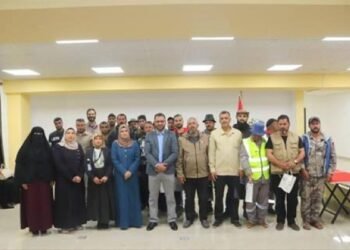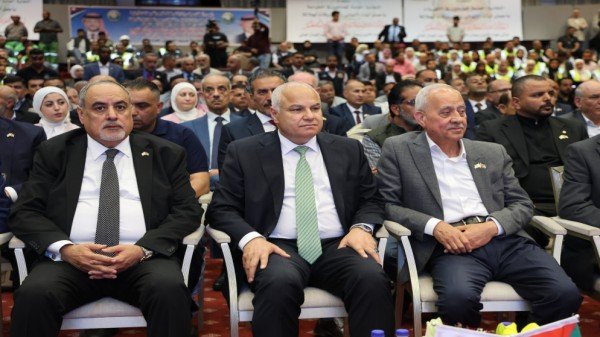
Minister of Labor, Khaled Al-Bakkar, sponsored the national ceremony organized by the General Federation of Jordanian Trade Unions, on Saturday, at the Royal Cultural Center to celebrate International Workers’ Day, in the presence of members and heads of trade unions, representatives of employers, civil society organizations, notables and representatives, and representatives of companies and economic establishments.
During the celebration, Al-Bakkar conveyed the greetings and congratulations of His Majesty the King to the workers of Jordan for all their efforts to build the nation. He also conveyed Prime Minister Jaafar Hassan’s congratulations to them for their efforts and achievements, stressing that celebrating this day is not just an annual tradition, but rather a clear message that embodies the state’s deep appreciation for the value of work and its firm belief in the role of workers in building development and promoting the national economic renaissance.
The Minister announced the launch of the National Decent Work Program, which is implemented by the Ministry of Labor in cooperation with the International Labor Organization and in partnership with representatives of workers and employers. It aims to enhance decent work opportunities, achieve social justice, and support comprehensive and sustainable economic growth, in line with the vision of economic modernization and the goals of sustainable development, and is based on a tripartite participatory approach that includes the government, representatives of workers and employers.
He pointed out that the government is keen to create decent job opportunities for Jordanians locally, in addition to opening new Arab and international markets through bilateral agreements with brotherly and friendly countries to market Jordanian talent and enable them to obtain job opportunities in various fields.
Al-Bakkar stated that the economic modernization vision implemented by the government was built on the premise of providing a million job opportunities for Jordanians while improving the standard of living of citizens. Based on the directives of the Prime Minister, the government dealt with this issue with two plans. The first was internal, including employment programs such as the National Employment Program, the Royal Initiative for Productive Branches, and soft and good loans granted by the Development and Employment Fund and the Fund to Support Education, Vocational and Technical Training and Skills Development Activities. All of these efforts are integrated, aiming to enable the private sector to provide job opportunities for Jordanians and integrate youth and women into the labor market.
He added that the second plan that the government is working on externally is through empowering Jordanian youth with the skills and needs of foreign labor markets and signing cooperation agreements with sister countries such as the Arab Gulf countries and others with friendly countries such as Germany, Italy and Canada to market qualified Jordanian competencies trained to work in these markets.
He stressed that the government is working to address the skills gap in the ability of young people to adapt to the changing and new requirements of the labor market, especially since the global economy is growing with new professions and skills such as artificial intelligence, data protection, data processing and analysis, so that traditional professions such as “construction professions, mechanics, car maintenance, and others” have been introduced by modern technology. Therefore, the government is working through the Vocational Training Corporation and the College of Advanced Vocational Training, which is supervised by the Crown Prince Foundation and the National Employment and Training Company, which is supervised by the armed forces, in cooperation with the Ministry of Labor and the private sector, to provide programs that qualify Empowering young people to meet the new requirements of the labor market.
Al-Bakkar said: “To the extent that we believe that we are able to achieve achievement in the field of empowering and qualifying youth and providing job opportunities for Jordanians internally and externally, there are certainly challenges, including the presence of non-Jordanian workers in many sectors, and some sectors need skills that are not available among young people and a high unemployment rate. Also, in the coming years the world will lose about 300 million job opportunities, while in return it will create approximately 160 million job opportunities in other sectors, and yet we must take advantage of the competitive advantage.” Jordanian youth, which is the presence of a large number of Jordanian youth capable of empowering and qualifying them for the requirements and needs of labor markets regionally and internationally.”
In turn, the President of the General Federation of Jordanian Trade Unions, Khaled Al-Fanatsa, said, “The General Federation has chosen to proceed in a new phase entitled “trade union modernization inspired by the royal vision” in line with the royal directives that placed the Jordanian citizen at the heart of the comprehensive modernization process. We have worked during the past period to develop the tools of trade union work, enhance the efficiency of our trade union institutions, and openness to various partners, in a way that contributes to building a modern trade union movement capable of keeping pace with the challenges and responding to the requirements of the stage, according to a clear vision, which was translated into a plan. A strategy that will continue to be implemented until 2027.
He added, the meeting of the Central Council of the Union, which was held less than a month ago, came to confirm this trend, as the Union reviewed a number of achievements that had been achieved, most notably the expansion of the conclusion of collective labor agreements, which formed a model for responsible social dialogue, and contributed to improving working conditions, enhancing job stability, and achieving balance between production parties.
He pointed out that the Union continued its active role in following up on critical labor issues, most notably the proposed amendments to the Social Security Law and the Labor Law, as the Union’s position was clear and solid in defending workers’ rights and gains in these two laws.
Al-Fanatsa explained that the General Union has taken an important decision to allocate a quota for women and youth in union positions of responsibility, at a rate of 20% for each of them, with the implementation of this decision starting from the next union session, after its approval by the General Conference of the Union, which will be held next year, God willing. He stressed that the decision reflects a firm conviction that empowering women and youth is not an option, but rather a national necessity, as they represent the force of change and renewal, and an essential lever for developing union work and ensuring its sustainability.
For his part, the head of the Amman and Jordan Chambers of Industry, Fathi Al-Jaghbir, said, “The Jordanian worker was never just an element in the production process. Rather, he was and will remain the real capital on which the industry is based, and the main driver of any economic progress.”
He pointed out that the number of workers in the industrial sector exceeds 271 thousand male and female workers in the industrial sector, working in approximately 18 thousand industrial facilities spread across the various governorates of the Kingdom, representing about 21% of the total workforce in Jordan, and this percentage rises to about 28% of the total employment in the private sector.
He added that these workers are not just numbers, but rather they are productive human energies, representing the essence of the industrial process, and contributing to the production of more than 2,500 national products, reaching more than 150 markets around the world, bearing the name of Jordan with pride, and embodying the quality of the national industry and its ability to compete.
He noted that what distinguishes the industrial sector is its high ability to provide job opportunities, as it accounts for approximately 40% of the job opportunities created in the private sector.
In turn, the Regional Director for Arab Countries at the International Labor Organization, Dr. Ruba Jaradat, said, “The International Labor Organization extends its sincere congratulations on the occasion of International Workers’ Day, which this year coincides with the launch of the National Decent Work Programme, which supports Jordan’s national priorities and builds on the tangible achievements that the organization has achieved in cooperation with our partners so far.”
Jaradat explained that the organization, in cooperation with all its partners in Jordan, has been able, over the past years, to provide 41,036 decent job opportunities, integrate 13,412 people into the labor market, rehabilitate 5,170 agricultural dunams, and plant 220,000 trees, in addition to 53,889 people benefiting from training, employment, and professional certification programs.
The ceremony included honoring a number of Jordanian male and female workers from various productive sectors and economic activities, in addition to honoring a number of national companies and supporters of the Union’s work process. A short video was shown by the Ministry of Labor on the integration of people with disabilities in the work environment, and another video included various contributions from the male and female workers who were honored, in addition to an artistic segment with which the ceremony concluded.
The President of the Union also handed the Minister of Labor a shield in honor of the efforts of the Ministry of Labor in caring for workers’ interests, protecting their rights, and supporting the Union’s work process.