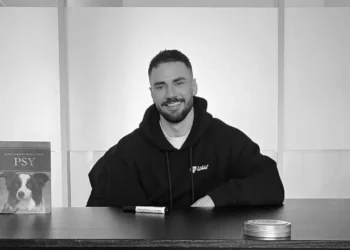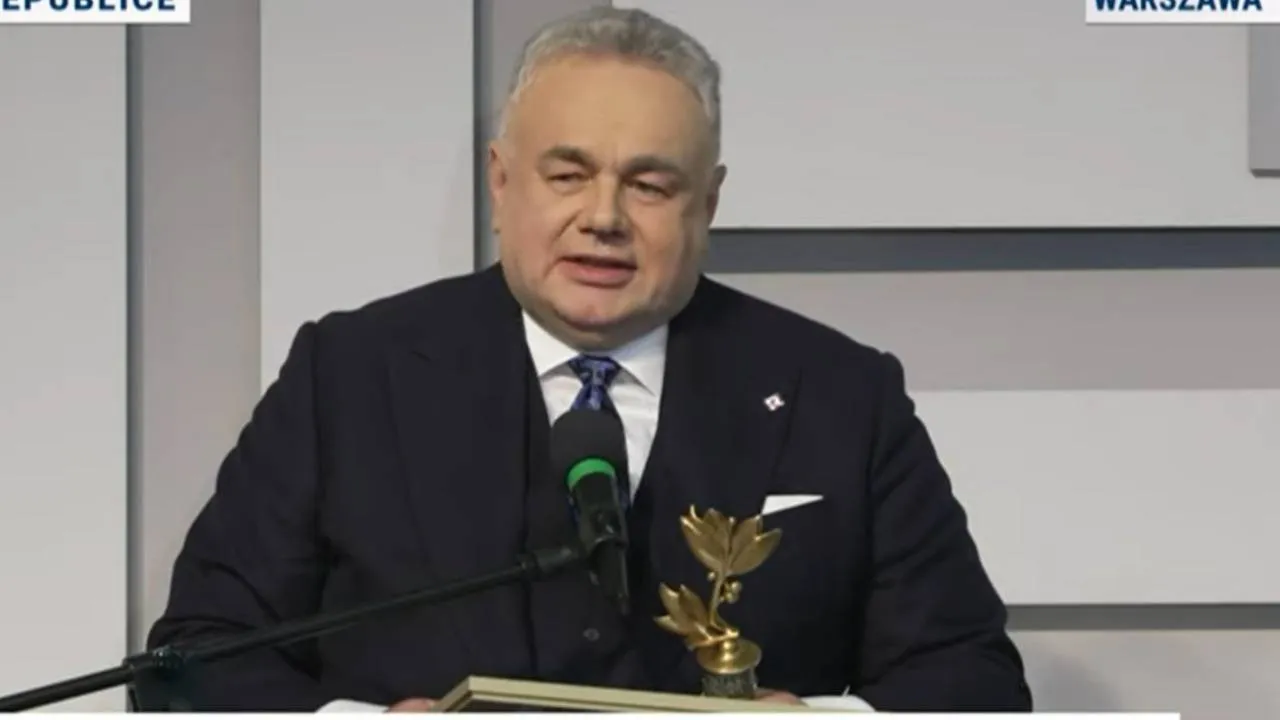
“For years, in his journalistic work, Tomasz Sakiewicz has consistently proven that media independence is the foundation of a democratic society. His professionalism, passion, and extraordinary determination in the pursuit of reliably informing the public deserve the highest recognition,” said Dr. Jolanta Hajdasz, President of the Polish Journalists’ Association (SDP), in her laudation in honor of Tomasz Sakiewicz, President of TV Republika.
Laurel of Freedom of Speech for Tomasz Sakiewicz
Today, at the headquarters of the Polish Journalists’ Association, the Gala of the 32nd SDP Journalism Competition with SDP Awards took place. Among the winners were a great many journalists from the Station of the Free Speech Zone. Tomasz Sakiewicz, President of TV Republika, received the Laurel of the Polish Journalists’ Association for “creative use of the media in the service of Poland.”
In her laudation for the President of TV Republika, Dr. Jolanta Hajdasz, President of the SDP, pointed out that his work “constitutes a model of steadfastness, courage, and commitment in the service of truth and freedom of speech.”
“Mr. Tomasz, through years of his journalistic activity, has consistently proven that media independence is the foundation of a democratic society. His professionalism, passion, and extraordinary determination in striving to reliably inform the public deserve the highest recognition. Ladies and Gentlemen, these are words generated by artificial intelligence after entering the prompt: ‘justify the SDP laurel for Tomasz Sakiewicz.’ We are at such a stage of AI development that I think we all still enjoy such experiments and are curious about what it will write on a given topic. But I want to justify this award to you without AI slogans and without banalities. The 13-member Main Board of the Polish Journalists’ Association awarded this distinction unanimously. This is valuable because, as you can see, these are specific names signed under this verdict. These are also people from direct competition with the media managed by Tomasz Sakiewicz, and by signing the relevant board resolution, they have confirmed that he deserves such an award,”
she declared.
She emphasized that “Tomasz Sakiewicz is a publicist, publisher, editor-in-chief, and social activist. He is the originator of the Gazeta Polska weekly, its editor-in-chief, co-founder and editor-in-chief of Gazeta Polska Codziennie, co-founder and editor-in-chief of TV Republika, as well as president of the company publishing the independent portal niezależna.pl and the monthly magazine Nowe Państwo, creator and animator of Gazeta Polska clubs, which have developed into one of the largest civic communities in Poland and beyond its borders.”
“And here, one could essentially put a full stop and end. Editor Sakiewicz writes, publishes, records, and broadcasts. On top of that, he is a manager, creates media, comes up with ideas for new ventures, and implements them with passion. We all know these titles: Gazeta Polska, Gazeta Polska Codziennie, the Niezależna.pl portal, Nowe Państwo. And today, surely every Pole already knows what TV Republika is, and many of them, many of us, watch this television regularly. But, dear Ladies and Gentlemen, to say everything I have said so far is as if to say nothing. Because to understand the phenomenon of Tomasz Sakiewicz, one must know the context and the environment in which he has had to operate,”
she stated.
She then recalled the events of 2011.
“In October 2011, Gazeta Polska Codziennie was launched. On the very first day, someone at the airport detained the newspaper transport because part of the print run had to be delivered by air. As a result, GPC was late in delivering the newspapers, and Sakiewicz, as the boss, had to pay a gigantic financial penalty for the delay. Then it turned out there was no chance of getting advertisements on television. When a scandal broke out about it on TVP, one of the two previously prepared ads was aired. Polsat, which had initially agreed to broadcast it, also suspended it. TVN had no time at all to air any advertisement and simply informed that its advertising slots were fully booked. The Ruch kiosks, where newspapers were advertised in so-called frames, were also strangely uncooperative at that time. Precisely when Gazeta Polska approached them with advertisements, it turned out that those frames did not meet the requirements set by the President of Warsaw, Hanna Gronkiewicz-Waltz. It was strange because Tomasz Sakiewicz had submitted identical frames to those used by other publishers, for example, the daily Fakt. When Sakiewicz asked “Ruch” to place the frames in other cities across the country, he received a reply that the standards had just changed nationwide and Ruch could not accept those frame advertisements because, as you know, they did not meet the norms,”
she said.
She also pointed out that in 2018, Prime Minister Mateusz Morawiecki gave an interview to Gazeta Polska.
“The effect? A group of 38 judges from the Regional Court in Kraków, known for the “defense of the rule of law,” as the newspaper writes, sued the editor-in-chief of Gazeta Polska, Tomasz Sakiewicz, for words spoken by Mr. Morawiecki in that interview. The result: a trial that lasted until 2024, that is, until a judge was found who overturned previous rulings favorable to Gazeta Polska. And that judge ordered a correction, an apology, and payment of costs or other compensation. I don’t even know if this case has any further developments. Don’t be surprised, because probably no one can keep track of all such cases anymore. This year, the Press Freedom Monitoring Center of the Polish Journalists’ Association counted 46 lawsuits in which editor Tomasz Sakiewicz is involved and must appear. This number alone is alarming, and in any normal country, it would be a red alert and a warning. What is happening here? What does this have to do with freedom of speech? How can one fight for the right to say what one thinks, to write what one has said, when one can so quickly become entangled in a time-consuming, legally complex, and costly lawsuit – both civil and criminal? After all, in Poland, one can still go to prison for expressing opinions in the media and end up on the list of common criminals alongside murderers and thieves. So it is no wonder that many prefer to remain silent and, as they say colloquially, keep their heads down and not stick out. But Tomasz Sakiewicz does not belong to them. And not much gets past him. If he says that TVN is lying, he immediately faces a lawsuit for PLN 100,000 in damages, and a private lawsuit at that. Today, the current Prime Minister, the head of the Internal Security Agency, a former head of the Constitutional Tribunal, and a social activist associated with the crossed-out boards with the inscription “LGBT-free zone” (which he invented himself and which he is allowed to place wherever he likes) are all appearing in court against him. They all have one common denominator. They have sued editor Sakiewicz and are counting on him eventually bending, on him no longer wanting to be feisty and straightforwardly insolent, and on him stopping saying out loud what millions of Poles think and feel,”
she said.
She added that “Tomasz Sakiewicz has certainly already earned a substantial paragraph in the as-yet-nonexistent encyclopedia of Polish journalism.”
“In December 2023, there was a forcible takeover of public media by the government team of December 13, that is, by Donald Tusk under the leadership of then-Minister Bartłomiej Sienkiewicz. The transmission of the protests was conducted mainly by TV Republika, which became the voice of the United Right. As early as December 22, it turned out that TV Republika’s viewership had increased by 1300%, and after a few weeks, it became clear that the year-on-year increase in viewership ranged from 2500% to 3000%, depending on the month. This is a world record in terms of viewership growth for any television station. In July of last year, TV Republika’s market share already reached 6.8%. That is also another record. During that period, the station clearly outperformed TVN24 and the liquidated TVP Info, and in some weeks, it even outperformed all other television stations combined, including Polsat and TVN. For many, this is a shock and a reason for sleepless nights; for ordinary viewers, it is satisfaction and joy from access to reliable information. And for that, Tomek, you deserve great thanks and great congratulations. And for everything, our respect and admiration, which we express this year with this SDP Laurel,”
she concluded.
Tomasz Sakiewicz emphasized that this is for him “a very moving moment.”
“The Laurel for lifetime achievement is reminiscent of another award. I don’t know if you know, but in Hollywood, they give an Oscar for lifetime achievement in filmmaking. It is a very unusual award because, just as after every award, there is usually one party, this one is usually associated with two events. The first is the everyday gala, where one can say thank you and reminisce. The second usually comes shortly afterward, when friends and important people in the country remember the deceased. As Jola mentioned, I am not planning to go anywhere yet. I still have a lot to do, which will probably not please quite a few people. We still have a few ideas that could really stir things up here. One thing is certain: throughout my entire life, no matter what I did, I always heard that it would soon end. That it wouldn’t succeed, that it would collapse, go bankrupt, that it was on the brink, that we were going through a crisis. And then it would turn out that it succeeded, it didn’t collapse, and the crisis turned into success. This would not have been possible without two groups of people,”
he declared.
He also pointed to “an incredible team of people who have always accompanied him.” In this group, he mentioned Katarzyna Gójska, Piotr Lisiewicz, Joanna Jenerowicz, and Michał Rachoń.
“Everyone I met and who stayed with me, or who passed through and were with us for some time, had to be brave. Not because I am so dangerous, I am, that’s true, but because what we do in Poland requires great courage. And the second group of people was the recipients of our media. First readers, then viewers. If it weren’t for people who need us, we wouldn’t be here. Or we would have closed ourselves off only within this circle. But on the other side, we met people who are the generation of the Home Army, the National Armed Forces, the Cursed Soldiers, Solidarity, the NZS (Independent Students’ Association), which I myself had the opportunity to join, and all those generations that fought for a free Poland, but above all for freedom of speech. These are special people. They are people endowed with that sense of a free Poland, but also of free speech. Poland has this characteristic, and it distinguishes it among other nations, that one must be free. There is no Poland without freedom. Some nations can manage without freedom and somehow live, nations that have never been free or have only occasionally been free. But we are a nation that needs freedom. And to achieve anything here among people, one must carry within oneself that gene of freedom. This gene of freedom is that fatal force about which Słowacki wrote, which changes everyone. If someone wants to be free in Poland, they must pay a certain price for it. But if they are willing to pay that price, they will achieve extraordinary things, things that will surprise even themselves, that it was possible to do,”
he said.
The President of TV Republika stated that “we live in a world in which one must not only fight for freedom of speech, but also pay a certain price for it, and that is what makes this freedom beautiful.”
“If something is free, it is not valued. But we have something for which a price had to be paid. And we will probably have to pay it for some time yet, or maybe always. But this is the message we can leave to future generations: that it was worth it. That it was worth it and that what we have done must be continued. That even if at some stage we stumbled or our foot slipped, what we did was still worth it. And we haven’t finished yet. My dear ones, there is still Europe, there is still the whole world. And we can still do something. We will manage. Thank you very much,”
he concluded.
Main Freedom of Speech Award for Katarzyna Gójska
The most important distinction of the plebiscite, the Main Freedom of Speech Award, was received by TV Republika journalist Katarzyna Gójska. She was honored “for preparing and hosting the presidential debates broadcast on TV Republika in 2025.”
In her laudation, Dr. Jolanta Hajdasz pointed out that “freedom of speech is not a value given once and for all; it is like oxygen, we notice its absence only when it begins to run out.”
“In times when journalistic reliability is often confused with opportunism, and bold questioning is called aggression and unprofessionalism, the role of a journalist certainly becomes, and is, a mission. A mission to stand guard over the truth. Today, we have the honor of honoring a person for whom this mission is the foundation of her professional work. The Main Freedom of Speech Award for editor Katarzyna Gójska is not only an appreciation of her craftsmanship, but above all an expression of recognition for her journalistic courage, steadfastness, and consistency. The Main Board of the SDP awarded the editor for preparing and hosting the presidential debates broadcast on TV Republika last year. In key moments for Polish democracy, when the fate of the most important office in the state was at stake, Katarzyna Gójska proved that public debate can be substantive, sharp, but above all free from pressure, and engaging and interesting for viewers. The four debates organized by TV Republika had a fundamental impact on the dynamics and final course of last year’s election campaign. In a key moment for the country, they became for millions of Poles the main and independent platform for substantive discussion about the future of the state. The debates hosted by Katarzyna Gójska were not merely technically correct interviews. That the editor professionally knows how to conduct such interviews, we all know that. The debates were a clash of arguments, in which the host, with extraordinary determination, sought to reveal the full truth about the candidates’ programs and intentions,”
she said.
She added that thanks to the charisma and professionalism of editor Gójska, “the debates became a truly important point of reference for Polish society, presenting all the running candidates in the same way and giving them all equal chances to win the hearts and votes of the electorate.”
“The persistence of TV Republika in organizing a debate for all candidates, while the Polish television in liquidation wanted to organize it immediately only for two, and even before the first round of elections, was, I repeat once again, the turning point of the campaign. That debate in Końskie overturned the table of those elections set up by the ruling team for one candidate,”
she announced.
Katarzyna Gójska pointed out that “in reality, this award should have, or to a large extent has, a completely different addressee; in fact, it has tens of thousands of addressees. These are simply the viewers of TV Republika – incredible people.”
“It is not only those who watch us, but also those who support us. And each of these debates took place mainly because the viewers of TV Republika wanted it and supported it financially. And this is an authentic, somewhat astonishing phenomenon. I think that someday this phenomenon will really be studied. In a situation of restricting freedom of speech, sometimes even brutally, with the help of the police or some security agency, a huge mass of people emerged who demanded the debate and who were able to oppose censorship. These debates took place precisely because those tens of thousands of people said ‘enough’ to the cryptodictatorship or ‘fighting democracy.’ We want access to a free exchange of views. And I sincerely thank all those who are the true and fully rightful addressees of this award, because it is you, dear viewers of TV Republika, who have earned the Freedom of Speech Award. After all, it is you who have guarded this freedom and taken care of it,”
she indicated.
The TV Republika journalist recalled that this was “probably the only election campaign in which so many debates took place.”
“I had the impression that there was debate after debate, and the candidates, I even know that some of them had had enough of these debates, but they participated in them out of respect for democracy. And those who did not participate paid for it in these elections. And it is really very comforting that the viewers of TV Republika and other media assessed who is truly imbued with the spirit of democracy and who understands it,”
she stated.
At the end, she directed her thanks:
“I thank everyone who works with me at TV Republika, I thank my husband and my sons, who are here in the hall, and all the journalists of TV Republika who every day create the House of Free Speech,”
she concluded.