Activists around the world participated in May Day marches and protests Friday calling for peace, higher wages and better working conditions, as many workers grapple with rising energy costs and reduced purchasing power linked to the war with Iran.
In many countries, May 1 is a holiday commemorating International Workers’ Day, or Labor Day, when unions often mobilize around wages, pensions, inequality and broader political issues. Protests were taking place from Seoul, Sydney and Jakarta, to many European capitals. In the United States, activists opposed to the policies of its president, Donald Trump, were also organizing marches and boycotts.
“Workers refuse to pay the price for Donald Trump’s war in the Middle East,” stressed the European Trade Union Confederation, which represents 93 trade union organizations in 41 European nations. “Today’s demonstrations show that workers will not sit idly by as they watch their jobs and standard of living destroyed.”
Here’s what you should know about May Day.
Protests around the world
The rising cost of living linked to the conflict in the Middle East emerged as a key issue in Friday’s marches.
In Manila, the capital of the Philippines, large crowds denounced the United States’ role in the war with Iran. Protesters clashed with police who blocked their path near the US embassy.
Indonesian President Prabowo Subianto joined a protest in Jakarta, where workers demanded greater government protection in the face of rising prices and difficulties in finding raw materials for key industries.
On a main avenue in Casablanca, Morocco’s largest city, taxi drivers honked their horns and bus drivers parked their vehicles to protest rising fuel costs.
“All my expenses have gone up, but my salaries have not moved,” said Akherraz Lhachimi of the Moroccan Labor Union.
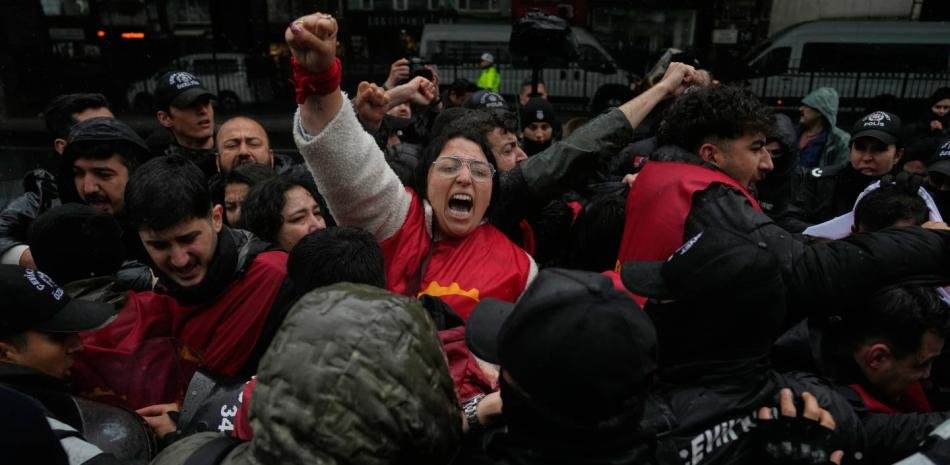
In Istanbul, Turkish authorities detained hundreds of protesters for attempting to march in areas declared off-limits for security reasons, particularly the central Taksim Square, the epicenter of the 2013 protests. May Day marches in Turkey are often marred by clashes with authorities.
Tens of thousands of people packed a public square in front of the US embassy in Havana, celebrating Cuba’s workers and denouncing US sanctions. Many carried banners with the slogans “Down with imperialism” and “U.S. hands off Cuba.” President Miguel Díaz-Canel and former President Raúl Castro attended the event.
Several protests were held in South Africa, where the head of the Congress of South African Trade Unions, Zingiswa Losi, said workers were “suffocating” over rising costs of food, electricity, transport and healthcare.
Mandatory holiday in France
May Day has special meaning this year in France following a heated debate over whether working should be allowed on the country’s most protected holiday – the only one when most employees have a mandatory paid day off.
Almost all businesses, shops and shopping centers are closed, and only essential sectors such as hospitals, transportation and hotels are exempt. A recent parliamentary proposal to extend working on this day caused widespread outrage among unions and left-wing politicians.
“Don’t touch May Day,” the unions warned in a joint statement.
Tens of thousands of people joined marches across the country, including in Paris, where there were brief clashes with police.
“May 1 is not just any day,” said Small and Medium Enterprises Minister Serge Papin. “It symbolizes social achievements derived from a century of construction of social norms that have given rise to the labor code that we know in France. It is, indeed, a special day.”
Calls for street protests and boycotts in the US
In the United States, where May Day is not a federal holiday, May Day Strong, a coalition of activist groups and unions, called on the population to protest under the slogan “workers before billionaires.”
Showing strong opposition to Trump’s policies, organizers listed thousands of actions for the day across the country and seek to cause an economic blackout with the slogan “no school, no work, no shopping.”
Their demands include taxing the rich and ending the Trump administration’s immigration offensive.
Although labor and migrant rights have historically been intertwined, the focus of the country’s May Day marches was on immigration in 2006. That’s when approximately one million people, including nearly half a million in Chicago alone, took to the streets to protest a federal law that would have made living in the United States without legal permission a felony.
Roots in Chicago
May Day, or International Workers’ Day, dates back more than a century to a crucial period in American labor history.
In the 1880s, unions pushed for the implementation of the eight-hour workday. A demonstration in Chicago in May 1886 turned deadly when a bomb exploded and police responded with gunfire. Several union activists—most of them migrants—were convicted of conspiracy and other charges, and four were executed.
Later, unions designated May 1 as the day to honor workers. A monument in Chicago’s Haymarket Square commemorates them with the inscription: “Dedicated to all the workers of the world.”