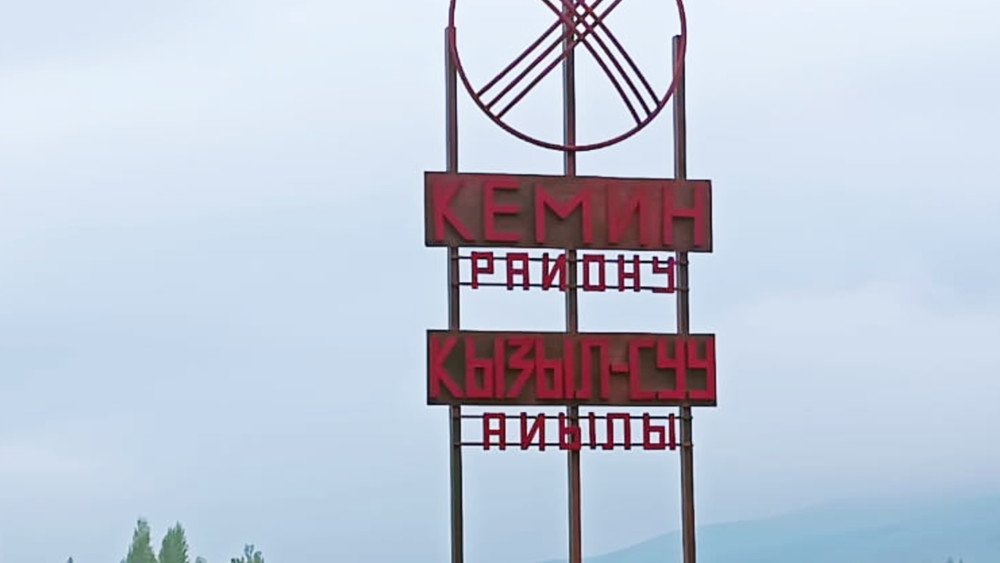
Turmush — About 1,400 people live in the village of Kyzyl-Suu in the Chym-Korgon ayil aimak, Kemin district, Chui region. About the history of the village Turmush said the head of library No. 18, Gulniza Uzagalieva.
Having passed Tokmok, Onbir-Zhylga, and then reached the village of Madaniyat and crossed the mountain river Kyzyl-Suu, a person encounters a beautiful monument dedicated to the people’s leader Kashka. It says: “Satybek uulu Kashka azhy.” Founder of the village of Kyzyl-Suu. 1992.” The then chairman of the aiyl okmotu, Kazy Abdinasirov, and honorary people of the three villages made a great contribution to the creation and completion of this monument. The author of the monument is the talented sculptor Aidarbek Usukeev.
According to Uzagaliyeva, in the matter of founding the village of Kashka, Azhy himself set an example. He was the first to build a house in the upper part of the present village of Kyzyl-Suu and lived there. He paid great attention to irrigation water and built a canal. The people called it “Kashkanin alyshy” (Kashki Channel). The village of Kashka, which was previously the center of the Bordu village council, also received the name Kashka Satybek uulu.
The people, who previously lived separately by clan, were mainly resettled in the upper part in the 1900s. At the time when the villages of Kyzyl-Suu and Almaluu began to form, orchards with sweet apples, pears and apricots remained on the lower side. They occupied many hectares of land, produced a rich harvest and created a comfortable place to rest in the shade for people working in the fields in the summer heat. The old empty houses left there were used as places for cooking and as shelter during hot weather or heavy rains.
“The residents who grew these orchards, famous for their fruits, in the lower part were the Shambetaalys – Smat’s father from Kyzyl-Suu, and his older brother Mambetaalys. Elders who have always lived in the village and worked on the collective farm often talk about this. During collectivization, these apple orchards were transferred to the collective farm. The descendants of these famous people, famous for their gardening – Manapbai and Karypbai Asanalievs – live in the village of Almaluu. It feels like the names of the villages are given very correctly and accurately. The village in the eastern part of the Kyzyl-Suu River received the name Kyzyl-Suu, imprinted in the memory and never leaving the lips of the people, and the name of the village Almaluu (Yablochnoe) has its justification. It was taken into account that in the hollows at the foot of the mountains near that place there were many wild apple trees, and also those vast gardens of previous settlements were not forgotten, which proved the skill of local gardeners – so the majority of the people gave the new village such a name,” she said.
Gulniza Uzagalieva notes that in the Chu Valley, including in the Kyzyl-Suu and Almaluu regions, land and water reform began to be gradually implemented after 1920.
“The impetus for this was the plan-decision adopted at the IX Congress of Soviets of Turkestan in September 1920. Attention was paid to the settlement of the nomadic population; since 1921, they were allocated lands for cultivation and pastures for livestock. They also lent money to sow grain. The Koshchu Union, which united the poor and peasants, contributed to the strengthening of Soviet power locally. Since 1922, the first collective farms – communes and artels – began to be created.
Until the end of the 1960s, the farm was called the Komsomol collective farm, and since 1970 it became the Kyzyl-Suu collective farm. In the 1893–1920s, the nomadic population began to settle down. During these years, on the initiative of Kashka azhy Satybek uulu, people began to settle in the foothills of Kyzyl-Suu, Almaluu, Bordu along the Kyzyl-Suu River. The local population was part of the Tynai volost, and after the October Revolution became part of the Pishpek district. On May 25, 1925, the Kyrgyz Autonomous Region was organized, the region became part of the Pishpek district, and the Chui office was created.
In 1928–1929, the Almaluu village council was formed. It was part of the Bystrovsky district. In 1933–1936, the chairman of the village council, Aryksha Korukchu uulu, went to Alma-Ata, brought a land surveyor, and the boundaries of the village council were clarified. In the 1920s and 1930s, massive work began to eliminate illiteracy among the population. In 1924–1933, the first 4-year school was opened, organized by Zhumabai Zhalilov. Afterwards, a 7-year school was organized, the director of which was Bakas Mamytov. In 1937–1942 he served as chairman of the collective farm.
In 1934–1937, the artels were merged into a collective farm, and Abdykalyk Kulchiev was elected chairman. In 1943–1959, during the war and after it, the task of restoring the destroyed economy was carried out by Kermaaly Aitpaev. This man served as chairman for 15 years. In 1953–1960, one of those who promoted the work of the collective farm forward was Abyui Tolaliev. At that time, the Komsomol collective farm was called a millionaire collective farm among districts and regions. In 1965–1968, Alybek Niyazaliev was appointed chairman of the Komsomol collective farm. In those years, the streets of the village were filled with gravel and the roads were repaired.
In 1970, for the development of agriculture, the Komsomol collective farm was transformed into the Kyzyl-Suu state farm. The director of the state farm was Mamytbek Zhakypov. During the period of the state farm, machine operator Cherikbay Maatkaziev worked, whose work was appreciated and he was awarded the Order of Lenin. In 1973–1974, under the director of the state farm, Abdibek Smatov, the farm was ahead in delivering meat, milk and wool to the state,” says Gulniza Uzagalieva, head of library No. 18.
The librarian also said that the first head of the aiyl okmotu was Esengul Isaev and that presidents visited the village.
“In 1991, the perestroika reform began in our country, and on November 1, the first president of the USSR, Mikhail Gorbachev, and the first president of the Kyrgyz Republic, Askar Akaev, arrived at the Kyzyl-Suu state farm. The Kyzyl-Suu state farm was one of the first in Kyrgyzstan to be disbanded into peasant farms, its director was Kazy Abdinasirov. On May 13, 1996, by Decree of the President of the Kyrgyz Republic, the Almaluu aiyl okmotu was formed. The very first head of the aiyl okmotu was Esengul Isakov.
In 1999–2003, Azhybek Kiyizbaev was appointed head of the Almaluu aiyl okmotu. In 2003–2005, Esengul Isakov was again elected head. In 2006–2007, Taalai Umetaliev was appointed head. Toktonaaly Orozbaev worked in 2008–2009. In 2009–2013, Ulan Kalybekov was appointed. Nurmukhambet Kasenov worked in 2013–2014. In 2014–2017, Daniyat Abdinasirov was elected head.
Since February 2017, Eldiyar Abdinasirov has been appointed head. In 2024, the aiyl aimak joined the Chym-Korgon aiyl aimak. During the days of the collective farm, Aman Maadanbekov was a carpenter who made working tools with his own hands. Also blacksmiths who made plows, shovels, ketmen, scythes and other tools were Maatkazy Suranchiev, Duiseke Baysekeyev, Asan Sadyraliev.
More than 200 citizens left the Almaluu rural administration for the Great Patriotic War, of which 42 returned alive and healthy. 172 war veterans were awarded orders and medals. Currently, no one is left alive. In memory of the war participants in 1999, a monument was erected in front of the aiyl okmotu building. During the war, the people of Almaluu did not allow agriculture to decline: old people, women with children and able-bodied women plowed the fields, grazed livestock and sent food from the collective farm to the front. Among the women was Zhamilya Toktosunova, who plowed the land on a tractor.
After the war, during the difficult period of economic restoration, Kermaaly Aitpayev worked as chairman for 15 years. The activists were Alpamysh Zhunushpayev, Beltai Abdrasulov, Satygul Monoldorov, Baidaly Isakov. One of the first women to chair the village council was Shaliman Basmalieva. During these years, the Kyzyl-Suu secondary school, the building of the village council of the Komsomol collective farm, a garage, a club, and the buildings of the current FAP were built.
Library No. 18, located in two aiyl okmotu, has been operating since the 1960s. And the school named after Mukash Omuraliev was built in 1975. It is located in the center of the village of Kyzyl-Suu.
50 years later, in 2025, with the help of an incentive grant and the Keminn District Development Fund, the school was overhauled and a marathon was organized in honor of the 50th anniversary. The school has 343 students, 24 teachers and 12 technical staff.
The FAP in Kyzyl-Suu is located in the old state farm office, 2 nurses work there. In the village there is a kindergarten “Zhamila apa”, where 75 preschool children are educated. There is also 1 mosque and a mini-football court, commissioned in 2018. There are 9 streets in the village.
According to 2015 data, the population is approximately 1.37 thousand people.