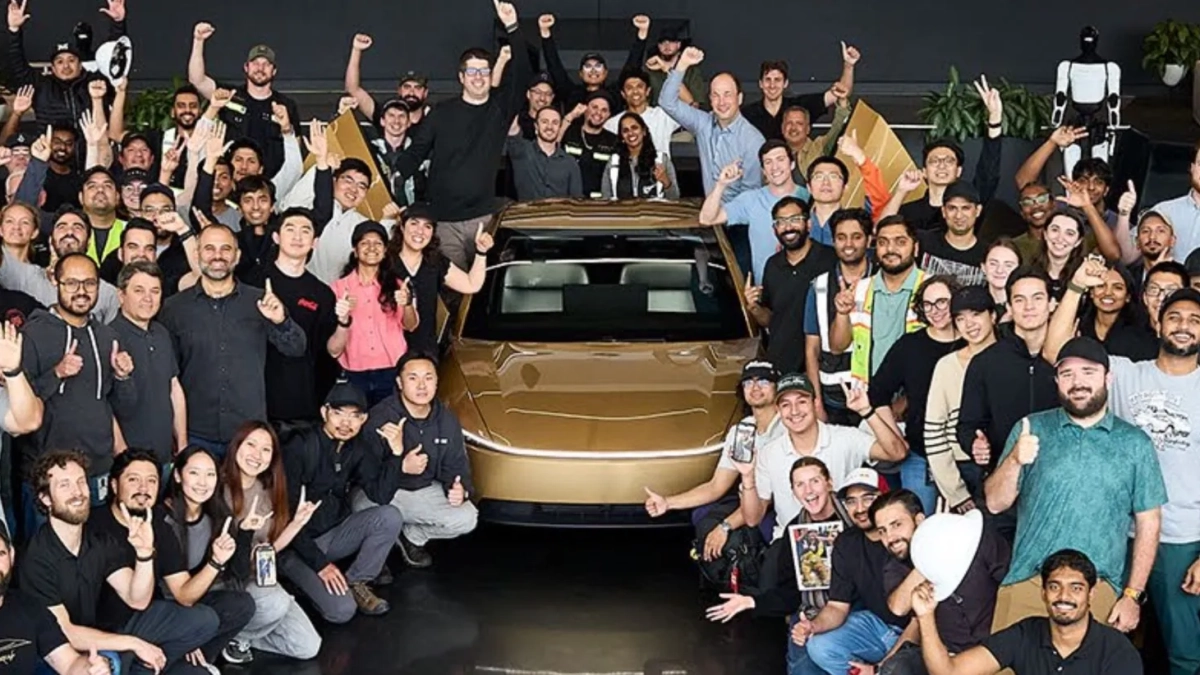
After continuous postponements it seems that the Cybercab has started to roll off the Giga Texas assembly lines, with the first examples arriving shortly

With the usual biblical times that elapse between Elon Musk’s enthusiastic announcements and the reality of the facts, it can officially be said that the Cybercab – the two-seater robotaxi developed by Tesla – has started production, with the first examples ready for delivery by the end of next month. As the founder of the American brand wanted to underline, being a completely new production line, slowdowns and delays are to be expected in this first phase, with the lines that will operate at full capacity only towards the end of the year.
No limits on production
Another interesting thing that came out during the traditional investor meeting is that it seems that the Cybercab will not be subject to the constraint that limits self-driving vehicles to 2,500 units per year. A rule which, in fact, until now has limited the diffusion of the vehicles of robotaxi operators such as Waymo and Cruise, forced to request an exemption from the NHTSA – National Highway Traffic Safety Administration, the most important road regulation authority in the USA and which deals with verify that cars meet all federal safety standards. While Congress is considering whether to raise the limit from 2,500 to 90,000 units, Tesla has sought the path of self-certification which would allow it to increase production without being bound by the exemption limits.

Only two people, with or without steering wheel and pedals
The first Cybercab unit without a steering wheel rolled off the production line in Februarybut actual production only began in April, in the Giga Factory in Texas where they will be released both the variants with steering wheel and pedals, and those that are entirely without them. In fact, the Cybercab was designed to accommodate only two people, with a form of autonomous driving which however – for the unsupervised version of the Tesla – still seems to have quite a few problems. In fact, Tesla’s current fleet of supervised robotaxis experience accidents about four times more frequently than human drivers: one accident every 57,000 miles (about 91,000 km) compared to the average of one accident every 229,000 miles (almost 370,000). In fact, Musk had to admit that the software still has problems, with cars crashing unexpectedly and suddenlyrefusing to proceed.

Despite the critical issues, Tesla is thinking about Superchargers exclusively
All this casts a heavy shadow on the Cybercab, which it was much criticized for the choice of being limited to two seatsdespite its large dimensions. Musk responded by saying that “90% of the kilometers traveled are done with one or two people on board”, further claiming that he expects the robotaxi to absorb a large part of the production lines in the future. However, this is unlikely to happen: the market for two-door cars in the USA is less than 10% and that for two-seater cars is even at 1%. Equally unlikely is that user confidence in Tesla’s autonomous driving system based on cameras and neural networks – already criticized for its danger – will grow rapidly. Getting into a car without a steering wheel or pedals also requires practically absolute trust in the technology which at the moment remains to be verified. Yet Tesla firmly believes in it, so much so that it has already submitted authorization requests for two private Supercharger stations in Arizona, dedicated exclusively to its robotaxi fleet.