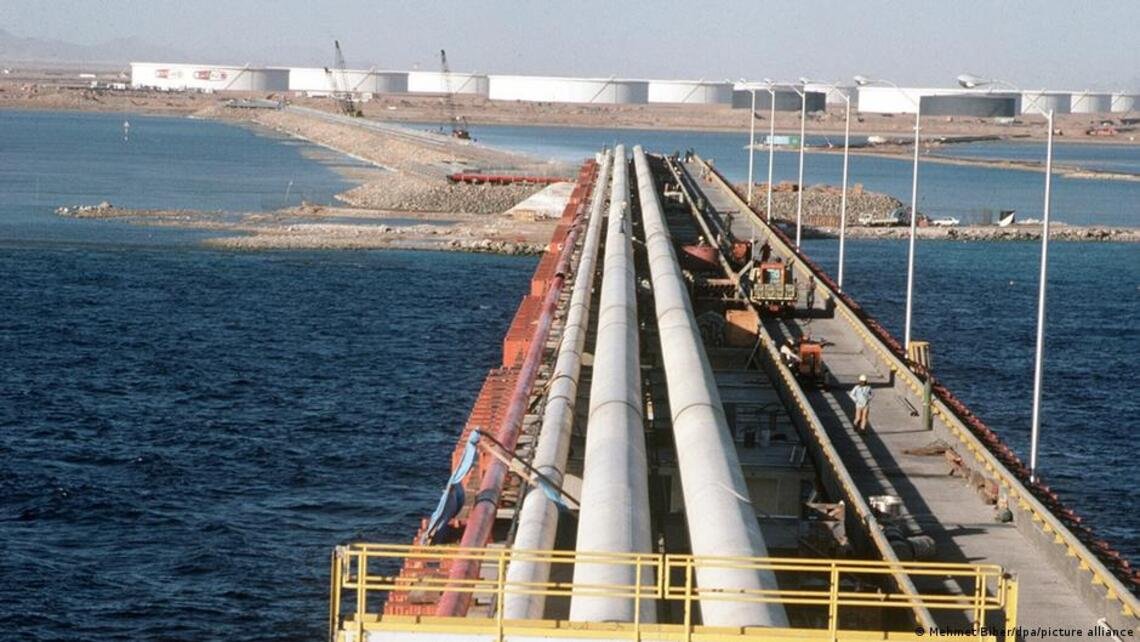
Already four decades ago, the Strait of Hormuz revealed its vulnerability to the global oil market. After attacks on oil tankers during the Iran-Iraq war (1980-1988), Saudi Arabia reacted by building the East-West pipeline across its vast desert peninsula to the port of Yanbu on the Red Sea. Years later, the United Arab Emirates (UAE) did the same with the Habshan-Fujairah pipeline, which connects the emirate of Abu Dhabi with the Gulf of Oman.
Now, after the closure of the strait in the war between Iran, the United States and Israel, the focus is on reducing the risks. The global energy market is relying on other oil nations to increase their production, while world powers such as China, India and the European Union, along with environmental groups, are urging accelerated investments in renewable energy.
Gulf countries’ goal: avoid the Strait of Hormuz
Meanwhile, Gulf leaders are moving forward with plans that will enable more of their crude to bypass the Strait of Hormuz entirely and help secure long-term exports.
In early April 2026, the newspaper Financial Times reported that Saudi Arabia, the United Arab Emirates and other countries were evaluating the construction of new pipelines that would run parallel to existing structures, along with the expansion of export terminals on alternative coasts.
Landon Derentz, senior director of the Global Energy Center at the Atlantic Council think tank, called on the Trump Administration to support those new projects with U.S. funding.
“Rather than forcing ships through that critical point, the United States and its partners should quickly build alternative infrastructure,” Derentz wrote in a recent report. “Saudi Arabia has already shown that bypass infrastructure can alleviate some of the bottleneck. That model should be dramatically expanded.”
The existing 1,200-kilometer Saudi pipeline is already operating at full capacity of seven million barrels per day (bpd), up from five million before the war, while the United Arab Emirates is transporting another 1.8 million bpd to its port of Fujairah.
Saudi Arabia and UAE need to double pipeline capacity
While those measures are providing some relief to global oil markets, the magnitude of the challenge is clear, according to Robin Mills, chief executive of Qamar Energy, a leading consultancy based in Dubai.
“Before the war, about 15 million barrels a day transited the strait,” Mills told DW. “It would be necessary to double (the current capacity of the pipelines) to be able to export that same amount of crude oil.”
He Financial Times quotes officials and energy experts as saying that while new pipelines are expensive, time-consuming, and sometimes politically complex, they would be the only way the Gulf states can reduce their vulnerability to future disruptions.
According to Mills, many of these beltway plans have been in the works for years, but those involving multiple countries have stalled due to distance, cost and regional rivalries.
Countries that cannot avoid Hormuz
“New routes from Saudi Arabia or the United Arab Emirates could start almost immediately and take a couple of years to build,” says Mills. Kuwait, Bahrain and Qatar have no alternative coastlines and almost all of their hydrocarbon exports transit through the Strait of Hormuz.
“They would most likely have to go through Saudi Arabia or Iran, which involves long pipelines and complicated political negotiations, which would take a minimum of three to four years, probably longer.”
The International Energy Agency (IEA) advocates the construction of a new major oil pipeline from Iraq to the Turkish port of Ceyhan, in the Mediterranean.
The executive director of the IEA, Fatih Birol, told the Turkish newspaper Hurriyet that the “extremely attractive” project would boost energy security, “especially from a European perspective,” and that “the financing problem can be overcome.”
Iraq’s push toward Western pipelines
The Iraqi export pipeline connecting the northern region of Kirkuk with Turkey was built in the 1970s and was reactivated in September 2025 after a two-and-a-half-year shutdown. It currently pumps up to 250,000 barrels per day.
Earlier this month, the Iraqi government pushed the $4.6 billion (€3.9 billion) Basra-Haditha stretch, which runs from the south to the Syrian border, into the bidding phase.
This 685 kilometer pipeline is considered the crucial initial section that could later be extended to the Jordanian Red Sea port of Aqaba, or even to Syria or Turkey. If approved, it would have the capacity to supply up to three million barrels per day in phases.
Iraq is also evaluating the construction of an independent oil pipeline connecting to the Omani port of Duqm, in the Gulf of Oman.
Gulf countries also already have concrete plans to expand limited rail and road networks to facilitate the export of non-oil goods and ease pressure on supply chains.
The Gulf Cooperation Council’s (GCC) flagship railway project aims to create a 2,100-kilometre integrated network spanning all six GCC countries by 2030.