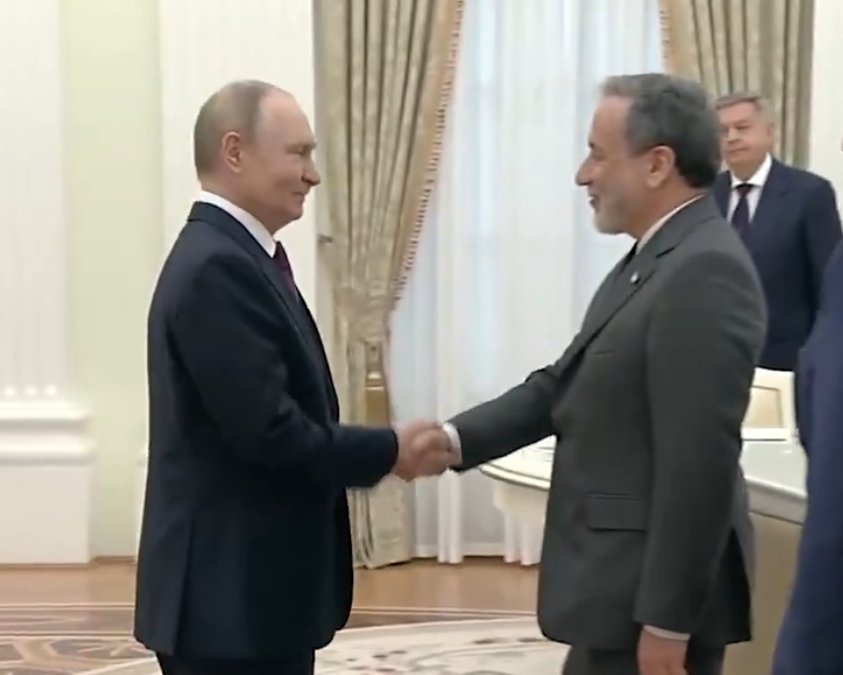
The visit of the Iranian foreign minister, Abbas Araghchi, to Moscow marks a new stage in Tehran’s diplomatic offensive, which is seeking support in its standoff with Washington after stalling direct talks, while Vladimir Putin reaffirms its role as a key ally of Iran amid lingering tensions in the region.
Almost three weeks after a ceasefire reached after 40 days of fighting between Iran and Israelan ally of the United States, Moscow remains one of the main supporters of the Islamic Republic.
Iran is waiting for Moscow’s support
Iran and Russia presents “a common front” in the face of “world hegemonic forces” opposing countries that aspire “to a world free of unilateralism and Western dominance,” Iran’s ambassador Kazem Jalali wrote on X.
He stated that the meeting will take place in St. Petersburg, a statement not confirmed by the Russian news agency.
In the absence of a prospective meeting with American emissaries, the Iranian foreign minister is intensifying his contacts, centered around Pakistani diplomacy, which plays the role of mediator with Washington.
Araghchi initially arrived in Islamabad on Friday for talks with Pakistan’s powerful army chief Asim Munir and Prime Minister Shehbaz Sharif before heading to Oman where he met Sultan Haitham ben Tariq.
“As the only riparian states on the Strait of Hormuz, we have focused on the means of ensuring safe transit in the interest of all our dear neighbors and the entire world,” Araghchi wrote on X after his meeting with the Sultan of Oman, referring to the strait under dual Iranian and American blockade.
Discussions and with Turkey
The minister also had a telephone conversation with his Turkish counterpart, Hakan Fidan, before returning to Pakistan and to leave for Russia on Sunday.
According to Iran’s Fars news agency, Tehran sent “written messages” through Pakistan to Washington regarding “red lines” regarding its nuclear program and the Strait of Hormuz.
Attempts to resume the talks initiated at the beginning of April in the Pakistani capital have so far failed in the face of the firm attitude shown by both Washington and Tehran.
Trump doesn’t want negotiations anymore
Donald Trump on Saturday canceled a planned visit to Pakistan by his son-in-law, Jared Kushner, and his special envoy, Steve Witkoff.
“I said we’re not going to have any more” direct negotiations with Iran, the US president said on Fox News on Sunday, before telling the Iranians: “if they want to talk, they can come to us or call us, we have very good secure phone lines.”
“We have done a very good job, it will be over soon and we will emerge victorious,” he added referring to the conflict.
On Saturday night, President Trump also dismissed the hypothesis of a link between the war and the entry of a gunman at the annual White House Correspondents’ Gala he was attending in Washington.
The blockade in the Strait of Hormuz is maintained
While the Strait of Hormuz, through which 20% of the world’s oil and liquefied natural gas (LNG) transited before the conflict, is subject to a double blockade by the belligerents, the US military announced the interception in the Arabian Sea of a vessel under sanctions “for activities related to the transport of Iranian energy products”. The ship then “returned to Iran under escort”.
According to the US military’s Middle East Command, “37 ships have been diverted since the start of the US blockade” of Iranian ports.
The command of the Iranian armed forces threatened United States with a military response if this blockade continues, denouncing acts of “piracy”.
The attacks continue in Lebanon
On the Lebanese front, Israeli attacks in the south of the country left 14 dead, the worst daily toll since the ceasefire came into force nine days ago, according to Health Ministry figures.
Two children were among those killed, the ministry said, adding that 37 people were injured.
The Israeli military indicated that one of its soldiers was killed and six others were wounded in the fighting in Lebanon.
Israeli Prime Minister, Benjamin Netanyahuand the pro-Iranian group Hezbollah have accused each other of violating the truce, the three-week extension of which was announced by Donald Trump on Thursday.
“Hezbollah’s violations are actually destroying the truce,” Netanyahu charged. Rejecting the allegations, Hezbollah said it would continue to retaliate against Israel’s “continuous violations” of the ceasefire.
Lebanon has recorded more than 2,500 people killed by Israeli operations since the Shiite movement resumed hostilities with Israel on March 2. At least 36 people have been killed since the ceasefire took effect on April 17.