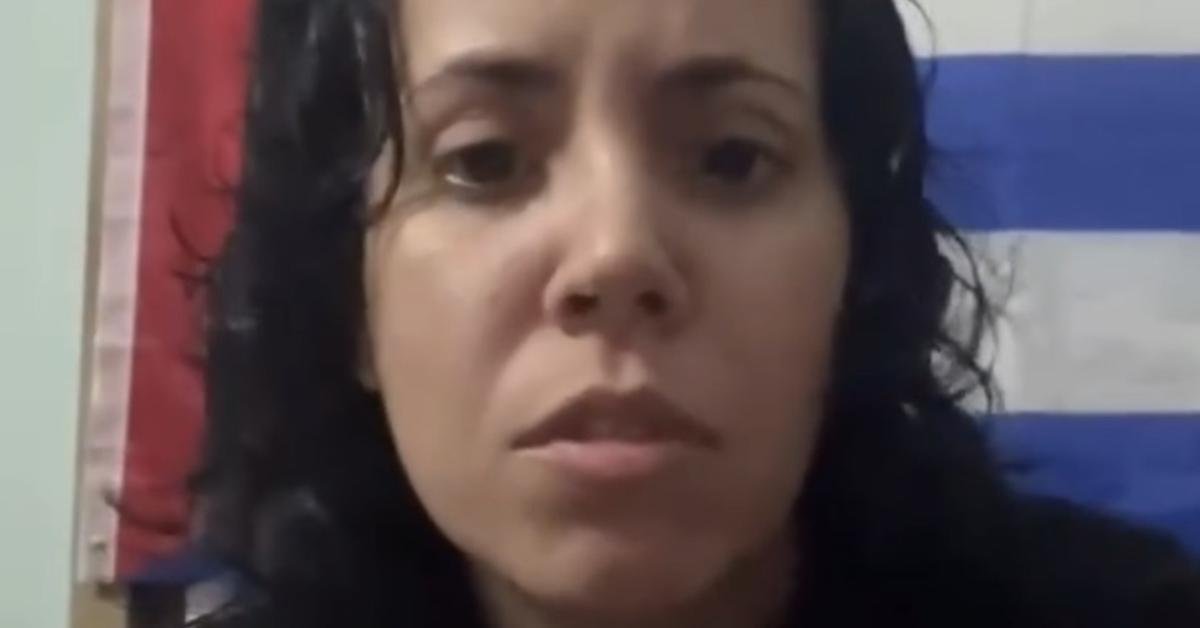
Madrid/Independent journalist Camila Acosta reported this Wednesday that she had been the victim of a kidnapping by State Security, which detained her on Tuesday afternoon. For eight hours, he remained at the Playa police station, from which he left with a warning report for having recorded a video in which an agent who prevented him from leaving his house on October 28 was identified.
The arrest took place near his home through a joint operation of plainclothes officers and uniformed police. According to the reporter, the agents tried to prevent her from using her phone. “This was one of the State Security officers who detained me without a court order, who kidnapped me, literally kidnapped me because there was a moment when I had to shout to the neighbors: ‘Please tell my husband that you are taking me,’” she said in a statement. direct drive on social networks in which he has once again shown the images of another agent.
Acosta explained that during her arrest she was accused of having provoked an attack on the mother of the State Security member whom she recorded last week, something that, in her opinion, they used to predispose the neighbors against her. “It was a showall the neighbors there watching… There was a moment when the neighbors began to say: ‘Don’t put handcuffs on her, don’t do that to her, she is a decent person, she is not a criminal.’ And that’s when the officer says: ‘Because of her they beat up the mother of a revolutionary.’ “Everything is a lie, all of this is to humiliate and defame us before our community,” he said.
It was the first time in her life that she had been handcuffed and she added that, although the handcuffs were not tightened, she arrived at the police station with pain in her wrists.
The reporter, who has been arrested numerous times over the years, stated that it was the first time in her life that she had been handcuffed and added that, although the handcuffs were not tightened, she arrived at the police station with pain in her wrists. There she had to wait, in the sun, for long minutes until she was taken inside and interrogated by a lieutenant colonel identified as Luis Miguel and the agent who arrested her. In the conversation, both explained to Acosta that the dissemination – which the journalist attributed to CubaNetmedia for which he works – of the video can constitute a crime against the privacy of the official. These facts are the same for which she was convicted a month ago activist Anna Bensi to two years of limitation of freedom.
Acosta argued with the agents who were interrogating her, asking them insistently why the officer in the video had prevented her from leaving the house and by what right they could limit her freedom of movement without even an order, but they stated that they did have the power to do so. “That State Security officer did not identify himself, he was dressed in civilian clothes. I left my house, I don’t know if he is a thug, I don’t know if he is a criminal, I don’t know if he is a drug addict… Because a guy comes here to my house so I don’t have to obey that order,” he claims.
The reporter assures that the filming was produced as a method of defense against the systematic violation of human rights suffered by those, like her, who confront the regime. Furthermore, and in response to the demand that these events not occur again, Acosta told the agents that he will repeat it as many times as necessary.
“When it is a State that is against the individual, that is State terrorism. And I insist: I have done it until now and I am going to continue doing it. Every time a patrol stops me and an officer who has no order or justification prevents me from leaving, I am going to record them because that is my support, my only guarantee,” he insisted.
Acosta left the station at eight at night, after being able to talk to her husband to pick her up.
Acosta left the station at eight o’clock at night, after being able to talk to her husband so that he could pick her up – the activist reports that until the last minute she was not allowed to telephone anyone – and she was given a warning document which, although it does not represent a precedent, does pose a risk if the behavior is repeated, and could lead to the opening of a case.
The journalist claims that, during the hours she spent in the cell, the agents mentioned the possibility of attributing different crimes to her, from acts against personal privacy to counterrevolutionary activities and instigation to commit a crime. “They couldn’t agree on which crime to apply to me,” he says ironically.
Furthermore, he claims that his mobile phone was destroyed with some type of acid or similar. “It had a green, greasy liquid. In fact, the case still has it in the corners. The best revenge they could have was to break my phone, because now I’m without it. Right now I’m only communicating through the laptop but I’ll have another one,” he said.
During the hours he was in custody, Acosta refused to eat or drink anything, for fear – he claims – of what they might give him. She also warned that the conditions – in addition to the darkness – were, at best, unhealthy, and she did not rule out developing an illness in the coming days due to the bite of one of the many mosquitoes that surrounded her in the cell. “I insist on thanking everyone who was concerned, those who were aware of the arrest. Visibility on social networks does work and it is the only support we really have when we are there alone in a semi-dark cell, without any protection, totally defenseless and vulnerable.”