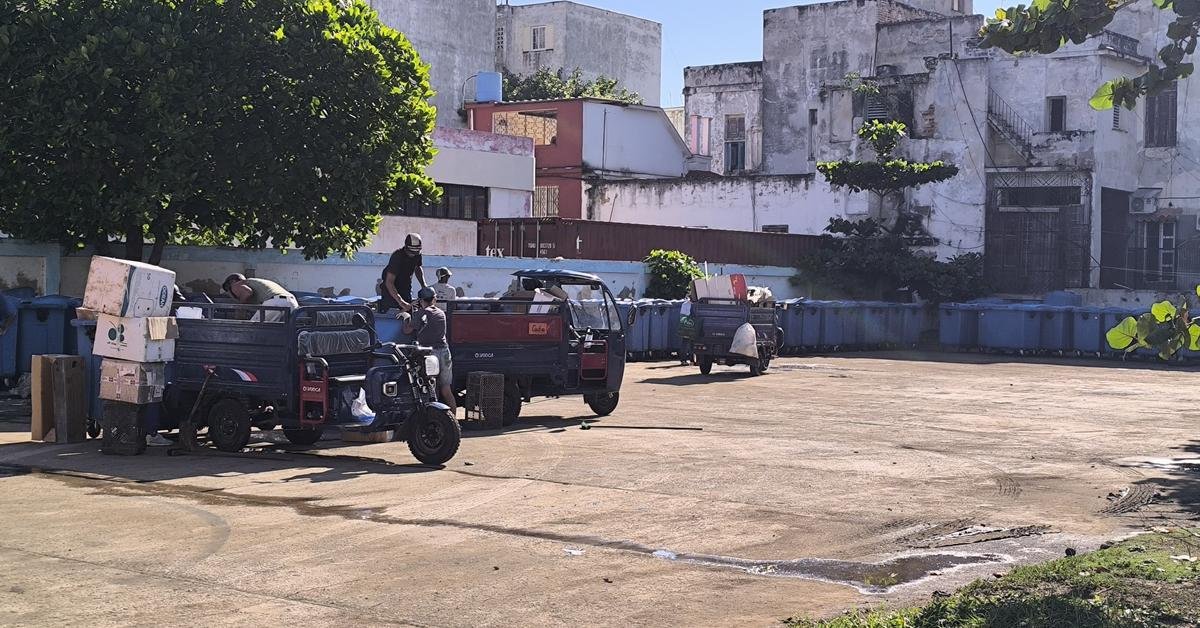
Havana/The bend that forms 5th Street and H, in Havana’s El Vedado, one block from the Malecón, is abuzz this Wednesday. Around fifty containers that occupy what was previously the parking lot of the Deportivo José Martí, electric tricycles come and go to leave bags of waste, and a Comunales truck takes what it can carry, which had accumulated for several days. In short, this place is the final destination of the garbage collected by the Popular Council Rampa pilot project called The Rampeñoand that continues to raise suspicions.
“This is from the project that collects garbage on electric tricycles,” confirmed a local resident. Twisting his face, he objected: “That is very good in principle, but they put those tanks there without anyone, and we do not agree with concentrating the waste so close to the homes.” Indeed, there is not much distance between the containers and the houses on the other side of H Street, from where the smelly blue row can be seen.
Another nearby resident explained that “probably due to lack of fuel, they had not come to pick up the garbage for several days.” If they came today, he assured, it is “because people have been complaining on social networks.” And he lamented: “This concentration of garbage attracts rodents and is a source of infections, not to mention the stench that exists all day and gets into the kitchen.”

/ 14ymedio
On the Facebook page of the Government of Havana, user Leticia Machín denounced the “unhealthy state” of the central garbage “collector” of El Rampeño. Although the woman judges the plan to be “successful,” she points out that, “apart from the indiscipline, which does not accompany the project,” the collection center was installed without consulting or even informing the neighbors. Currently, residents live with “a large number of flies and rodents” and “the typical bad smell of decomposing garbage.”
To make matters worse, the complainant continued, “they not only throw garbage there, but debris, bushes and other waste.” This newspaper certainly confirmed how a spontaneous dumping site for various waste has formed next to the containers, with remains of vegetation.
All of this, Leticia Machín concluded, is “a violation of environmental regulations and the rights that as human beings we have to live in a healthy and hygienic environment.” And he asked: “What response, what solution are they going to give to this situation? We have already complained at the municipal level to the local authorities of the Plaza government and the response is silence.”
/ 14ymedio
Among the comments, a correct Daris VT responded: “They dismantle one doll to assemble another.” Along these same lines, a neighbor he met this Wednesday 14ymedio He explained: “In the end it means moving the garbage from one place to another, and if not some, others end up having the problem, because the garbage does not disintegrate by chance.” His wife added, with bitter irony: “And you don’t eat it, because if you don’t you won’t be able to eat it.” had garbage in this country.”
El Rampeño, led by the hardworking local official Pedro Garcesat the head of the Popular Council, has been marked more by expectations than by tangible results. When it was presented at the end of June, its promoters announced the incorporation of 30 electric tricycles and the hiring of about 70 workers. On July 1, when the project began, they were only operational five of the total number of vehicles planned.
They also promised a solar charging station that would reduce dependence on the national electrical grid and extend collection to 14 constituencies of the Rampa Popular Council, which also did not happen.
Despite these difficulties, the first results were encouraging in the few streets served. On July 15, 14ymedio found that some of the areas included in the tours were practically free of waste. It was enough, however, to walk a few meters to a street out of service to find again overflowing containers and mountains of garbage.
/ 14ymedio
On that date, El Rampeño operated only in four small areas of the popular council. The difference between a clean street and one converted into a landfill depended, fundamentally, on being inside or outside the routes. The project demonstrated that it was possible to keep some areas in better conditions, but it was still far from offering a solution for the entire neighborhood.
In August, the problems were no longer just coverage problems. Garces publicly acknowledged that the initial objective had not been achieved. The official also criticized the delays in finding alternatives to charge vehicles during the prolonged blackouts.
However, the project has continued, even though the collectors have to carry waste with handsjust as they were surprised by this newspaper a few weeks ago. Lacking the means, El Rampeño also trusts their fate to paying attention to the signs written with a red brush and placed here and there around El Vedado: “Notice. Do not throw garbage or debris.” Unlike other successful posters in the capital, it is not accompanied by penalty warning.