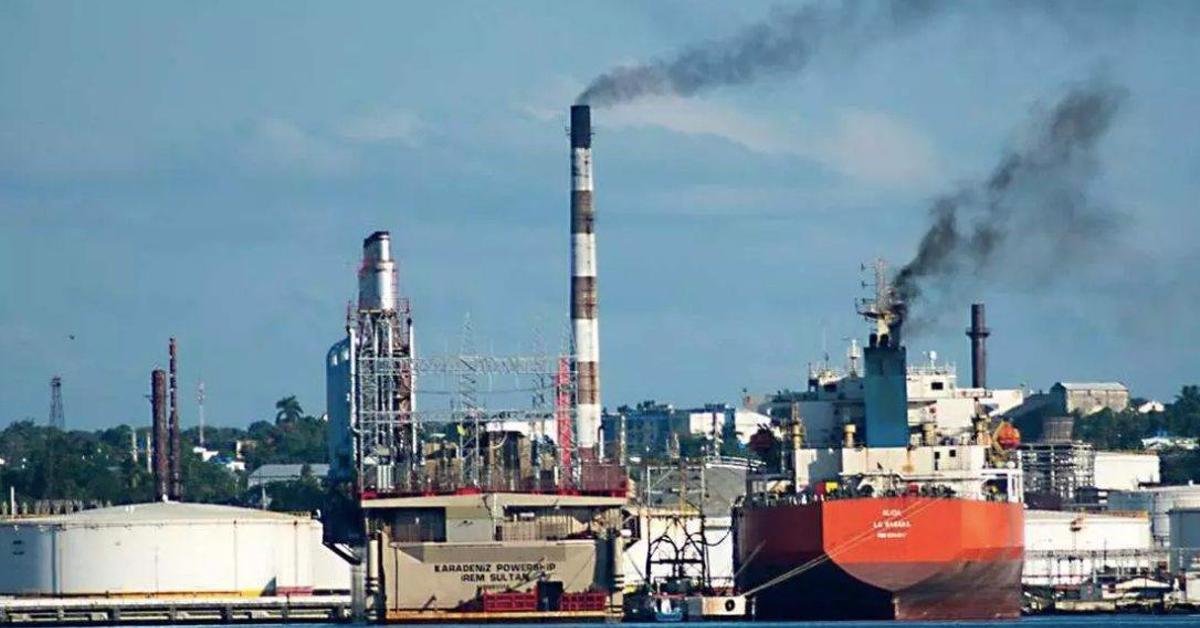
Havana/The Cuban Government updated its rules on Monday in the hydrocarbon sector and will allow investment by nationals and foreigners based on “the economic needs of the country,” which has been facing a deep energy crisis for two years.
Among the announced measures, Cuban refineries will be able to sell fuel directly to the public, as long as they obtain specific authorization, although the regulation does not specify which body must grant it. The rule appears in Decree 184/2026, published this Monday in the Official Gazette of the Republic of Cuba, number 85which also allows refineries to market their products wholesale, directly or through specialized companies.
Decree-Law 135/2026 expands the possibilities of participation in the exploration and exploitation of deposits, as well as in the transportation, storage and marketing of oil and gas. Decree 184/2026 develops these provisions.
MSMEs, self-employed workers, private Cuban companies with more than one hundred employees and foreign investors may participate.
Pedro Abigantus León, director of Investments and Oil and Gas Businesses of the Ministry of Energy and Mines, explained in a press conference in which the rule was presented that MSMEs, self-employed workers, private Cuban companies with more than one hundred employees and foreign investors may participate, in accordance with the activities authorized for each one.
Article 172 of the regulations requires marketers to have the corresponding registrations, licenses and permits. The supply must be carried out through contracts and buyers will have to prove technical and safety conditions to receive the product.
Article 105 of the Decree-Law establishes that the prices of oil, gas and their derivatives will take the international market as a reference, in accordance with a methodology that will be established by the economic authorities. It does not announce new prices nor eliminate state intervention in their formation.
Beyond distribution, the Government seeks to attract capital to increase crude oil extraction. The legislation incorporates oil concessions along with production sharing contracts, used since the 1990s. The latter may reach 40 years, extendable for another ten.
Contractors will be able to recover their recognized expenses with up to 65% of gross production in land and shallow waters, and up to 75% in deep waters.
The regulation also allows contractors to recover their recognized expenses with up to 65% of gross production in land and shallow waters, and up to 75% in deep waters. The remaining part is distributed according to what was agreed with the State.
The rules will come into force on October 19. Although they expand the modalities of business participation, they do not identify new investments or guarantee that the availability of fuel for the population increases.
The new regulation comes when the private sale of fuel is already widespread on the Island. In July, Prime Minister Manuel Marrero announced that more than one hundred private companies had authorization to wholesale fuel. He also reported the approval of a first business with foreign investment to import, distribute and sell fuel. Although he did not identify the company, it is assumed that I was talking about Bulkan MSME with foreign capital whose facilities 14ymedio He went to visit on Avenida del Puerto, in Havana.
The new regulation comes when the private sale of fuel is already widespread on the Island
In April it was learned that the authorities They rented state gas stations to MSMEs. The Acapulco service center, in Nuevo Vedado, dispatches fuel purchased in the United States by a private company.
In July, A Bulk began operating, which uses Cupet facilities in Havana and offers imported diesel at $2.50 per liter, based on certain quantities.
Since September, the Supermarket platform offers gasoline and diesel paid online, with pickup at various Havana service centers. Regular B90 gasoline costs $3.20 per liter and diesel costs $2.40.