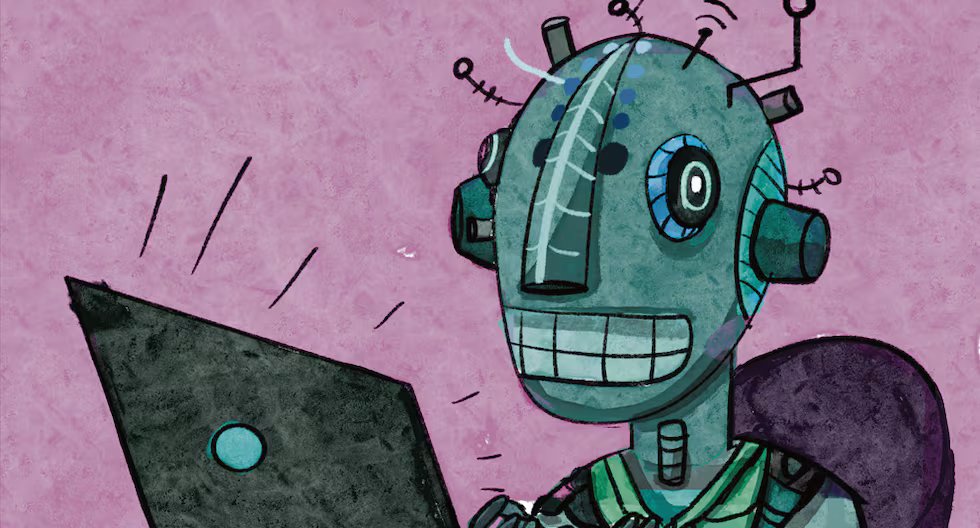
The world will no longer have to wait until 2075 to get closer to the scenario of The Moon is a cruel loverthe science fiction novel that Robert A. Heinlein published in 1966 and in which a computer makes decisions on its own, without human intervention. Agentic Artificial Intelligence (AI) is beginning to bring us closer to that scenario. An example is Molbot, an open source program that can function as a standalone extension of its user. Although it is an advanced level, the first steps of this technology are already reaching the region and Peru.
Rappi, for example, uses agents to analyze photos and validate claims, as well as manage refunds and cancellations. It also uses them to audit interactions with its users and provide agentic support through WhatsApp. At Natura, agents such as “Maya”, “Nat” and “Vela” make personalized recommendations to its 130,000 consultants, generate performance reports and identify the categories that each user purchases the most to offer suggestions in real time.
The German company SAP, for its part, began approximately a year ago to integrate agent-based solutions in the Peruvian market, which have still been adopted by 10%-15% of its clients.
The list of cases is long. At Microsoft, Mario Rodríguez, general manager of Microsoft Peru and leader of Consulting and Unified Services for MCSA (Microsoft Central and South America), points out that “in the last year, the creation of AI agents has multiplied by 15.” In fact, in June of this year, 89% of Latin American companies planned to adopt AI agents in the next 12 to 17 months.

In June of this year, 89% of companies in Latin America planned to adopt AI agents in the next 12 to 17 months. Image made with AI
Unlike a traditional language model, which only calculates probabilities to answer a question, an agent is that same model, but with the ability to perform actions and use tools, explains Omar Florez, PhD in Artificial Intelligence. Along these lines, there are also autonomous agents, those that are more evolved, that operate and interact by themselves for long periods of time. “He has a broader reasoning capacity or has been trained to reason. What is reasoning? It is taking a problem and breaking it down into parts. And then making each of these plans step by step,” he mentions.

According to McKinsey Global Institute, agents concentrate much of the potential for work automation in Latin America. In the 15 Latin American countries analyzed, including Peru, 57% of current working hours could technically be automated with existing technologies. 39% of that total could be achieved by agents doing non-physical work. / Image made with AI
Their capabilities are also analyzed when evaluating their potential to increase productivity. The study Agents, robots and usfrom McKinsey Global Institute, reveals that agents concentrate much of the potential for work automation in Latin America. In the 15 Latin American countries analyzed, including Peru, 57% of current working hours could technically be automated with existing technologies. 39% of that total could be achieved by agents doing non-physical work.
At the business level, Andrés Méndez, director of Customer Experience and Digital Transformation at Konecta Perú, observes greater adoption of agents in tasks such as collections, digital negotiation and transactional management in e-commerce and retail, among others.
“The main operational advantages they provide are scalability to manage massive peaks in demand without linearly increasing costs, continuous 24/7 attention without waiting queues and the possibility of freeing human collaborators to focus their talent on highly empathetic efforts, strategy or negotiation,” he highlights.
Konecta observes that, in banking and financial services, digital collection operates at 20% of the cost per call compared to the traditional channel. In tourism and hospitality, the Iberostar case made it possible to reduce waiting time at check-in by 65% and increase customer satisfaction by 20%. In insurance, in addition, a reduction of up to 40% has been achieved in end-to-end claims processing time.

Konecta observes that, in banking and financial services, digital collection operates at 20% of the cost per call compared to the traditional channel. / Image made with AI
Rappi has reduced the operational cost of service by less than half thanks to AI, which is integrated into its Customer Experience operation. “It allows us to resolve a much larger proportion of cases in an automated way: in the last year, the resolution of tickets handled by AI and automations went from 76% to more than 90%,” mentions Eugenio La Rosa, vice president of Customer Experience at Rappi.
At the level of adoption of artificial intelligence, Peru is growing at an average rate of 17.3%, very close to global levels (18%), says Rodríguez, from Microsoft. Although the figures focus on the use of generative AI, in the case of agentic AI there is still no quantitative measurement. However, its use already reaches sectors such as banking, insurance and manufacturing.
“I see three main uses: the generation of efficiencies; that is, to achieve faster and more accurate processes; to generate income in contact center-type sites (contact centers). A third very strong use is in mergers and acquisitions (M&A) because the valuation of companies increases when the company is more technologically advanced,” he highlights.
Growing in its implementation, “is a matter of time,” highlights Rodríguez, since it is enough for companies to identify the processes in which they can apply it, beyond the obvious.
However, on this path it is also necessary to consider the challenges that its incorporation entails, especially as agent models advance in autonomy and complexity, mentioned Juan Carlos Zevallos, CEO of IBM Peru, during the 2026 Leaders Congress, held in Peru, Mexico and Colombia.
“Agent AI is growing a lot. The challenge is generated in the management of agents, the excessive and uncontrolled use and growth. This is where technology companies are seeking to contribute to avoid cybersecurity disorder and exposure,” he said.