Havana/While Cuba loses more and more artists, the State does not give up deciding who can officially be one. Hundreds of musicians, actors, playwrights, filmmakers, dancers and visual creators have decided to rebuild their careers outside the Island, but the new labor framework preserves intact an old faculty of power: to accredit, evaluate and even withdraw the status of professional artist from any creator.
Resolution 29/2026 of the Ministry of Culture, published this Friday along with the new Labor Codeestablishes that artistic evaluation is “mandatory to practice professionally in the artistic field”, except for the exceptions provided. Its objectives even include “granting or revoking the status of professional artist.”
The standard replaces another from 2014, but does not dismantle the system. The Cuban Institutes of Music and Cinematographic Art and Industry, the National Council of the Performing Arts and the Institute of Information and Social Communication maintain control of the evaluation process, designate courts and handle claims.
The mechanism is inevitably reminiscent of Decree 349, approved in 2018 and not yet repealed
The system is not limited to an initial certification. Artists can be subjected to periodic evaluations and, if they lose the required category, be “devalued.” In that case, the entity with which they have an employment relationship may terminate the relationship. The regulations themselves also contemplate that an unfavorable evaluation may lead to the loss of professional status or the dissolution of an artistic unit.
The mechanism is inevitably reminiscent of Decree 349, approved in 2018 and not yet repealed. That rule made the provision of certain artistic services without authorization a contravention and allowed both creators and those who hired them to be punished. The measures included fines, confiscations, suspension of shows and withdrawal of licenses.
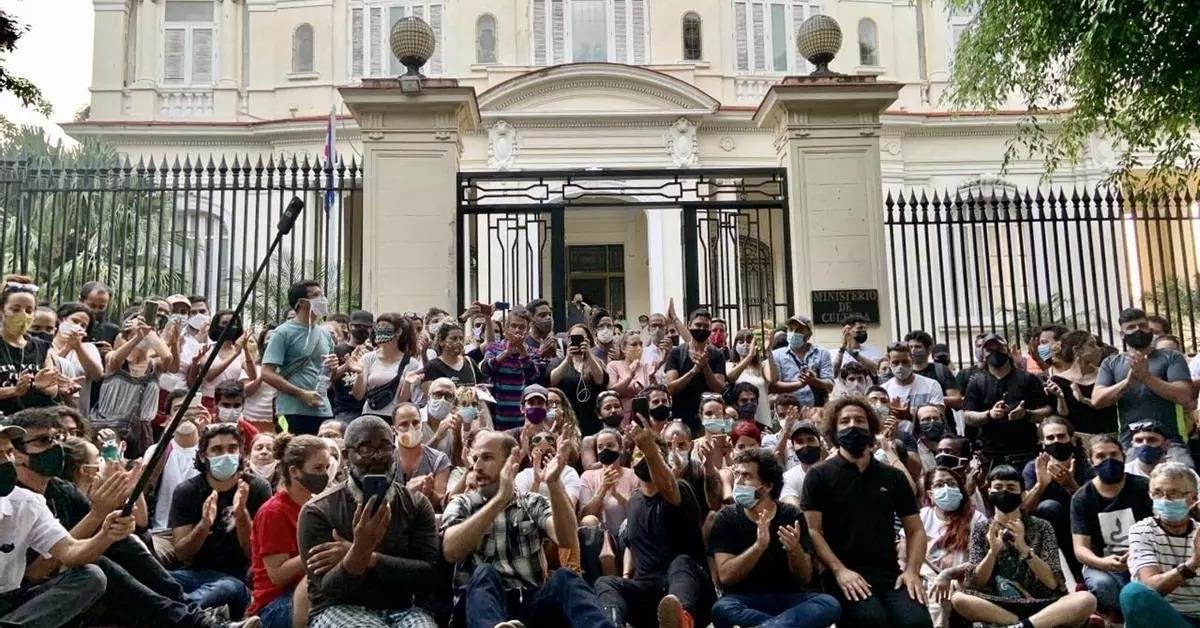
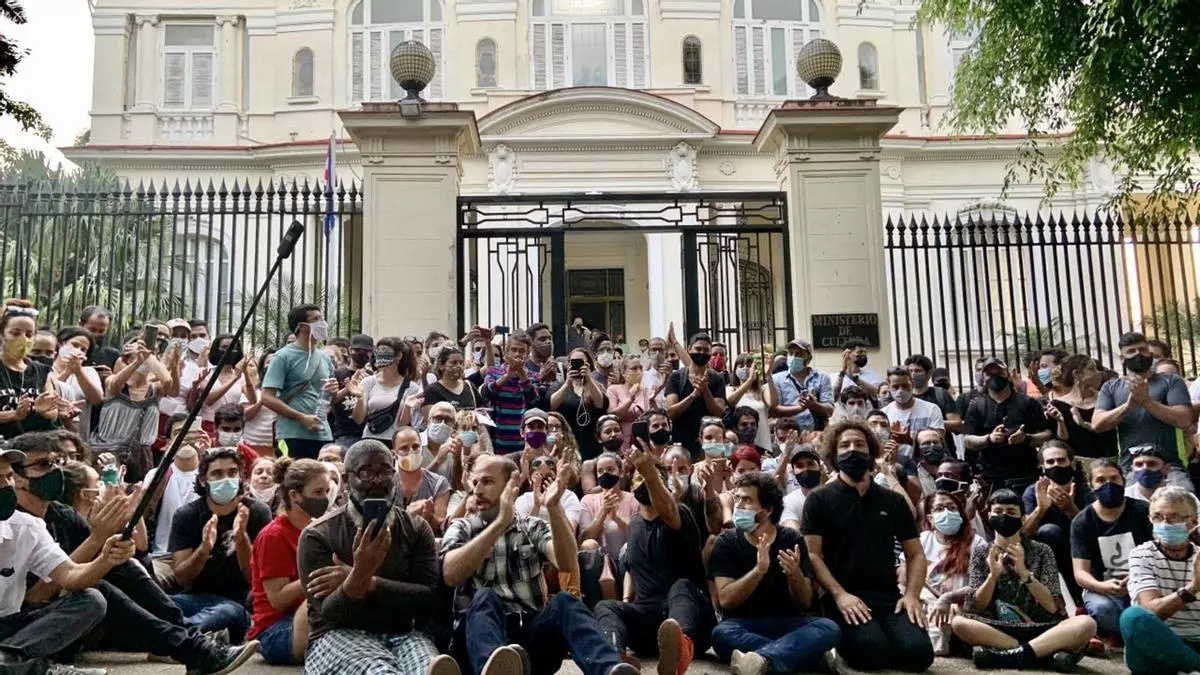
349 provoked one of the loudest rejections that the Cuban cultural sector had known until then. From that response emerged part of the movement that would later lead to the San Isidro Movement and the concentration on November 27, 2020 in front of the Ministry of Culture (27N).
That confrontation was followed by a wave of migration that also emptied a good part of the cultural sector. There is no official statistic that allows us to know how many Cuban artists have emigrated since 2021, but the departure goes through practically all demonstrations. Following the protests of July 11, 2021, PEN America and PEN Internationalorganizations defending freedom of expression and the rights of writers and artists, together with Cubalex, documented the arrest of dozens of creators.
In the visual arts, the relationship between political conflict and exile is even more direct
Political repression is mixed with the economic crisis, low salaries and lack of prospects. In music, several top names have moved the center of their careers outside of Cuba. Leoni Torres settled in Miami in 2021, after speaking out about the repression of 11J; Haydée Milanés also settled in the United States and has said that her public positions had professional consequences. Cimafunk lives mainly in New Orleans, while Carlos Varela develops a growing part of his activity outside the country and maintains a close relationship with Madrid. And the same goes for Liuba María Hevia.
The loss also affects actors and television figures. Coralita Veloz, National Television Award winner, settled in Miami; Erdwin Fernández (son) left after reporting threats and workplace retaliation for his political opinions; and Daniel Romero, protagonist of José Martí, the eye of the canary and The Majoremigrated after participating in 27N and has cited that episode and 11J among the reasons for his departure.
In the visual arts, the relationship between political conflict and exile is even more direct. Tania Bruguera left Cuba in 2021 after years of arrests, surveillance and restrictions. Hamlet Lavastida left the country that year after almost three months in prison and traveled to Europe with the poet Katherine Bisquet. Luis Manuel Otero Alcántara, figure of the San Isidro Movement and the protests against Decree 349, arrived in Miami in July of this year after serving five years in prison.
The theater does not escape bloodletting either. Carlos Celdrán, National Theater Award winner and founder of Argos Teatro, moved his work to Spain and Miami. Raúl Martín, founder of Teatro de La Luna, created Teatro El Duende in 2022 in the Dominican Republic. Rogelio Orizondo develops his career in the United States, while Yunior García, founder of Trébol Teatro, left Cuba in 2021 and his group was later closed.
Resolution 30/2026 allows artistic representation entities to receive up to 30% of the value of artistic service contracts
In dance, the phenomenon can be measured by companies. In 2023, eight dancers from the Camagüey Ballet remained in Spain during a tour, about a fifth of the delegation. That year, eight other members of Lizt Alfonso Dance Cuba did the same. In 2024, at least nine members of the National Ballet of Cuba left the company during a stay in Puerto Rico. Regina Balaguer, director of the Camagüey Ballet, acknowledged that the exodus had become “much more intense.”
Cinema and audiovisuals show another side of emptying. Carlos Lechuga, director of Molasses and Santa and Andrewhas developed a good part of his career outside official institutions since this last film was withdrawn from the Havana Film Festival. Part of the generation linked to independent cinema also moved to Madrid. Alejandro Alonso, author of The project, Abyssal and History is written at nightemigrated to Spain in 2021 with the director and producer Daniela Muñoz Barroso.
Both are linked to Estudio ST, an independent production company born in Cuba and today with offices in Havana and Madrid, which brings together José Luis Aparicio, Violena Ampudia, Gabriel Alemán, Fernando Fraguela, Carlos Melián and Joanna Montero. Producer Claudia Calviño, a key figure in Cuban independent cinema and responsible for titles such as John of the dead.
Meanwhile, the new regulation preserves the economic intermediation system. Resolution 30/2026 allows artistic representation entities to receive up to 30% of the value of artistic service contracts, depending on their participation in the management and other marketing expenses. The rest corresponds to the artistic unit.
The percentage already existed in previous regulations. What is significant is that the Government maintains it, despite its unpopularity, while it renews its labor legislation.