The Philippines is deepening ties with Pacific island nations, placing greater emphasis on maritime governance and international law as China continues to assert its claims and expand its activities in waters surrounding Philippine islands and maritime features.
At the 55th Pacific Islands Forum Leaders’ Meeting (55PIFLM) in Koror, Palau, from August 30 to September 4, the Philippines reaffirmed its “Pacific affinity and kinship” while seeking closer cooperation with fellow archipelagic states on climate change, food security, development and maritime concerns.
The engagement carries added strategic weight for Manila as it confronts China’s increasingly assertive activities in the West Philippine Sea, including its continued presence around Philippine maritime features and efforts to challenge the country’s exercise of its rights under international law.
The Philippines used the Pacific Islands Forum, whose members include 18 Pacific nations and the PIF Secretariat, to underscore a shared interest in protecting the rules governing the world’s oceans, particularly the 1982 United Nations Convention on the Law of the Sea (UNCLOS).
President Ferdinand R. Marcos Jr. designated Department of Foreign Affairs Undersecretary Leo M. Herrera-Lim as his Special Envoy to the Forum.
Speaking during the Leaders Dialogue with Forum Dialogue Partners, Herrera-Lim emphasized that the Philippines’ engagement with the Pacific is rooted in the common vulnerabilities and interests of archipelagic states.
“As an archipelagic state, the Philippines shares the defining challenges of the Blue Pacific — from geographic isolation, climate change, infrastructure gaps, development financing landscape shift, and rural transformation,” Herrera-Lim said.
“These realities demand that we rethink how we mobilize partnerships to sustain development gains and build unbreakable resilience into our communities. The Philippines is fully committed to deepening these partnerships. In 2024, we launched the Philippines-Pacific Initiative, through which we offer tangible cooperation across key areas of resilience,” he added.
Launched by Marcos in Manila in 2024, the Philippines-Pacific Initiative focuses on health, food security, capacity building and human capital development, disaster preparedness and climate action, environment, energy, and maritime and ocean governance.
The Philippines said it is prepared to expand technical and institutional cooperation with Pacific states in healthcare, education and the creative economy, as well as fisheries, agriculture, water and sanitation and other areas of resource management.
But maritime cooperation emerged as an important strategic component of the initiative.
Recognizing the Philippines’ “convergence with Pacific Island States on the need to address issues in the maritime and ocean governance space,” Herrera-Lim said Manila is particularly interested in working with Pacific partners on marine environmental protection, responses to sea-level rise, the climate-ocean nexus and adherence to international law, especially UNCLOS.
The emphasis on UNCLOS is significant for the Philippines, which has consistently invoked the convention and the 2016 South China Sea arbitral ruling in asserting its maritime rights against China’s expansive claims.
For Pacific island states, meanwhile, ocean governance is not merely a security concern but a matter directly tied to livelihoods, food security, climate vulnerability and national survival. The shared experience of living across widely dispersed islands gives the Philippines and Pacific nations a natural basis for cooperation.
The forum also provided an opportunity for Manila to strengthen its institutional links with the Pacific Islands Forum. On the sidelines, Herrera-Lim met with PIF Secretary General Baron Waqa to discuss the Philippines’ partnership with the region and ways to enhance the Forum’s engagement with ASEAN.
The Philippines has been a PIF Dialogue Partner since 1999, and its participation in the 55PIFLM underscores its long-term effort to strengthen relations with the Pacific.
Manila maintains resident embassies in Port Moresby, Suva, Canberra and Wellington, while its Embassy in Tokyo has concurrent jurisdiction over Palau, the Federated States of Micronesia and the Marshall Islands.
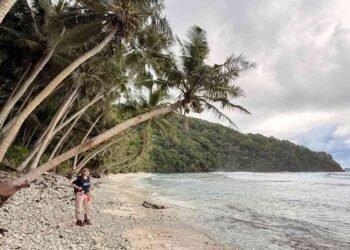
The Philippine delegation also visited Palau’s National Capitol in Melekeok.