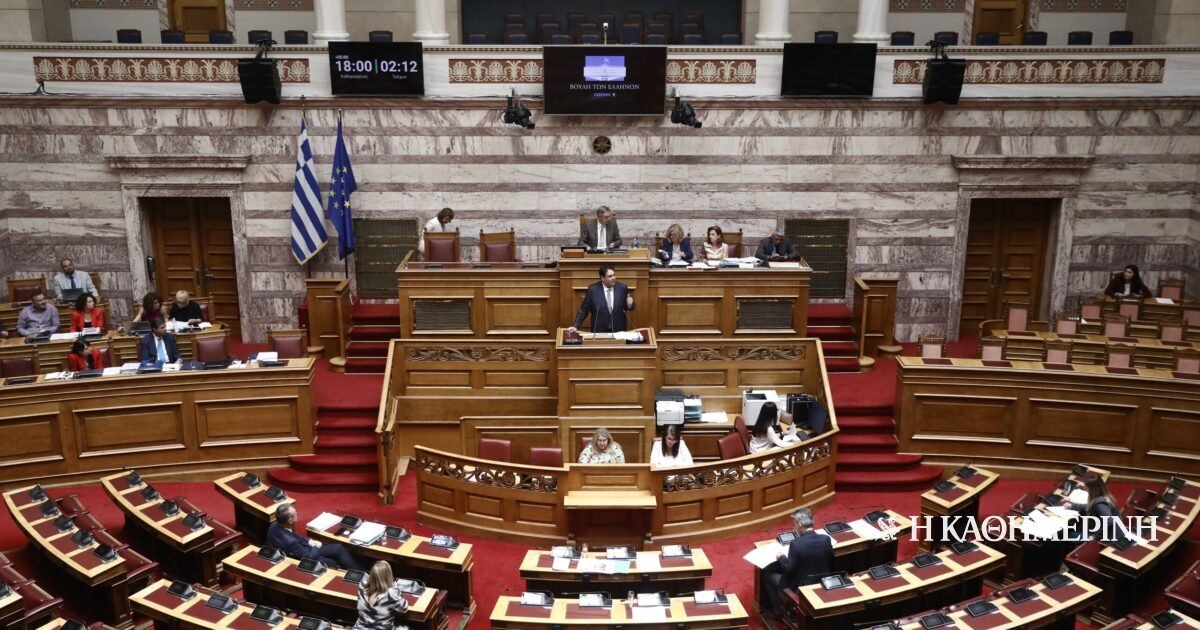
Radical changes in the way mayors and regional governors are elected are brought by the new Local Government Codewhich was upvoted by its Plenary Parliament.
On the principle of the relevant bill of the Ministry of the Interior, “in favor” was the ruling party of the ND. and “against” the opposition parties.
The main changes that are being established in view of the self-governing elections of 2028 are the following:
- Elections in one round: The process will be completed on the same day, with the simultaneous introduction of electronic voting and alternative voting.
- The 42% limit: If a combination reaches or exceeds 42% of the vote on the first count, it is elected directly. If not, the second phase of counting begins based on the next preferences (alternative choices) that citizens noted on the ballot paper.
Reactions from the opposition
The passing of the new Local Government Code triggered a fierce political campaign against the Parliament, with the electoral system and the financial autonomy of local governments being at the center of the controversy.
On the part of the official opposition, the president of PASOK, Nikos Androulakis, accused the government of “weakening of democratic legitimacy” of local rulers and clearly pledged that if his party wins the next national election this particular law will not be implemented.
On the other hand, the minister in charge fired back, stating that the old system had come full circle as, he said, it presented problems such as low participation in the second round and long delays. He defended the reform, calling it a faster, cleaner and more efficient process.
At the same time, the minor opposition parties focused on the internal distribution of powers, complaining that the new framework it degrades city councils and concentrates too much power in the hands of mayors.
Livanios: Start the dialogue on the redistribution of responsibilities
The Minister of the Interior, Th. Livanios, stated in this regard “…after we have created the foundations of self-government, and since we have a modern legislative framework, a dialogue should also begin for the redistribution of responsibilities, which can be transferred with the necessary resources, infrastructure, and human resources.”
Finally, and commenting on the proposal of the leader of the official opposition, Nikos Androulakis, for the “pilot performance” of ENFIA in self-government, Mr. Livanios said that such a move would give a lot of money to municipalities with properties of great commercial value such as Glyfada, in contrast to 90% of the rest of Greece that would receive smaller amounts from ENFIA than the CAPs which they now receive.
With information from ERT