He also emphasized that a great deal of work lies ahead to ensure that the Made in the Union State status becomes sought after and is firmly embedded in the economies of the friendly countries. “We want the Made in the Union State mark to serve as an additional impetus. We believe that the mechanism of national treatment for Made in the Union State, whereby manufacturers are granted the right to participate in public procurement on par with national goods, would be a major incentive for stronger integration of our producers. And a second impetus could come from financial support,” Gennady Klyga said adding that both the Russian Federation and Belarus have many opportunities in this regard such as subsidies, loans, and grants.
He also emphasized that Made in the Union State could become not just a new labeling mark, but an important legal and economic instrument for further development of the unified industrial and technological space of Belarus and Russia. “Here we have work to do. We have identified four avenues for ourselves. The first is the fastest and most efficient processing of applications. Businesses need to obtain the Made in the Union State status promptly in order to receive subsidies and have advantages in public procurement. I would like to propose that, at least at the level of coordinators, together with the Chamber of Commerce and Industry of Russia, we set up a group that could promptly exchange information on those goods for which it is difficult for us to confirm the origin and the share of production. In the future, we propose to reach an agreement between the chambers of commerce of the two countries on the exchange of information on domestic commodity producers. This will make it possible to determine as quickly as possible the Belarusian and Russian shares in the cost of a product. The second is the prompt identification of problematic issues in industrial cooperation, with information forwarded to the bodies of the Union State. The third is the active formation of new cooperation chains, the search for potential partners, and the strengthening of trust through participation in business missions and exhibition events under the Made in the Union State auspices. The fourth is the creation and promotion of the Made in the Union State brand as a symbol of reliability, responsibility, and quality, primarily on the external front, through numerous partnership ties with foreign chambers of commerce and industry,” Gennady Klyga said.
BelTA has reported that the Made in the Union State status may be granted to products in which the level of the cooperative share is at least 50% of the total cost of materials from the states party to the Union State Treaty in the price of the goods, with the percentage share of each party being at least 25%. Such a mark may be awarded to engineering goods included in the product groups “Machine Tools”, “Buses”, “Trucks” and “Microelectronics”.

Chairwoman of Bellegprom Concern, head of the Belarusian part of the Joint Belarusian-Russian Business Council Nadezhda Lazarevich said that in order to protect the light industry sector of the two countries, the concern will in the future submit a proposal to award the Made in the Union State mark to fabrics that will be produced at Belarusian enterprises from raw materials purchased in Russia. In particular, these could be woolen fabrics, both suit fabrics (including for school uniforms) and for military gear.
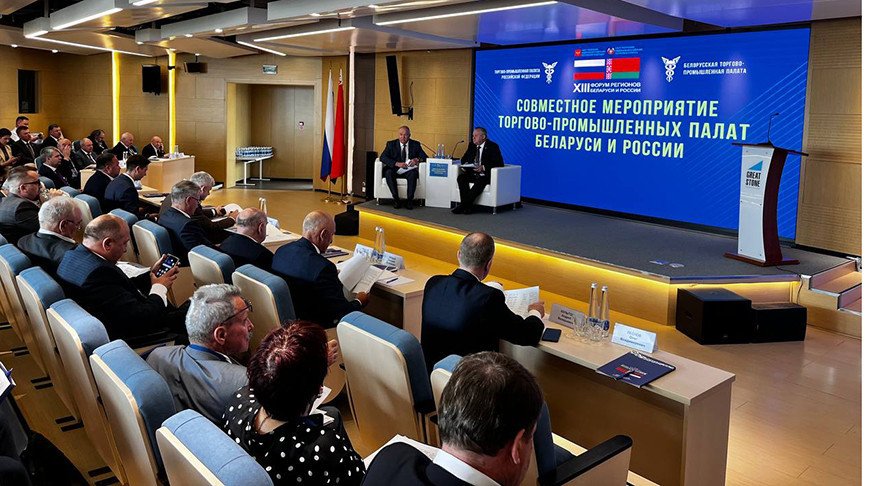
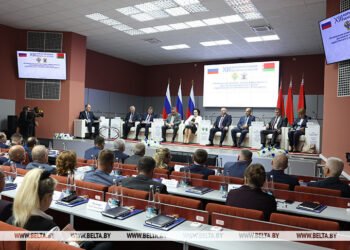
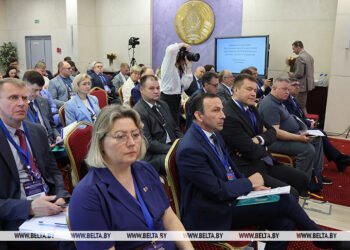
The participants of the event held at the China-Belarus Industrial Park Great Stone also discussed exports, logistics, the participation of small businesses in the production of joint goods, including Union State goods, countering unfair competition and the spread of counterfeit goods and the feasibility of transitioning to international production standards.