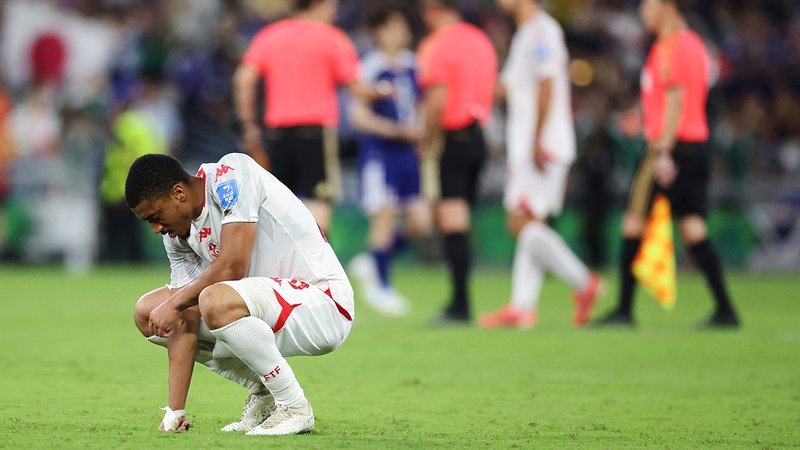
A state of frustration and anger dominated the Tunisian fans following the harsh loss to Japan 4-0, and the early exit from the 2026 World Cup, after the “Carthage Eagles” team suffered its second defeat in a row, becoming the first Arab team to officially exit the tournament, after conceding nine goals in the first two matches, losing to Sweden 1-5 and then Japan 0-4.
A number of Tunisian fans said, in statements to Emirates Al-Youm, that the early exit was not surprising, stressing that the decline in the level of Tunisian football in recent years, along with the courtesy in choosing players and technical staff, contributed to the emergence of the team at this level, demanding a comprehensive review of the football system in the country.
Fan Fouz Ragab said that she had been expecting the team to leave since the first match, and even before the start of the tournament, noting that the indicators were not reassuring in light of the decline in the level of the Tunisian league over the past years.
She added that “the difference has become clear compared to the Moroccan and Egyptian leagues, whose development was directly reflected in the strength of the two teams,” explaining that “the success of the clubs in creating local competition contributes to preparing players capable of representing the national team in the best way, which is what Tunisian football currently lacks.”
For his part, fan Ayman Al-Saheli held the Board of Directors of the Tunisian Football Federation and the League Association responsible for what the team had achieved, stressing that “the courtesy in selecting some players was one of the main reasons for the early exit.”
He pointed out that the team lacked real competition for positions, considering that some choices did not depend on technical readiness, which was reflected in the performance on the field, especially in the two matches against Sweden and Japan.
In turn, Ikram Farhani confirmed that “the team lacked experience in many situations during the matches between Sweden and Japan,” considering that “the technical staff bears a large part of the responsibility.”
She said that she did not expect to lose in such a big way, especially against Japan, noting that “the way the match was managed and the technical decisions did not help the team come back or even reduce the difference, which contributed to inflating the score.”
In the same context, Iman Ragab said, “Coach Sabri Lamouchi did not succeed in choosing the final list,” considering that “a number of players who were called up lacked international experience, in contrast to the absence of names that deserved to be with the team.”
She explained that “the technical choices clearly affected the team’s performance, especially with the absence of offensive solutions and the lack of a strong personality for the team on the field.”
For his part, Mehdi Sawalhia said that “the real crisis is not related to the players only, but rather begins with the sports administration and the Football Association,” stressing that “the decline in the level of Tunisian football in recent years was naturally reflected in the team’s results.”
He added, “What is happening to the Tunisian clubs, led by Esperance, reflects the extent of the technical decline, after the team was presenting strong levels on the continent, and included a large number of national team players, which no longer exists in the same form during the recent period.”
He stressed that “reform must begin by developing local competitions and setting clear criteria for selecting technical staff and players, away from niceties, so that Tunisian football regains its position at the Arab and African levels.”