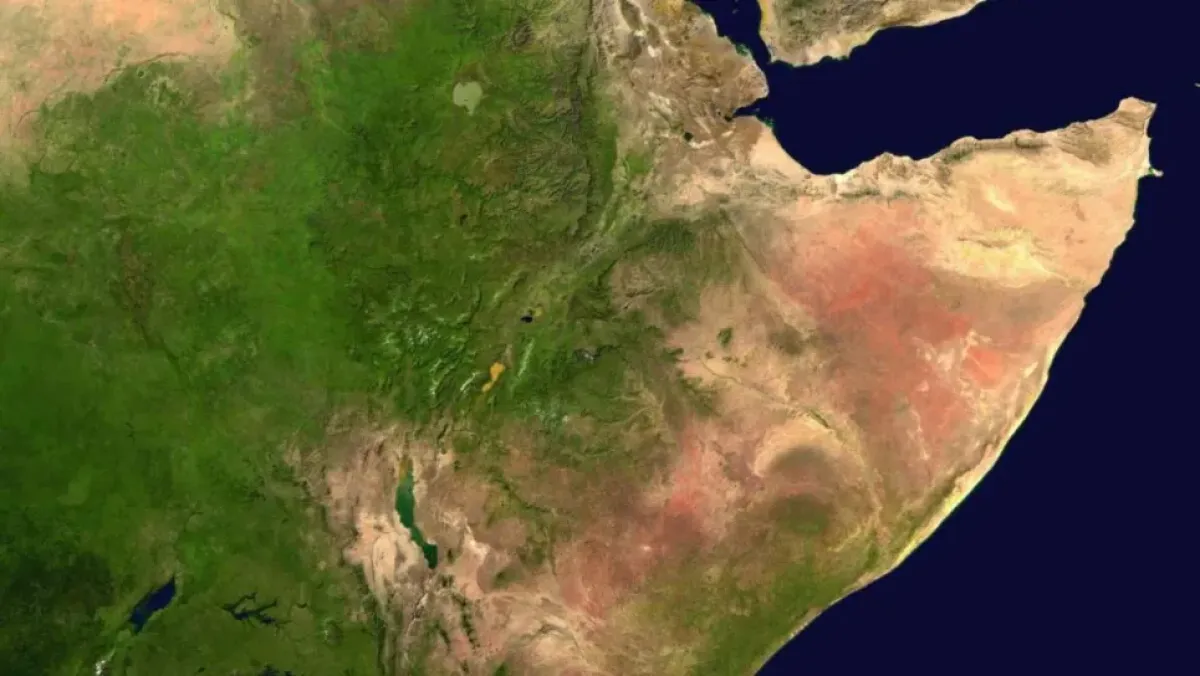
The Horn of Africa is no longer just a geographic spot suffering from the scourge of wars and poverty. Rather, it has turned into one of the most important arenas of geopolitical competition in the world, which can be explained by the theory of “geopolitics,” which sees the state’s location as its strategic destiny. Through its supervision of the Bab al-Mandab Strait, which is one of the most dangerous waterways in the world, this region has become a “gateway” that controls the flow of global trade and energy, and not just a “corridor” through which it passes. This transformation reflects what is called in the strategic literature “the importance of critical points” or “choke points,” where a narrow geographical location controls the fate of entire economies, which makes the region move from being marginal to being pivotal in international equations.
This transformation did not come out of nowhere. Rather, it is the result of the intersection of three main factors: the geostrategic importance of waterways, their connection to energy markets, and the internal fragility of the countries that control these corridors, which makes them an arena for external influence and intense global and regional competition, which turns the region into a theater of proxy conflicts.
The Horn of Africa as a “control point” not a “transit corridor”
The importance of the Horn of Africa derives from its unique location as a southern guardian of the Red Sea, where the Indian Ocean meets the Mediterranean Sea through the Suez Canal, but the fundamental difference that raises the value of the region, as the text explains, is its ability to control this corridor and not just pass through it. The Bab al-Mandeb Strait, which is only 30 kilometers wide, is a safety valve for the global economy. About 12% of global trade and 30% of container traffic pass through the Strait, in addition to millions of barrels of oil and gas daily.
On the other hand, any disturbance leads to ships being diverted around the Cape of Good Hope, adding between 10 to 14 days to the journey and an additional million dollars in fuel costs, as the interests of developed countries (Europe and Asia) are linked to the security of a remote and unstable region, and any tremor in this strait does not only affect Somalia or Yemen, but extends to store shelves in Europe and production lines in Asia. This is what makes the internationalization of the crisis inevitable, since collective security is achieved through concerted efforts to protect common interests.
The legacy of colonialism and the fragility of the state
Conflicts in the Horn of Africa cannot be understood without returning to their historical roots. According to the “constructivist” theory of international relations, identities and interests are not fixed, but rather are shaped by the historical and social context. The artificial colonial borders played a major role in fragmenting the social fabric of tribes and clans, which produced fragile states that lacked a “comprehensive national identity,” and Somalia represents the most dramatic example. The civil war and the repercussions of the Ogaden war with Ethiopia led to the collapse of the central state and the absence of authority turned traditional tribal competition (over water and pastures) into a major driver of polarization and violence. Even the federal system that was approved in 2012, although it was a theoretical solution, deepened the crisis when it made the regional (tribal) states superior to the central government and entered into direct security and economic agreements with external powers such as the Emirates and Kenya, which is what is called “state diplomacy,” which undermines National sovereignty, as well as the emergence of the issue of the breakaway region of Somaliland.
On the other hand, the ethnic federalism model adopted in 1991 was a major factor in igniting internal conflicts. This system, which established the management of solid borders between ethnicities, reinforced the idea of “authentic” ethnicities versus “alien” ethnicities, which led Ethiopia to the disastrous Tigray War and ongoing armed rebellions. This internal fragility in both countries made them vulnerable to external penetration, as regional and international powers found in the divisions a preferred access to influence.
Ethiopia constitutes an exceptional and essential case in the Horn of Africa equation. As it is the largest landlocked country in the world in terms of population (more than 120 million people), it suffers from an existential crisis represented by “port dependency” on Djibouti (more than 95% of its trade). Here the concept of “punitive geography” or “geographic blockade” emerges, where the dream of a sea port is an unnegotiable national security issue.
The signing of the memorandum of understanding with the separatist region of Somaliland in 2024 was a qualitative shift in the conflict, as it was not just an economic deal, but rather a redrawing of the political map of the region, as it granted Ethiopia the right to establish a naval base on the coast of the Gulf of Aden (for a period of 50 years), in exchange for its recognition of Somaliland’s independence from mother Somaliland. This move ignited Mogadishu’s anger and pushed it to ally with Egypt and Eritrea, creating a new polarity in the region: the (Ethiopia – Somaliland – UAE) camp versus the (Somalia – Egypt – Eritrea – Turkey) camp.
This conflict is a vivid example of the “security dilemma” in international relations, as a state (Ethiopia)’s quest to enhance its security (by obtaining an outlet) generates a feeling of insecurity among other states (Somalia, Eritrea), which leads to an arms race and counter-alliances and pushes the region towards alignments and tensions.
International and regional competition…the struggle for bases and ports
At least seven major powers are jostling in the Horn of Africa, with each country seeking to maximize its gains and relative power in a chaotic international environment. The UAE has adopted a strategy of “ports as geopolitical assets,” establishing a network of ports and bases along the coast (Berbera in Somaliland, Assab in Eritrea), not only to enhance its commercial influence but to secure its supply lines and confront its regional opponents, while Turkey supports Somali sovereignty, through its base in Mogadishu, which allows it to have influence in the Somali interior and compete with Gulf influence, in exchange for an Egyptian move motivated by protecting its national water security from the Renaissance Dam and protecting it. Suez Canal revenues affected by the Red Sea disturbances, so it established a defensive alliance with Somalia and Eritrea, which represents a “balancing strategy” against Ethiopian and Emirati expansion.
China’s presence is deeper and longer, as it has a base in Djibouti (a naval support base) and huge investments in the “Belt and Road” initiative and focuses on protecting its strategic assets, while the United States focuses on “fighting terrorism”, securing navigation, and confronting Chinese influence, through its base in Djibouti, which is a tactical approach rather than strategic, with a recorded presence for the entity, especially after the recognition of Somaliland, which opened a new door to competition, so that the region remains between the logic of polarization. And containment.